

Kirjailija
Rudolf Steiner
Kirjat ja teokset yhdessä paikassa: 1 477 kirjaa, julkaisuja vuosilta 1910–2026, suosituimpiin kuuluu The Cosmic New Year: A Course of Lectures by Rudolf Steiner. Vertaile teosten hintoja ja tarkista saatavuus suomalaisista kirjakaupoista.
1 477 kirjaa
Kirjojen julkaisuvuodet: 1910–2026.

Die befruchtende Wirkung der Anthroposophie auf die Fachwissenschaften
Rudolf Steiner
Steiner Verlag, Dornach
2018
sidottu
Rudolf Steiner's superb thesis provides deep insight into spiritual science, and the history of mankind as viewed through the philosophy of the anthroposophy movement he founded. An Outline of Esoteric Science attempts to reconcile mankind's spiritual being with the scientific exactitude which had emerged among scholars in the 19th century. Steiner lays out the spiritual realms which are invisible to us, attempting to use a defined precision similar to that which had emerged in science. In the final section, this book refers to the spiritual development and contemplation necessary for individuals to see the spiritual realms and planes which comprise existence and the universe. The means by which individuals may train themselves introspectively to see are detailed by Steiner, whose theosophical philosophy was, by the time of this book's publication in 1909, well-developed.
Rudolf Steiner's superb thesis provides deep insight into spiritual science, and the history of mankind as viewed through the philosophy of the anthroposophy movement he founded. An Outline of Esoteric Science attempts to reconcile mankind's spiritual being with the scientific exactitude which had emerged among scholars in the 19th century. Steiner lays out the spiritual realms which are invisible to us, attempting to use a defined precision similar to that which had emerged in science. In the final section, this book refers to the spiritual development and contemplation necessary for individuals to see the spiritual realms and planes which comprise existence and the universe. The means by which individuals may train themselves introspectively to see are detailed by Steiner, whose theosophical philosophy was, by the time of this book's publication in 1909, well-developed.
CHRISTIANITY AS MYSTICAL FACT AND THE MYSTERIES OF ANTIQUITY
Rudolf Steiner
Aziloth Books
2018
nidottu
ARTISTIC SENSITIVITY AS A SPIRITUAL APPROACH TO KNOWING LIFE AND THE WORLD
RUDOLF STEINER
SteinerBooks, Inc
2018
nidottu
Today's orthodox notions of science--which is to say, of knowing--are exceedingly narrow; they posit, implicitly or otherwise, that the only knowledge possible, if any, is that of the physical world. But the skeleton key to unlocking the door, behind which lies the root of the problems and difficulties of our age, and thus their solution, is to be able to fully answer this question: What is it to know something? This question lies at the foundation of spiritual science. Rudolf Steiner had first to solve it for himself, pointing the way for others to do the same (in, for example, his Philosophy of Freedom), long before he could give such lectures as these. Rudolf Steiner's work and words, still largely undiscovered as compared to their value for humanity, continue to point the way toward a different path--a way of knowing that encompasses the fullness, the breadth and depth of life and the worlds we inhabit. This knowing--which is to say, science--does not ignore or even contradict the narrower physical sciences of technologists and other specialists, but offers an expansive understanding of reality that also includes a deeper engagement with those aspects of our experience that we are told are beyond the ken of science. But is truth not accessible through art? Are poetry and literature, indeed the beauty and wisdom of each human language, not portals through which we can glimpse truths, every bit as real (though of a different order) than those we might grasp through a microscope? These thirteen lectures were given in Dornach, Switzerland, from January to May 1915, between the fifth and ninth month of World War I. Given the interrupted, fragmented nature of this sequence, one might assume that the lectures could not possibly present a tight, coherent whole. This is not the case. Rudolf Steiner lays down the framework for the series in a concise but detailed manner in the first two lectures, and then goes on to demonstrate in lecture after lecture how, on this basis, many aspects of life reveal the hidden presence and activities of the realities--and the approach--he has established in the framework. In fact, it is humbling to witness Rudolf Steiner's powers of attention and presence of mind: to see how, after a significant interval, in the same tone of voice and with seamless continuity, he can pick up and further develop and interweave his announced intention: namely, to provide "a detailed look at things we have been considering for years."
An Outline of Occult Science is Rudolf Steiner's thesis discussing the unknown, the nature of mankind, and his belief that science may be used to explain the unusual phenomena known as the occult. First published in 1910, this book strives to define, categorize and explain various manifestations of the occult. The author concedes at the opening of the book that many otherwise open-minded and receptive individuals immediately recoil from the concept of the the unknown, especially in relation to attempts to investigate it scientifically. After introducing the occult, Steiner delves into explaining the two worlds he thought comprised the reality we live in. The natural world, that which is visible and readily perceivable around us, and the spiritual world, where the unexplained phenomena arise. The nature of man as a bodily being, and how his physical self bridges the gap between these two worlds, is much detailed.
An Outline of Occult Science is Rudolf Steiner's thesis discussing the unknown, the nature of mankind, and his belief that science may be used to explain the unusual phenomena known as the occult. First published in 1910, this book strives to define, categorize and explain various manifestations of the occult. The author concedes at the opening of the book that many otherwise open-minded and receptive individuals immediately recoil from the concept of the the unknown, especially in relation to attempts to investigate it scientifically. After introducing the occult, Steiner delves into explaining the two worlds he thought comprised the reality we live in. The natural world, that which is visible and readily perceivable around us, and the spiritual world, where the unexplained phenomena arise. The nature of man as a bodily being, and how his physical self bridges the gap between these two worlds, is much detailed.

Reincarnation and Karma from a Scientific Standpoint
Rudolf Steiner
Independently Published
2018
nidottu
This present lecture was originally published in Steiner's periodical Lucifer-Gnosis in the October/November issue of 1903. It is truly exceptional in Steiner's work, and it is a pity that it is buried in an untranslated volume of the Collected Works. It is exceptional in at least three ways. First, it is a closely argued engagement with the contemporary science of his day. Somewhat surprisingly, given later statements, he is a proponent of Darwinism here, more specifically, the variant promoted by the German champion of Darwinism, Ernst Haeckel. Secondly, Steiner makes a limited number of points, but establishes those arguments very fully. And finally, he argues very strongly that it is the task of European and American civilization to reconcile Eastern wisdom with Western science. Steiner's first point is one he makes elsewhere, but nowhere as strongly as here. Francesco Redi was a hero because he opposed spontaneous generation, arguing that life arises only from life. He was nearly burned at the stake by the Inquisition for this heretical view, but subsequent scientific developments have shown he was absolutely right. Anthroposophists are in a similar situation today, because they argue that soul can only arise out of soul. They are mocked for it now, but future science will prove that this is correct. Steiner second point is about a fundamental distinction between humans and animals. Humans have individual biographies, but animals have group-souls. Lions are all similar in ways that humans are not. And Steiner's third point is the most important, and the most elegant. Haeckel had argued that there is a greater difference between the highest animal and the lowest human than between the lowest human and the highest. Surprisingly, Steiner assents vigorously to this proposition, and he argues beautifully that it follows that the same evolution from the highest animal to the lowest human must also be assumed between the lowest human and the highest. But because humans have individual biographies, it follows further that the only possible antecedent of a higher human form is the same soul in an earlier incarnation. Enjoy this little gem of an argument.
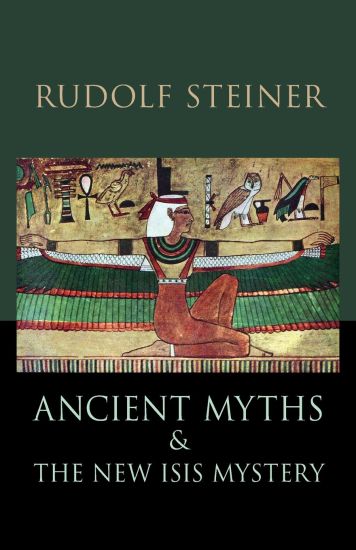
Ancient myths are an expression of great truths about the nature of the universe and human development. Through mysterious, lively images, they describe knowledge of a people's origin, their place in the cosmos, and their unique state of consciousness. Because modern consciousness has become so abstract, such stories challenge us to exercise a different kind of consciousness to experience their truths and reunite with the realities they describe. In these eight lectures, Steiner looks at Egyptian, Greek, and Hebrew myths, illustrating how they express people's consciousness then. He views in the Osiris-Isis story an expression of the loss of direct perception of the invisible, suprasensory realm. He shows the connection between that loss and the challenge we face today in bringing new life to our abstract thinking and understanding the world. Steiner offers remarkable a new Isis legend. In the Egyptian myth, the veiled Isis says, "I am the All. I am the Past, the Present, and the Future. No mortal has yet lifted my veil." In the New Isis legend, as told by Rudolf Steiner, the Isis figure states, "I am the Human Being. I am the Past, the Present, and the Future. Every mortal should lift my veil." This extraordinary story challenges modern humanity to awake to a new consciousness of the spiritual forces that work in our lives and in society. We are to bear this new spirit within us with increasing understanding and a fresh sense of responsibility. This book offers tremendous inspiration to transform our head knowledge into heart knowledge and to lift the veil to spirit and know our place and purpose in the past, present, and future.

20 Vorträge für Mitglieder in Berlin zwischen 1. April 1904 und 30. Oktober 1905 und 10 Vorträge für Mitglieder in Köln und Düsseldorf zwischen 19. Januar und 4. Dezember 1905

The Bologna Lecture: The Psychological Foundations and the Epistemological Stance of Anthroposophy
Rudolf Steiner
Independently Published
2018
nidottu
This is a very important and unusual lecture, for a number of reasons. Steiner gave very few presentations at academic conferences; indeed, this may be the only one he gave after becoming the head of the Theosophical Society in Germany. He took great care in preparing it, and was proud of it afterwards. He refers to it, or to the arguments it contains, often, and it is one of the cornerstones of what I would like to term Rudolf Steiner's "late philosophy."


Imagination, Inspiration, and Intuition are the basic cognitive forms of higher knowledge. We might say that everyday thinking is but a shadow cast by the enlivening thinking that is Imagination. Likewise, ordinary feeling is the shadow cast by Inspiration, and ordinary willing is the shadow cast by Intuition. We strengthen our normal faculties through meditation. Eventually, beings penetrate along the paths opened up through this meditation.
As a spiritual teacher, Rudolf Steiner wrote many inspired and beautifully-crafted verses. Often they were given in relation to specific situations or in response to individual requests; sometimes they were offered to assist generally in the process of meditation. Regardless of their origins, they are uniformly powerful in their ability to connect the meditating individual with spiritual archetypes. Thus, the meditations provide valuable tools for developing experience and knowledge of subtle dimensions of reality. Matthew Barton has translated and selected Steiner's verses, sensitively arranging them by theme. In this collection - to promote harmony and healing - Rudolf Steiner helps us discover a renewed sense of our true place in the world. The verses show how we can learn to know ourselves by looking outwards to the substances and processes at work in the cosmos, and in contrast to know the world by looking inwards to the microcosmic depths of the human self. By integrating spirit and matter within, we heal divisions in our relationships with others. For modern people, increasingly divorced from a living relationship with nature, these verses help to unfold a world of interconnections.
Delivered in the context of post-war cultural and social chaos, these lectures form part of Rudolf Steiner’s energetic efforts to cultivate social understanding and renew culture through his innovative ideas based on `threefolding’. Steiner develops a subtle and discerning perception of how social dynamics could change and heal if they were founded on real insight into our threefold nature as individuals, social beings and economic participants in the world. He doesn’t offer a programmatic agenda for change, but a real foundation from which change can organically grow. Social forms and reforms, says Steiner, are `created together’, not imposed by lone geniuses. Nevertheless, the detail of some of the thoughts and ideas he presents here as a possible model – down to the economic specifics of commodity, labour, taxation, ground rent and capitalism itself – are staggering in their clarity and originality. This is no mystic effusion but a heartfelt plea, backed by profound insights, to change our thinking and the world we live in. As he points out, thoughts create reality, and so it is vital how and what we think. Among the many contemporary and highly-relevant topics Steiner discusses here are: the nature of money and capital; taxation and the state; free enterprise and initiative; capitalism and Marxism; the relationship between employer and employee; `added value’ theory and the concept of commodity; and `class consciousness’, the proletariat and the bourgeoisie.
Meditations for the Dead
Rudolf Steiner
Rudolf Steiner Press
2018
nidottu
Halvin toimitettuna 17,30 €
As a spiritual teacher, Rudolf Steiner wrote many inspired and beautifully-crafted verses. Often they were given in relation to specific situations or in response to individual requests; sometimes they were offered to assist generally in the process of meditation. Regardless of their origins, they are uniformly powerful in their ability to connect the meditating individual with spiritual archetypes. Thus, the meditations provide valuable tools for developing experience and knowledge of subtle dimensions of reality. Matthew Barton has translated and selected Steiner's verses, sensitively arranging them by theme. In this collection - for maintaining a connection to those who have died - Rudolf Steiner offers hope and consolation to the bereaved. The first section features words of wisdom on death and its deeper, spiritual meaning; the second part consists of verses which stress the continued links between the living and the dead, indicating how our thoughts can help those who have departed earthly life. The final section is devoted to verses which express something of what the dead experience in their new existence.
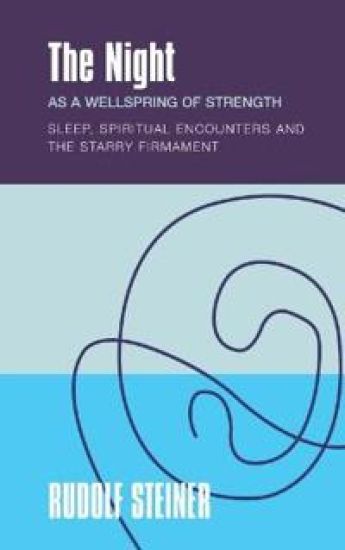
`I fall asleep. Until I awaken my soul will be in the world of spirit, and there will meet the guiding impulse-giver of my earthly life, my genius, who dwells in the world of spirit, hovering round my head…’ – Rudolf Steiner The night is an essential counterpart to the day. By day we possess the capacity of conscious, logical thought, whilst at night – leaving the physical body to regenerate during sleep – we give ourselves up to a different form of consciousness. Rudolf Steiner describes the night as the realm of intuition, a place of deep spiritual encounter, but also as a wellspring of renewal and healing. With its lucid introduction and notes, The Night seeks to conjure the special atmosphere and quality of the nocturnal hours, so that the real spiritual encounters of night-time can fruitfully inform our daily life, helping us to live in a fuller, healthier way. Night-time is when we can, consciously or unconsciously, meet our higher self; we have the opportunity to work with angelic beings, and even to access the world of the dead. The night can be a source of poetic and artistic inspiration, whilst for initiates it provides a field for conscious awareness. It is also a special time – before going to sleep and upon waking – for specific esoteric exercises. Edited by Edward de Boer, the textual passages, lecture extracts, exercises and the many verses and prayers in this anthology are an invitation to readers to engage more consciously with the starry heavens and the nightly realm.