Kirjojen hintavertailu – 12 903 725 kirjaa ja 27 kauppaa

Kirjailija

Rudolf Steiner

Kirjat ja teokset yhdessä paikassa: 1 477 kirjaa, julkaisuja vuosilta 1910–2026, suosituimpiin kuuluu The Cosmic New Year: A Course of Lectures by Rudolf Steiner. Vertaile teosten hintoja ja tarkista saatavuus suomalaisista kirjakaupoista.

1 477 kirjaa

Kirjojen julkaisuvuodet: 1910–2026.

The Mysteries of the Holy Grail

The Mysteries of the Holy Grail

Rudolf Steiner

Rudolf Steiner Press
2010
nidottu

Halvin toimitettuna 22,50 €

From the ancient British tales of King Arthur and his knights through the medieval Central European sagas of Parzival, right up to modern-day blockbuster novels and films, the Grail has long maintained its enigmatic presence in western culture. It is said to be many things: a lost and priceless treasure, the chalice cup of the Last Supper, the cup that caught Jesus Christ's blood from the cross on Golgotha, or even a secret royal bloodline... Basing his presentations on far-reaching spiritual research, Rudolf Steiner gave profoundly esoteric, multifaceted insights into the mysteries of the Holy Grail. Collected together for the first time in a single volume, together with commentary and notes, these passages offer vivid tableaux with a multiplicity of meanings: a story that speaks to the human soul with a depth and complexity that intellectual interpretations alone cannot begin to fathom. Just as Parzival had to encounter and engage with veils of illusion and valleys of shadow and doubt, Rudolf Steiner presents us with a similarly challenging path. This book is more than a treasure of thought and insight: it invites us to embark on a personal quest to develop the abilities and vision required for grasping the elusive Grail itself. As editor Matthew Barton writes: "The vessel of the Grail gradually descends towards us and comes into focus as we raise ourselves individually to it by piercing through the illusions of materialism, acknowledging that we ourselves can ultimately become true vessels for the spirit."
Nature's Open Secret

Nature's Open Secret

Rudolf Steiner

SteinerBooks, Inc
2010
nidottu
The holistic paradigm, Gaia, deep ecology, and new alchemy all have a hidden ancestor: Johann Wolfgang von Goethe (1749-1832). At the youthful age of twenty-one, Steiner was chosen to edit Goethe's scientific writings for the principle Geothe edition of his time. Goethe's literary genius was universally acknowledged; it was Steiner's task to understand and comment on Goethe's scientific achievements. Steiner recognized the significance of Goethe's work with nature and his epistemology, and here began Steiner's own training in epistemology and spiritual science. This collection of Steiner's introductions to Goethe's works re-visions the meaning of knowledge and how we attain it. Goethe had discovered how thinking could be applied to organic nature and that this experience requires not just rational concepts but a whole new way of perceiving. In an age when science and technology have been linked to great catastrophes, many are looking for new ways to interact with nature. With a fundamental declaration of the interpenetration of our consciousness and the world around us, Steiner shows how Goethe's approach points the way to a more compassionate and intimate involvement with nature. Contents: Editor's Introduction 1. Introduction by John Barnes2. The Origin of Goethe's Concept of Metamorphosis3. The Origin of Goethe's Thinking on Animal Morphology4. The Nature & Significance of Goethe's Writings on Organic Morphology5. Goethe's Way of Knowing6. Concluding Remarks on Goethe's Morphology7. The Arrangement of Goethe's Scientific Writings8. From Art to Science9. Goethe's Theory of Knowledge10. Knowledge & Action in the Light of Goethe's Ideas11. Goethe's Way of Thinking Compared to Other Views12. Goethe and Mathematics13. Goethe's Fundamental Geological Principle14. Goethe's Meteorological Ideas15. On the Subjectivity of Sensory Perceptions16. Goethe As Thinker & Researcher17. Goethe versus Atomism18. Goethe's Worldview in His Verses in Prose Essay by John Barnes: "Participatory Science As the Basis for a Healing Culture" Nature's Open Secret is a translation of Goethes Naturwissenschaftliche Schriften, Einleitungen, (1884-1897). Previous translations were titled Goethe the Scientist and Goethean Science.
Art as Seen in the Light of Mystery Wisdom

Art as Seen in the Light of Mystery Wisdom

Rudolf Steiner

Rudolf Steiner Press
2010
nidottu
Within the Mystery cultures of ancient history, art, science and religion formed a unity that offered direction and spiritual nourishment to the broader society. Today, art, science and religion can again be reunited. However, as Marie Steiner indicates in her introduction to these lectures, these aspects of our culture need rejuvenation through fresh spiritual understanding and knowledge. Art cannot be renewed through compromise, but only by returning to the spiritual foundations of life. As she says: "The remedy lies in unlocking the wisdom of the Mysteries and presenting it to humanity in a form adapted to contemporary needs." In these wide-ranging lectures, Rudolf Steiner offers spiritual insight for the modern day into a revitalised world of the arts. His themes include: the relation of art to technology, the moral experience of the worlds of colour and music, the legendary Norwegian Dream Song of Olaf Asteson, and the relationship between the various arts of architecture, sculpture, painting, music, poetry, eurythmy and the human being.
Eurythmy Therapy

Eurythmy Therapy

Rudolf Steiner

Rudolf Steiner Press
2009
nidottu
Created in 1911, eurythmy was developed for years as an artistic and educational discipline. Although Rudolf Steiner pointed out its healing aspects from the very beginning, it was only in 1921 that he gave a course of lectures that gave the art of eurythmy a vital new application. To the assembled eurythmists and doctors, he presented what one participant described as '...a complete and detailed method of eurythmy therapy, in which we could directly experience that even today the creative and therapeutic power of the word ...is still at work'. Steiner's comprehensive lectures, republished here in a thoroughly revised translation, describe the principles of therapeutic eurythmy, giving many specific exercises. Primarily intended for practising eurythmists, these lectures also contain much material of particular interest. Steiner reveals the intricacies of rhythmic interplay between human physiology and the life-forces in the world around us. He describes the qualities of language and the dynamism contained in the individual vowels and consonants, elucidating their relationship with eurythmical movements and human experience. Through such movements, individuals are able to access the healing etheric forces. The exercises, referred to by Steiner as 'inner gymnastics', contain enormous potential for psychological and physiological well-being. Gaining ever-wider recognition today, they complement conventional medicine, offering a therapeutic process concerned with mind, soul and body. This new edition of these important lectures - previously published under the title Curative Eurythmy - includes an appendix with reminiscences by early eurythmists, as well as additional commentary from Dr Walter Kugler.
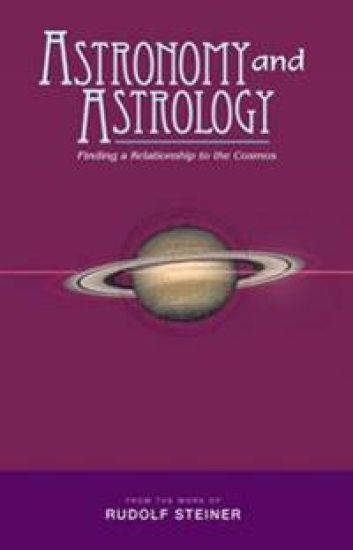
Astronomy and Astrology

Astronomy and Astrology

Rudolf Steiner

Rudolf Steiner Press
2009
nidottu

Halvin toimitettuna 24,60 €

In the Middle Ages, Astronomia - one of the Seven Liberal Arts - was as much about astrology as astronomy. In fact the two disciplines only parted company in the seventeenth century, as the materialistic world-view gained greater prominence. Where once human destiny was connected to stars and planets, and spiritual or soul qualities were associated with the natural world, now the cosmos was seen as consisting of gases, fire and dead rock. Rudolf Steiner brings a new spiritual perspective to our study of the heavens. Humanity, he says, is intimately connected to cosmic beings, who in turn are related to planets and stars. There is meaning in the cosmos. Although Steiner rejects the simplistic notion of the planets determining our lives and behaviour, he makes a clear connection between the heavenly bodies and human beings. Whilst criticizing the superficial nature of much astrology, Steiner shows that as individuals, and with the guidance of spiritual beings, we choose an appropriate time of birth to match the destiny we are to live. This enlightening anthology, expertly collated by Margaret Jonas, features excerpts of Steiner's work on the spiritual individualities of the planets, the determination of human characteristics by the constellation at birth, the cultural epochs and the passage of the equinox, cosmic influences on the individual and humanity, life in the planetary spheres between death and rebirth, solar and lunar eclipses, comets, and much more.
Biography: Freedom and Destiny

Biography: Freedom and Destiny

Rudolf Steiner

Rudolf Steiner Press
2009
nidottu

Halvin toimitettuna 24,60 €

The path of an individual human life - our biography - is something of a mystery. Despite the abundance of published biographies and autobiographies of celebrities and historical figures, the scientific study of human biography remains in its infancy, with little understanding of the inherent laws in the path of an individual's life. Yet as Rudolf Steiner shows here, every biography, regardless of the individual's fame, perceived importance or outer success, is ruled by archetypal influences, patterns and laws. This broad-ranging anthology addresses some critical and as yet unanswered questions: What effects do education - and in particular contrasting education methods - have on later life? How do the various periods of life relate to each other? Do the effects of events on the individual become evident immediately, or is their true impact delayed - perhaps by decades? To what extent can an individual shape the stages of his or her biography? How much freedom of choice do we have, and how much of life is predetermined? Out of the higher knowledge Rudolf Steiner acquired from his spiritual research, he described the human individuality as a being with a continuing existence - before birth and beyond death. This eternal being experiences many varied conditions and situations, the effects of which are observable in our biography. This book addresses these and other issues such as freedom and destiny, the effects of heredity, illness, and the impact of education, offering answers based on a profound knowledge of the human being. Compiled by E. Fucke (Selected lectures, various GAs)
The Riddles of Philosophy

The Riddles of Philosophy

Rudolf Steiner

SteinerBooks, Inc
2009
nidottu

Halvin toimitettuna 35,60 €

From the introduction by Fritz C. A. Koelln: "Rudolf Steiner's Riddles of Philosophy: Presented in an Outline of Its History is not a history of philosophy in the usual sense of the word. It does not give a history of the philosophical systems, nor does it present a number of philosophical problems historically. Its real concern touches on something deeper than this, on riddles rather than problems. Philosophical concepts, systems and problems are, to be sure, to be dealt with in this book. But it is not their history that is to be described here. Where they are discussed they become symptoms rather than the objects of the search. The search itself wants to reveal a process that is overlooked in the usual history of philosophy. It is the mysterious process in which philosophical thinking appears in human history. Philosophical thinking as it is here meant is known only in Western civilization. Oriental philosophy has its origin in a different kind of consciousness, and it is not to be considered in this book. "What is new here is the treatment of the history of philosophic thinking as a manifestation of the evolution of human consciousness. Such a treatment requires a fine sense of observation. Not merely the thoughts must be observed, but behind them the thinking in which they appear. "To follow Steiner in his subtle description of the process of the metamorphosis of this thinking in the history of philosophy we should remember he sees the human consciousness in an evolution. It has not always been what it is now, and what it is now it will not be in the future. This is a fundamental conception of anthroposophy." READ THE COMPLETE INTRODUCTION BY FRITZ KOELLN. CONTENTS: Introduction Preface to the 1923 Edition Preface to the 1918 Edition Preface to the 1914 Edition PART I Guiding Thoughts on the Method of Presentation The World Conception of the Greek Thinkers Thought Life from the Beginning of the Christian Era to John Scotus Erigena The World Conceptions of the Middle Ages The World Conceptions of the Modern Age of Thought Evolution The Age of Kant and Goethe The Classics of World and Life Conception Reactionary World Conceptions The Radical World Conceptions PART II The Struggle Over the Spirit Darwinism and World Conception The World as Illusion Echoes of the Kantian Mode of Conception World Conceptions of Scientific Factuality Modern Idealistic World Conceptions Modern Man and His World Conception A Brief Outline of an Approach to Anthroposophy Alphabetical Index The Riddles of Philosophy: Presented in an Outline of Its History is a translation of Die R tsel der Philosophie (Vol. 18 in the Bibliographic Survey, 1961).
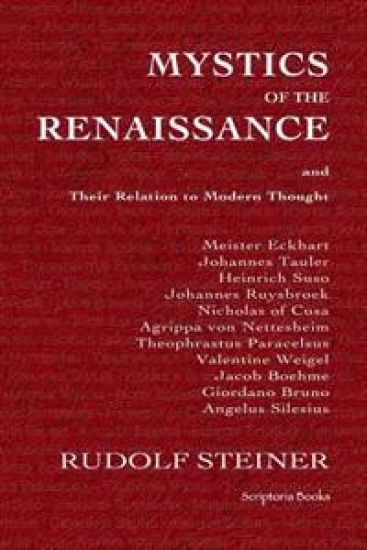
Mystics of the Renaissance and Their Relation to Modern Thought

Mystics of the Renaissance and Their Relation to Modern Thought

Rudolf Steiner

Createspace Independent Publishing Platform
2009
nidottu
In Mystics of the Renaissance, Rudolf Steiner examines the thought of eleven European mystics (Eckhart, Tauler, Suso, Ruysbroek, Nicholas of Cusa, Agrippa von Nettesheim, Paracelsus, Weigel, Boehme, Giordano Bruno, and Angelus Silesius) through a collection of essays and explains their ideas and how they relate to modern concepts. Scriptoria Books has transcribed this edition word for word from the original text. It was then edited, formatted, typeset, and proofread through each revision. Our procedures are not automated. Our editions are not facsimiles and do not contain OCR interpreted text. Our books are carefully created new editions of classic works.
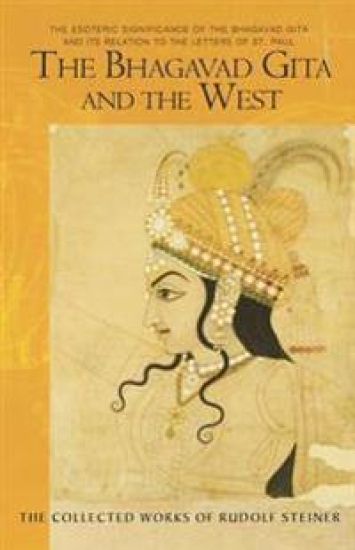
The Bhagavad Gita and the West

The Bhagavad Gita and the West

Rudolf Steiner

SteinerBooks, Inc
2009
nidottu
5 lectures, Cologne, Dec. 28, 1912 - Jan. 1, 1913 (CW 142)9 lectures, Helsinki, May 28 - June 5, 1913 (CW 146)1 lecture, Basel, Sept. 19, 1912 (CW 139)This combination of two volumes in Rudolf Steiner's Collected Works presents Steiner's profound engagement with Hindu thought and, above all, the Krishna in the Bhagavad Gita as they illuminate Western Christian esotericism. In his masterly introduction, Robert McDermott, a longtime student of Rudolf Steiner, as well as Hindu spirituality, explores the complex ways in which the "Song of the Lord," or Bhagavad Gita, has been understood in East and West. He shows how Krishna's revelation to Arjuna--a foundation of spirituality in India for more than two and a half millennia--assumed a similarly critical role in the Western spiritual revival of the nineteenth and twentieth centuries. In the West, for instance, leading up to Steiner's engagement, he describes the different approaches manifested by Emerson, Thoreau, H. P. Blavatsky, and William James. In the East, he engages with the interpretation of historical figures such as Mahatma Gandhi and Sri Aurobindo, relating them to Steiner's unique perspective. At the same time, and most valuable, he illuminates the various technical terms and assumptions implicit in the worldview expressed in the Bhagavad Gita. The main body of The Bhagavad Gita and the West consists of two lecture courses by Rudolf Steiner: "The Bhagavad Gita and the Epistles of Paul" and "The Esoteric Significance of the Bhagavad Gita." In the first course, his main purpose, as McDermott shows, is to integrate the flower of Hindu spirituality into his view of the evolution of consciousness and the pivotal role played in it by the Mystery of Golgotha--the incarnation, death, and resurrection of Jesus Christ. Steiner views Krishna as a great spiritual teacher and the Bhagavad Gita as a preparation, though still abstract, for the coming of Christ and the Christ impulse as the living embodiment of the World, Law, and Devotion, represented by the three Hindu streams of Veda, Sankhya, and Yoga. For him, the epic poem of the Bhagavad Gita represents the "fully ripened fruit" of Hinduism, whereas Paul is related but represents "the seed of something entirely new." In the last lecture, Steiner reveals Krishna as the sister soul of Adam, incarnated as Jesus, and claims Krisha's Yoga teachings streamed from Christ into Paul. In the second lecture course, given five months later, Steiner engages the text of the Bhagavad Gita on its own terms, as signaling the beginning of a new soul consciousness. To aid in the understanding of both these important cycles, this volume includes the complete text of the Bhagavad Gita in Eknath Easwaran's luminous translation. In our age, when East and West are growing closer together and we live increasingly in a global, intercultural, religiously pluralistic world, The Bhagavad Gita and the West is necessary reading for all concerned with a truly spiritual approach to the new reality. This book is a translation of two volumes in German: Die Bhagavad Gita und die Paulusbriefe (CW 142) and Die okkulten Grundlagen der Bhagavad Gita (CW 146), published by Rudolf Steiner Verlag, Dornach, Switzerland, 1961. The lecture in the appendix is translated from Das Markus-Evangelium (CW 139) and was published in The Gospel of St. Mark, Anthroposophic Press, 1986. Part I: "The Bhagavad Gita and the Epistles of Paul" was translated by Lisa D. Monges and Doris M. Bugbey. Part II: "The Esoteric Meaning of the Bhagavad Gita" was translated by George and Mary Adams and amended by Doris M. Bugbey. Both translations were revised for this edition by Mado Spiegler. The lecture in the Appendix was translated by Conrad Mainzer and edited by Stewart C. Easton. Part III: The text of the Bhagavad Gita, translated by Eknath Easwaran, is reproduced with kind permission from Nilgiri Press, Berkeley, CA, 2007. Click here to read the first part of Robert McDermott's introduction to The Bhagavad Gita and the West.

Sannhet og vitenskap

Sannhet og vitenskap

Rudolf Steiner

Antropos
2009
sidottu
I denne boken fra 1892 la Rudolf Steiner noe av det erkjennelsesteoretiske grunnlaget for sitt senere verk. Han hevder her at før vi kan innta noe vitenskapelig eller filosofisk standpunkt, må vi finne det riktige utgangspunktet for en fundert vitenskapelig tankeutvikling - en forutsetningsløs utgangsposisjon. Påvisningen av et slik utgangspunkt for erkjennelsesteori og vitenskapspraksis er selve kjernepunktet i denne boken. Steiners argumentasjon retter seg mot filosofiene på slutten av 1700-tallet og på 1800-tallet, særlig Kants erkjennelseskritikk og Fichtes vitenskapslære. Har litteraturliste.