Kirjailija
Rudolf Steiner
Kirjat ja teokset yhdessä paikassa: 1 477 kirjaa, julkaisuja vuosilta 1910–2026, suosituimpiin kuuluu The Cosmic New Year: A Course of Lectures by Rudolf Steiner. Vertaile teosten hintoja ja tarkista saatavuus suomalaisista kirjakaupoista.
1 477 kirjaa
Kirjojen julkaisuvuodet: 1910–2026.

The Fourth dimension: Sacred Geometry, Alchemy and Mathematics
Rudolf Steiner
Dennis Vogel
2025
nidottu
Halvin toimitettuna 22,20 €
The point, line, plane and solid objects represent the first three dimensions, but a kind of reversal of space is involved in the ascent to a fourth dimension. Steiner leads us to the brink of this new perspective―as nearly as it can be done with words, diagrams, analogies, and examples of many kinds. In doing so, he continues his lifelong project of demonstrating that our objective, everyday thinking is the lowest rung of a ladder that reaches up to literally infinite heights. The talks in this series and the selections from the question-and-answer sessions on many mathematical topics over the years are translated into English for the first time in The Fourth Dimension.

The Way Of InitiationOr, How To Attain Knowledge Of The Higher Worlds (Edition1)
Rudolf Steiner
Double 9 Books LLP
2025
nidottu

Die Entstehung und Entwicklung der Eurythmie 1922-1924
Rudolf Steiner
Steiner Verlag, Dornach
2025
sidottu

Die vierte Dimension. Mathematik und Wirklichkeit.
Rudolf Steiner
Steiner Verlag, Dornach
2025
sidottu

Four Mystery Plays
Rudolf Steiner; Harry Collison; Shirley M K Gandell
Anson Street Press
2025
pokkari



Four Mystery Plays
Rudolf Steiner; Harry Collison; Shirley M K Gandell
Anson Street Press
2025
sidottu

The Spiritual Guidance of Man and of Mankind
Rudolf Steiner; Harry Collison
Anson Street Press
2025
pokkari



Zwei Wege zu einem Ziel: Die Philosophie der Freiheit (1894); Theosophie (1904)
Rudolf Steiner
Freies Geistesleben GmbH
2025
nidottu



5 lectures in Berlin, January 25 - February 8, 1916 (CW 166)Abounding in lively anecdotes and fresh insights, these lectures draw the reader into a rich contemplation on the nature of necessity and freedom in human life and in the world. Rudolf Steiner weaves together seemingly disparate elements while resolving contradictions into a higher unity, showing us that, far from being mutually exclusive, necessity and freedom are intimately interwoven in the intricate tapestry of life. Every external event has a counterpart in the spiritual world, and what is true on the physical plane often appears very different on the spiritual plane. There, spiritual beings are active in the unfolding of destiny. Thus, an event might intervene in the course of earthly life with the iron law of necessity and, at the same time on a higher level, create a possibility for free action. A tragedy on the physical plane--for example, deaths of a group of people in a car accident--might be experienced by the souls of the victims as a source of great joy across the threshold, because they have received a new and important task in the spiritual world. Steiner expands on his central theme with a fascinating account of three teachers with different attitudes to life--one ahrimanic, another luciferic, and a third who takes the path of progressive development. The third, instead of dwelling on past mistakes or successes, seeks to meet the children as they are now in the present before him. By meeting what isand not what was, we open the door to freedom. Nature was once a free deed of the gods, and the past thoughts of the gods appear to us as necessity. Similarly, our present life of thought will become the future world of outer nature. In the future, the world will look bleaker and the will have less strength. Spiritual science will then reawaken consciousness of the human aura, bring about a strengthening of will, and enable a valid understanding of past lives. Spiritual science is necessary now as an evolutionary development, and yet we can take it up only in freedom. Other subjects covered in the lectures include: the legend of the astronomical clock in Prague; the activities of Ahriman and Lucifer; Faust as an evolutionary factor independent of Goethe; the historic conflict of the Roman world and the Teutonic tribes; and the importance of viewing historical events in light of intentions rather than results. An incisive study of the mysteries of existence, this book is sure to inspire all who explore its pages. This volume is a translation from German of Notwendigkeit und Freiheit im Weltengeschehen und im menschlichen Handeln (GA 166).
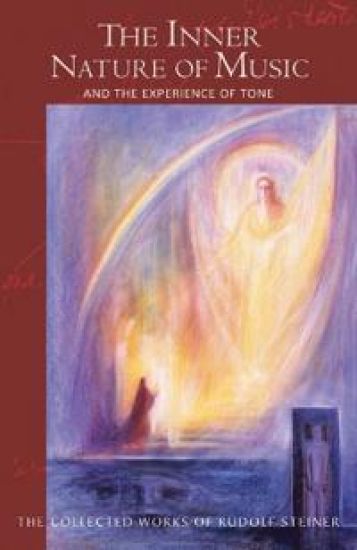
7 lectures in various cities, December 3, 1906 - March 16, 1923 (CW 283)"A tone is at the foundation of everything in the physical world." This is one of many astonishing statements made by Rudolf Steiner in this collection of seven lectures on the inner realities of music. These lectures are an unusual treasure, since they are the only two groups of lectures that Steiner gave primarily on music, other than the lecture cycle for the tone eurythmy course, Eurythmy as Visible Music. In the first group of three lectures, given in 1906, Steiner explains why music affects the human soul so powerfully. Music has always held a special position among the arts because it is the only art form whose archetype, or source, lies not in the physical world, as with architecture, sculpture, and painting, but purely in the spiritual world-the soul's true home. Music thus directly expresses through tones the innermost essence of the cosmos, and our sense of wellbeing when we hear music comes from a recognition of our soul's experience in the spiritual world. In the remaining lectures, given in 1922 and 1923, Steiner discusses our experience of musical intervals and shows how it has undergone profound changes during the course of evolution. The religious effects of music in ancient times and the union of music with speech are considered, as well as the origin of musical instruments out of imaginations that accompanied singing. New insights are offered on the nature of the major and minor modes and on future directions of musical development." Major and minor keys, this strange bond between music and human subjectivity, the actual inner life of feeling--insofar as this life of feeling is bound to the earthly corporeality--came into being only in the course of the fourth post-Atlantean epoch and are related to the experience of the third. The difference between major and minor keys appears; the subjective soul element relates itself to the musical element." -- Rudolf Steiner (lect. 5)This volume is a translation of 7 lectures (of 8) in Das Wesen des Musikalischen und das Tonerlebnis im Menschen, published by Rudolf Steiner-Nachlaftverwaltung, Dornach, 1969 (GA 283).