Kirjailija
Slavoj Zizek
Kirjat ja teokset yhdessä paikassa: 185 kirjaa, julkaisuja vuosilta 1991–2026, suosituimpiin kuuluu Nakanune Gospodina. Sotrjasaja ramki. Vertaile teosten hintoja ja tarkista saatavuus suomalaisista kirjakaupoista.
Nimi esiintyy myös muodoissa: Slavoj Žižek
185 kirjaa
Kirjojen julkaisuvuodet: 1991–2026.
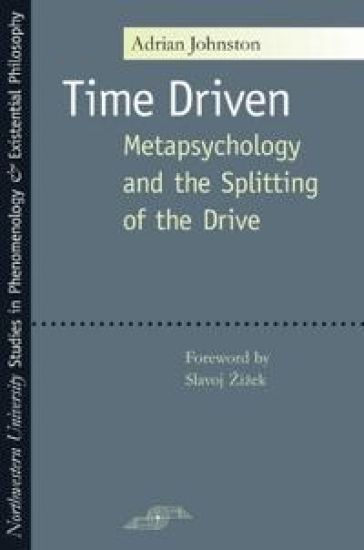
Elaborating the fundamental concept of Trieb, or drive, Freud outlines two basic types of conflict that at once disturb and organize mental life; the conflict between drives and reality; and the conflict between the drives themselves (as in amorous Eros against the aggressive death drive). In Time Driven, Adrian Johnston identifies a third distinct type of conflict overlooked by Freud; the conflict embedded within each and every drive. By bringing this critical type of conflict to light and explaining its sobering consequences for an understanding of the psyche, Johnston's book makes an essential theoretical contribution to Continental philosophy. is work offers a philosophical interpretation and reassessment of psychoanalysis that places it in relationship to the larger stream of ideas forming our world and, at the same time, clarifies its original contribution to our understanding of the human situation. Johnston draws on Jacques Lacan's oeuvre in conjunction with certain philosophical resources - elements from transcendental philosophy, structuralism, and phenomenology - to rectify the inconsistencies within the Freudian metapsychological model of drive. In doing so, he helps to answer a question haunting Freud at the end of his career: Why is humanity plagued by a perpetual margin of discontent, despite technological and cultural progress? In Time Driven, Johnston is able to make sense of Freud's metapsychology both as a whole and in its historical development of Lacan's reinterpretation of Freud, and of the place of both Freud and Lacan in modern philosophy.
"Att låna en kittel" hänvisar till ett skämt som Freud citerade för att belysa drömmarnas märkliga logik. En man kräver tillbaka sin utlånade kittel och får svaret: (1) Jag lånade aldrig någon kittel av dig. (2) Kitteln var redan trasig när jag fick den av dig. (3) Jag lämnade tillbaka den till dig oskadd.
This title offers a series of conversations which illustrate the originality of Slavoj Zizek's thinking on psychoanalysis, philosophy, multi-culturalism, popular/cyber culture, totalitarianism, ethics and politics.
Conversations with Zizek
Slavoj Zizek; Glyn Daly
Polity Press
2003
nidottu
Halvin toimitettuna 29,70 €
In this new book, Slavoj Žižek and Glyn Daly engage in a series of entertaining conversations which illustrate the originality of Žižek’s thinking on psychoanalysis, philosophy, multiculturalism, popular/cyber culture, totalitarianism, ethics and politics. An excellent introduction to one of the most engaging and controversial cultural theorists writing today. Žižek is a Slovenian sociologist who trained as a Lacanian and uses Lacan to analyse popular culture and politics. Illustrates the originality of Žižek’s thinking on psychoanalysis, philosophy, multi-culturalism, popular/cyber culture, totalitarianism, ethics and politics. Provides a unique glimpse of Žižek’s humour and character and offers new material and fresh perspectives which will be of interest to followers of Žižek’s writings.
The latest book by the Slovenian critic Slavoj Zizek takes the work of French philosopher Gilles Deleuze as the beginning of a dazzling inquiry into the realms of radical politics, philosophy, film (Hitchcock, Fight Club ), and psychoanalysis. Of Organs without Bodies Joan Copjec (Imagine There's No Woman ) has written: With all his ususal humor and invention, Zizek -- the acknowledged master of the 180 degree turn -- here takes a trip into enemy territory to deliver Deleuze of a marvelously rebellious child, one that seriously challenges Deleuze's other progeny with a surprising but convincing bid for succession. Those who thought Deleuze's forward march into the future would follow a straight path are forced to rethink their stance. From now on all readings of Deleuze will have to take a detour through this important -- even necessary -- book. Eric Santner (On the Psychopathology of Everyday Life ) describes Organs without Bodies as offering an entirely new degree of conceptual clarity and political urgency. Through his deep engagement with the logic of Deleuze's project, Zizek opens up new possibilities of thought beyond the terms of the current political debates on globalization, democratization, war on terror. Once again, Zizek has produced an utterly timely and radically untimely meditation. Recently profiled in The New Yorker , and hailed by the Village Voice as the giant of Ljubljana, Zizek is one of the most provocative and entertaining thinkers at work today.
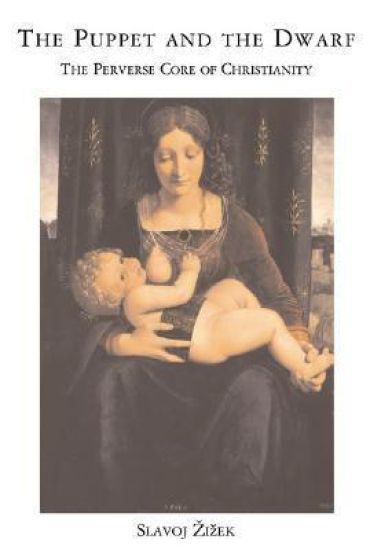
One of our most daring intellectuals offers a Lacanian interpretation of religion, finding that early Christianity was the first revolutionary collective. Slavoj Zizek has been called "an academic rock star" and "the wild man of theory"; his writing mixes astonishing erudition and references to pop culture in order to dissect current intellectual pieties. In The Puppet and the Dwarf he offers a close reading of today's religious constellation from the viewpoint of Lacanian psychoanalysis. He critically confronts both predominant versions of today's spirituality-New Age gnosticism and deconstructionist-Levinasian Judaism-and then tries to redeem the "materialist" kernel of Christianity. His reading of Christianity is explicitly political, discerning in the Pauline community of believers the first version of a revolutionary collective. Since today even advocates of Enlightenment like Jurgen Habermas acknowledge that a religious vision is needed to ground our ethical and political stance in a "postsecular" age, this book-with a stance that is clearly materialist and at the same time indebted to the core of the Christian legacy-is certain to stir controversy.
In the mid 1920s Lukács wrote a sustained and passionate response to Stalin's onslaught on his earlier seminal work History and Class Consciousness. Unpublished at the time, Lukács himself thought that the text had been destroyed. However, a group of researchers recently found the manuscript gathering dust in the newly opened archives of the CPSU in Moscow. Now for the first time, this fascinating, polemical and intense text is available in English. It is a crucial part of a hidden intellectual history and will transform interpretations of Lukács's oeuvre.
Was Sie immer schon über Lacan wissen wollten und Hitchcock nie zu fragen wagten
Slavoj Zizek; Mladen Dolar; Alenka Zupancic
SUHRKAMP VERLAG
2002
pokkari
Hoe kunnen we nog geloven en regels hebben in dit postmoderne tijdperk waarin naar verluidt niets is om in te geloven en geen regels zijn. De beroemde filosoof en onstuitbaar cultuurcriticus Slavoj Zizek daagt iedereen uit in dit overtuigende en adembenemende nieuwe boek. In Geloof, dat van 'cyberspace-denken' tot de paradox van het 'westerse boeddhisme' gaat, legt Zizek de vooronderstellingen bloot achter de manier waarop we gewoonlijk over geloof denken, met name in judaïsme en christendom. Door de zogenaamde authenticiteit van het religieuze geloof tegen een kritisch licht te houden en te putten uit psychoanalyse, film en filosofie, laat hij op schokkende wijze zien dat de basis van onze fundamenteelste overtuigingen minder rotsvast is dan wij denken.
Opera's Second Death is a passionate exploration of opera - the genre, its masterpieces, and the nature of death. Using a dazzling array of tools, Slavoj Zizek and coauthor Mladen Dolar explore the strange compulsions that overpower characters in Mozart and Wagner, as well as our own desires to die and to go to the opera.
Gets behind the contours of the way we normally think about belief, in particular Judaism and Christianity.
What is the basis of belief in an era when globalization, multiculturalism and big business are the new religion? Slavoj Zizek, renowned philosopher and irrepressible cultural critic takes on all comers in this compelling and breathless new book. From 'cyberspace reason' to the paradox that is 'Western Buddhism', On Belief gets behind the contours of the way we normally think about belief, in particular Judaism and Christianity. Holding up the so-called authenticity of religious belief to critical light, Zizek draws on psychoanalysis, film and philosophy to reveal in startling fashion that nothing could be worse for believers than their beliefs turning out to be true.
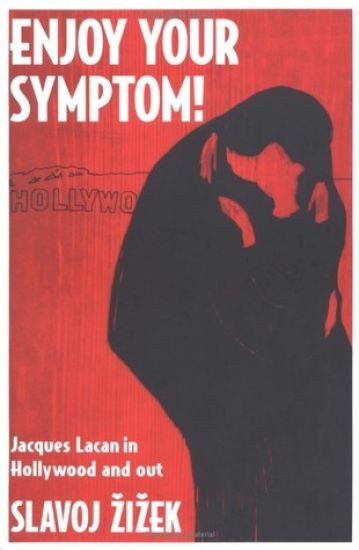
Slavoj Zizek, dubbed by the Village Voice "the giant of Ljubljana," is back with a new edition of his seriously entertaining book on film, psychoanalysis (and life). His inimitable blend of philosophical and social theory, Lacanian analysis, and outrageous humor are made to show how Hollywood movies can explain psychoanalysis-and vice versa using films such as Marnie and The Man Who Knew TooMuch.
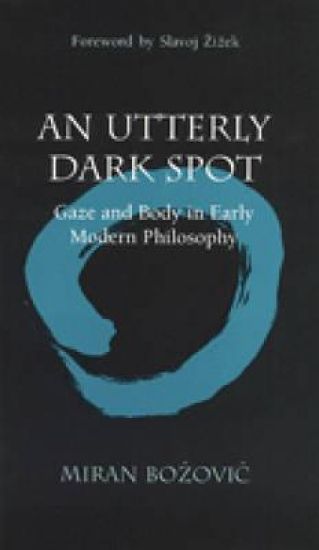
Slovenian philosopher Miran Bozovic's An Utterly Dark Spot examines the elusive status of the body in early modern European philosophy by examining its various encounters with the gaze. Its range is impressive, moving from the Greek philosophers and theorists of the body (Aristotle, Plato, Hippocratic medical writers) to early modern thinkers (Spinoza, Leibniz, Malebranche, Descartes, Bentham) to modern figures including Jon Elster, Lacan, Althusser, Alfred Hitchcock, Stephen J. Gould, and others. Bozovic provides startling glimpses into various foreign mentalities haunted by problems of divinity, immortality, creation, nature, and desire, provoking insights that invert familiar assumptions about the relationship between mind and body. The perspective is Lacanian, but Bozovic explores the idiosyncrasies of his material (e.g., the bodies of the Scythians, the transvestites transformed and disguised for the gaze of God; or Adam's body, which remained unseen as long as it was the only one in existence) with an attention to detail that is exceptional among Lacanian theorists. The approach makes for engaging reading, as Bozovic stages imagined encounters between leading thinkers, allowing them to converse about subjects that each explored, but in a different time and place. While its focus is on a particular problem in the history of philosophy, An Utterly Dark Spot will appeal to those interested in cultural studies, semiotics, theology, the history of religion, and political philosophy as well. Miran Bozovic is Associate Professor of Philosophy at the University of Ljubljana, Slovenia. He is the author of Der grosse Andere: Gotteskonzepte in der Philosophie der Neuzeit (Vienna: Verlag Turia & Kant, 1993) and editor of The Panopticon Writings by Jeremy Bentham (London: Verso, 1995).
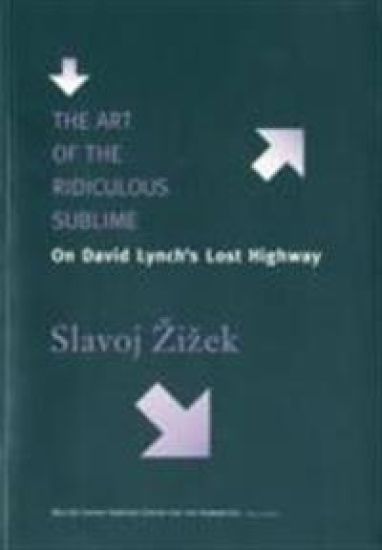
The Art of the Ridiculous Sublime is first of all the detailed reading of David Lynch's The Lost Highway, based on the premises of Lacanian psychoanalysis. Lynch's unique universe of the "ridiculous sublime" is interpreted as a simultaneous playful staging and traversing of the fundamental ideological fantasies that sustain our late capitalist society. A master of reversals, Zizek invites the reader to reexamine with him easy assumptions, received opinion, and current critical trends, as well as pose tough questions about the ways in which we understand our world and culture. He offers provocative readings of Casablanca, Schindler's List, and Life Is Beautiful in the process of examining topics as diverse—and as closely linked—as ethics, politics, and cyberspace.
In this study the author challenges both cognitivist-historicist accounts of cinema and conventional film-theory. Arguing that the reading of Lacan operative in the 1970s and 1980s was particularly reductive, he asserts that there is "another Lacan" in reference to whom film theory, cultural studies and critical thought as such can be transformed and revitalized. He supports this argument with readings of Tarkovsky ("Stalker", "Nostalghia"), Kieslowski (the "Three Colours Trilogy") and Lynch ("Lost Highways"), demonstrating how their work can be saved from obscurantist analysis by Lacanian interpretation.
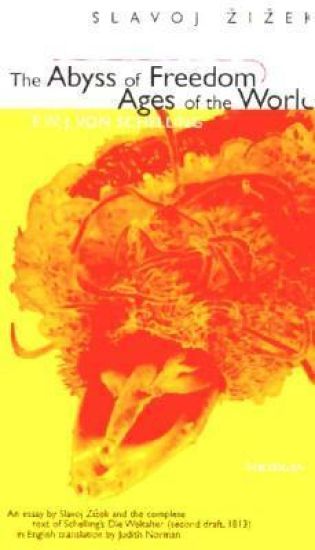
The Abyss of Freedom/Ages of the World
Slavoj Zizek; F.W.J. von Schelling
The University of Michigan Press
1997
nidottu
In the last decade, F. W. J. von Schelling has emerged as one of the key philosophers of German Idealism, the one who, for the first time, undermined Kant's philosophical revolution and in so doing opened up the way for a viable critique of Hegel. In noted philosopher Slavoj Zizek's view, the main orientations of the post-Hegelian thought, from Kierkegaard and Marx, to Heidegger and today's deconstructionism, were prefigured in Schelling's analysis of Hegel's idealism, and in his affirmation that the contingency of existence cannot be reduced to notional self-mediation. In The Abyss of Freedom, Zizek attempts to advance Schelling's stature even further, with a commentary of the second draft of Schelling's work The Ages of the World, written in 1813. Zizek argues that Schelling's most profound thoughts are found in the series of three consecutive attempts he made to formulate the "ages of the world/Weltalter," the stages of the self-development of the Absolute. Of the three versions, claims Zizek, it is the second that is the most eloquent and definitive encompassing of Schelling's lyrical thought. It centers on the problem of how the Absolute (God) himself, in order to become actual, to exist effectively, has to accomplish a radically contingent move of acquiring material, bodily existence. Never before available in English, this version finally renders accessible one of the key texts of modern philosophy, a text that is widely debated in philosophical circles today. The Abyss of Freedom is Zizek's own reading of Schelling based upon Lacanian psychoanalytic theory. It focuses on the notion that Lacan's theory--which claims that the symbolic universe emerged from presymbolic drives--is prefigured in Schelling's idea of logos as given birth to from the vortex of primordial drives, or from what "in God is not yet God." For Zizek, this connection is monumental, showing that Schelling's ideas forcefully presage the post-modern "deconstruction" of logocentrism. Slavoj Zizek is not a philosopher who stoops to conquer objects but a radical voice who believes that philosophy is nothing if it is not embodied, nothing if it is only abstract. For him, true philosophy always speaks of something rather than nothing. Those interested in the genesis of contemporary thought and the fate of reason in our "age of anxiety" will find this coupling of texts not only philosophically relevant, but vitally important. Slavoj Zizek is the author of The Sublime Object of Ideology, Tarrying with the Negative: Kant, Hegel and the Critique of Ideology, and most recently, The Indivisible Remainder: An Essay on Schelling and Related Matters. Currently he is a Senior Researcher at the Institute for Social Sciences, University of Ljubljana. Judith Norman is Assistant Professor of Philosophy at Trinity University in San Antonio, Texas.