Kirjojen hintavertailu – 12 903 724 kirjaa ja 27 kauppaa

Kirjailija

Desiderius Erasmus

Kirjat ja teokset yhdessä paikassa: 315 kirjaa, julkaisuja vuosilta 1933–2026, suosituimpiin kuuluu Ulrich Von Hutten Gegen Desiderius Erasmus, Und Desiderius Erasmus Gegen Ulrich Von Hutten. Vertaile teosten hintoja ja tarkista saatavuus suomalaisista kirjakaupoista.

315 kirjaa

Kirjojen julkaisuvuodet: 1933–2026.

Erasmi Colloquia selecta

Erasmi Colloquia selecta

Desiderius Erasmus

Gale Ecco, Print Editions
2018
sidottu
The 18th century was a wealth of knowledge, exploration and rapidly growing technology and expanding record-keeping made possible by advances in the printing press. In its determination to preserve the century of revolution, Gale initiated a revolution of its own: digitization of epic proportions to preserve these invaluable works in the largest archive of its kind. Now for the first time these high-quality digital copies of original 18th century manuscripts are available in print, making them highly accessible to libraries, undergraduate students, and independent scholars. The Age of Enlightenment profoundly enriched religious and philosophical understanding and continues to influence present-day thinking. Works collected here include masterpieces by David Hume, Immanuel Kant, and Jean-Jacques Rousseau, as well as religious sermons and moral debates on the issues of the day, such as the slave trade. The Age of Reason saw conflict between Protestantism and Catholicism transformed into one between faith and logic -- a debate that continues in the twenty-first century.++++The below data was compiled from various identification fields in the bibliographic record of this title. This data is provided as an additional tool in helping to insure edition identification: ++++British LibraryT138080Parallel Latin and English texts in columns. York: printed by Thomas Gent, for the author: and sold by him, and A. Bettesworth; J. Hazard, London; and T. Hammond, junior, in York, 1727. vi,226p.; 12
Desid. Erasmi Roterodami Colloquia familiaria selecta. Juxta editiones probatissimas. In usum scholarum.
The 18th century was a wealth of knowledge, exploration and rapidly growing technology and expanding record-keeping made possible by advances in the printing press. In its determination to preserve the century of revolution, Gale initiated a revolution of its own: digitization of epic proportions to preserve these invaluable works in the largest archive of its kind. Now for the first time these high-quality digital copies of original 18th century manuscripts are available in print, making them highly accessible to libraries, undergraduate students, and independent scholars. The Age of Enlightenment profoundly enriched religious and philosophical understanding and continues to influence present-day thinking. Works collected here include masterpieces by David Hume, Immanuel Kant, and Jean-Jacques Rousseau, as well as religious sermons and moral debates on the issues of the day, such as the slave trade. The Age of Reason saw conflict between Protestantism and Catholicism transformed into one between faith and logic -- a debate that continues in the twenty-first century.++++The below data was compiled from various identification fields in the bibliographic record of this title. This data is provided as an additional tool in helping to insure edition identification: ++++British LibraryT137872Perthensi: impensis R. Morison et Fil. et W. Coke, Leith; apud quos veneunt, 1791. 142p.; 12
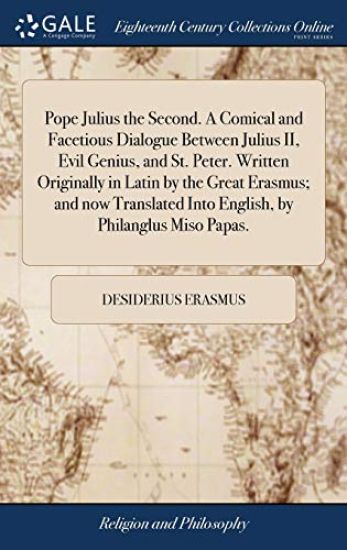
Pope Julius the Second. A Comical and Facetious Dialogue Between Julius II, Evil Genius, and St. Peter. Written Originally in Latin by the Great Erasmus; and now Translated Into English, by Philanglus Miso Papas.
The 18th century was a wealth of knowledge, exploration and rapidly growing technology and expanding record-keeping made possible by advances in the printing press. In its determination to preserve the century of revolution, Gale initiated a revolution of its own: digitization of epic proportions to preserve these invaluable works in the largest archive of its kind. Now for the first time these high-quality digital copies of original 18th century manuscripts are available in print, making them highly accessible to libraries, undergraduate students, and independent scholars. The Age of Enlightenment profoundly enriched religious and philosophical understanding and continues to influence present-day thinking. Works collected here include masterpieces by David Hume, Immanuel Kant, and Jean-Jacques Rousseau, as well as religious sermons and moral debates on the issues of the day, such as the slave trade. The Age of Reason saw conflict between Protestantism and Catholicism transformed into one between faith and logic -- a debate that continues in the twenty-first century.++++The below data was compiled from various identification fields in the bibliographic record of this title. This data is provided as an additional tool in helping to insure edition identification: ++++British LibraryT103782Variously attributed to Erasmus, G. Balbi, Ulrich von Hutten and P. F. Andrelinus, but probably by Erasmus. London: printed for T. Warner, 1719. viii,88p.; 8
In Praise of Folly

In Praise of Folly

Desiderius Erasmus

Createspace Independent Publishing Platform
2018
nidottu
At the onset of his hugely successful satire of medieval European society, Dutch scholar Desiderius Erasmus invokes the goddess Folly, daughter of Youth and Wealth, who was raised by Drunkenness and Ignorance. She's followed by idolatrous companions, including Self-love, Flattery, Pleasure, and Laziness. Through Folly's wry and humorous speech, Erasmus denounces the superstitions and nonsensical eccentricities of his contemporary theologians and churchmen, monastic life, and the condition of the Catholic Church. An immensely influential humanist text, In Praise of Folly helped lay the groundwork for the Protestant Reformation and marked a transitional time between medieval beliefs and modern ideals.
Publii Syri Mimi Similesque Sententiae

Publii Syri Mimi Similesque Sententiae

Publilius (Syrus); Desiderius Erasmus

Sagwan Press
2018
pokkari
This work has been selected by scholars as being culturally important, and is part of the knowledge base of civilization as we know it. This work was reproduced from the original artifact, and remains as true to the original work as possible. Therefore, you will see the original copyright references, library stamps (as most of these works have been housed in our most important libraries around the world), and other notations in the work. This work is in the public domain in the United States of America, and possibly other nations. Within the United States, you may freely copy and distribute this work, as no entity (individual or corporate) has a copyright on the body of the work. As a reproduction of a historical artifact, this work may contain missing or blurred pages, poor pictures, errant marks, etc. Scholars believe, and we concur, that this work is important enough to be preserved, reproduced, and made generally available to the public. We appreciate your support of the preservation process, and thank you for being an important part of keeping this knowledge alive and relevant.
The Colloquies of Desiderius Erasmus Concerning Men, Manners and Things; Volume 3

The Colloquies of Desiderius Erasmus Concerning Men, Manners and Things; Volume 3

Edwin Johnson; Desiderius Erasmus; Nathan Bailey

Sagwan Press
2018
pokkari
This work has been selected by scholars as being culturally important, and is part of the knowledge base of civilization as we know it. This work was reproduced from the original artifact, and remains as true to the original work as possible. Therefore, you will see the original copyright references, library stamps (as most of these works have been housed in our most important libraries around the world), and other notations in the work. This work is in the public domain in the United States of America, and possibly other nations. Within the United States, you may freely copy and distribute this work, as no entity (individual or corporate) has a copyright on the body of the work. As a reproduction of a historical artifact, this work may contain missing or blurred pages, poor pictures, errant marks, etc. Scholars believe, and we concur, that this work is important enough to be preserved, reproduced, and made generally available to the public. We appreciate your support of the preservation process, and thank you for being an important part of keeping this knowledge alive and relevant.
Erasmus: Life of a humanist

Erasmus: Life of a humanist

Desiderius Erasmus; Richard C. Jebb

Createspace Independent Publishing Platform
2017
nidottu
This book presents the history of Erasmus, an European humanist; and his essay against war. "With Erasmus a new period opens. Two things broadly distinguish him, as a scholar, from the men before and after him. First, he was not only a refined humanist, writing for the fastidious few, and prizing no judgment but theirs; he took the most profitable authors of antiquity, -profitable in a moral as well as a literary sense, -chose out the best things in them, -and sought to make these things widely known, -applying their wisdom or wit to the circumstances of his own day. Secondly, in all his work he had an educational aim, -and this of the largest kind. The evils of his age, -in Church, in State, in the daily lives of men, -seemed to him to have their roots in ignorance, -ignorance of what Christianity meant, -ignorance of what the Bible taught, -ignorance of what the noblest and most gifted minds of the past, whether Christian or pagan, had contributed to the instruction of the human race. Let true knowledge only spread, and under its enlightening and humanizing influence a purer religion and a better morality will gradually prevail. Erasmus was a man of the world; but with his keen intellect, so quickly susceptible to all impressions, he made the mistake, not uncommon for such temperaments, of overrating the rapidity with which intellectual influences permeate the masses of mankind. However, no one was ever more sistently or brilliantly true to an idea than Erasmus was to his; and it is wonderful how much he achie
Collected Works of Erasmus

Collected Works of Erasmus

Desiderius Erasmus

University of Toronto Press
2017
sidottu
After spending several months in England, Erasmus returned to Paris in the winter of 1500 and set about compiling a small anthology of classical proverbs known as the Adagiorum collectanea. This modest work became the basis for one of Erasmus’ best known and longest works, when it was expanded in 1508 into the far more substantial Adagiorum chiliades. The essay that begins this introductory volume to the Adages explores the development of the Collectanea and its transformation into the Adagiorum chiliades. It is followed by the first annotated translation into English of the Collectanea. The second part of this volume contains a series of indexes to all of the adages found in CWE volumes 31–36: Greek; Latin; Early Modern English proverbs with possible sources or parallels in Erasmus; Erasmus’ original topical index; and full indexes of all the proverbs and names mentioned by Erasmus. The Prolegomena to the Adages is a much needed resource for Erasmus and Renaissance scholars alike and it continues the excellence in scholarship which defines the entire series. Volume 30 of the Collected Works of Erasmus series.
The Correspondence of Erasmus

The Correspondence of Erasmus

Desiderius Erasmus; James M. Estes

University of Toronto Press
2017
pokkari
This volume contains the surviving correspondence of Erasmus for the first seven months of 1529. For nearly eight years he had lived happily and productively in Basel. In the winter of 1528-9, however, the Swiss version of the Lutheran Reformation triumphed in the city, destroying the liberal-reformist atmosphere Erasmus had found so congenial. Unwilling to live in a place where Catholic doctrine and practice were officially proscribed, Erasmus resettled in the quiet, reliably Catholic university town of Freiburg im Breisgau, Despite the turmoil of moving, Erasmus managed to complete the new Froben editions of Seneca and St Augustine, both monumental projects that had been underway for years. He also found time to engage in controversy with his conservative Catholic critics, as well as to write a long letter lamenting the execution for heresy of his friend Louis de Berquin at Paris. Volume 15 of the Collected Works of Erasmus series.
Life and Letters of Erasmus

Life and Letters of Erasmus

James Anthony Froude; Desiderius Erasmus

Hansebooks
2017
pokkari
Life and Letters of Erasmus is an unchanged, high-quality reprint of the original edition of 1894. Hansebooks is editor of the literature on different topic areas such as research and science, travel and expeditions, cooking and nutrition, medicine, and other genres. As a publisher we focus on the preservation of historical literature. Many works of historical writers and scientists are available today as antiques only. Hansebooks newly publishes these books and contributes to the preservation of literature which has become rare and historical knowledge for the future.
Collected Works of Erasmus

Collected Works of Erasmus

Desiderius Erasmus

University of Toronto Press
2017
sidottu
Volume 58 in the Collected Works of Erasmus series contains, for the first time, the English translation of Erasmus’ Annotations on Paul’s Epistles to the Galatians and Ephesians. Erasmus’ Annotations began as marginal comments in his own copy of the New Testament and were subsequently published in 1516 as a supplement to the Novum Instrumentum. His annotations were intended to justify his changes based on the Greek text. In each successive edition, published between 1516 and 1535, the Annotations grew in size and scope providing Erasmus with the opportunity to defend his translations in the face of growing criticism from orthodox Catholic theologians. This volume notes the editorial changes made in the five editions and also provides the reader with information about the patristic, medieval and contemporary sources consulted by Erasmus, and about the evolving relations with contemporary critics. The Annotations played a pivotal role in the development of sixteenth-century biblical exegesis and mark a significant stage in the evolution of humanist biblical scholarship.
Das Lob der Narrheit

Das Lob der Narrheit

Desiderius Erasmus; Daniel Chodowiecki

Hansebooks
2017
pokkari
Das Lob der Narrheit - aus dem Lateinischen des Erasmus ist ein unver nderter, hochwertiger Nachdruck der Originalausgabe aus dem Jahr 1781. Hansebooks ist Herausgeber von Literatur zu unterschiedlichen Themengebieten wie Forschung und Wissenschaft, Reisen und Expeditionen, Kochen und Ern hrung, Medizin und weiteren Genres. Der Schwerpunkt des Verlages liegt auf dem Erhalt historischer Literatur. Viele Werke historischer Schriftsteller und Wissenschaftler sind heute nur noch als Antiquit ten erh ltlich. Hansebooks verlegt diese B cher neu und tr gt damit zum Erhalt selten gewordener Literatur und historischem Wissen auch f r die Zukunft bei.
Against War and In Praise of Folly

Against War and In Praise of Folly

Desiderius Erasmus

Devoted Publishing
2017
pokkari
Starting off by teaching about the heinousness of war, Erasmus convicts us all about the tendencies of our violent and sinful nature in the face of God's love and justice in a world consumed by war. Next he takes us on a journey showing what benefit heresy and falsehood have for strengthening the church and making us who believe in God realize what is truth and what is not.
Éloge de la Folie

Éloge de la Folie

Desiderius Erasmus; Désiré Nisard; Jean-Jacques Barrett

Hachette Livre - BNF
2016
pokkari
eloge de la folie d'erasme (3e edition) / traduit par Victor Develay; et accompagne des dessins de Hans HolbeinDate de l'edition originale: 1876Ce livre est la reproduction fidele d'une oeuvre publiee avant 1920 et fait partie d'une collection de livres reimprimes a la demande editee par Hachette Livre, dans le cadre d'un partenariat avec la Bibliotheque nationale de France, offrant l'opportunite d'acceder a des ouvrages anciens et souvent rares issus des fonds patrimoniaux de la BnF. Les oeuvres faisant partie de cette collection ont ete numerisees par la BnF et sont presentes sur Gallica, sa bibliotheque numerique. En entreprenant de redonner vie a ces ouvrages au travers d'une collection de livres reimprimes a la demande, nous leur donnons la possibilite de rencontrer un public elargi et participons a la transmission de connaissances et de savoirs parfois difficilement accessibles. Nous avons cherche a concilier la reproduction fidele d'un livre ancien a partir de sa version numerisee avec le souci d'un confort de lecture optimal. Nous esperons que les ouvrages de cette nouvelle collection vous apporteront entiere satisfaction. Pour plus d'informations, rendez-vous sur www.hachettebnf.fr