Kirjojen hintavertailu – 12 903 725 kirjaa ja 27 kauppaa

Kirjailija

Rudolf Steiner

Kirjat ja teokset yhdessä paikassa: 1 477 kirjaa, julkaisuja vuosilta 1910–2026, suosituimpiin kuuluu The Cosmic New Year: A Course of Lectures by Rudolf Steiner. Vertaile teosten hintoja ja tarkista saatavuus suomalaisista kirjakaupoista.

1 477 kirjaa

Kirjojen julkaisuvuodet: 1910–2026.

Michael's Mission

Michael's Mission

Rudolf Steiner

Rudolf Steiner Press
2015
nidottu
'... This will generate a struggle covering the face of the whole earth. The one and only remedy for this nonsense being made of human evolution will be the path that can lead humanity to the spirit - the path of Michael, which finds its continuation in the path of Christ.' - Rudolf Steiner Speaking in the aftermath of the Great War, Rudolf Steiner presents a series of extraordinary lectures on the power and mission of the Archangel Michael. He paints on a broad canvas - in the context of cosmic and human evolution - revealing Michael's tasks in the past, present and future. Originally the countenance of Yahweh, Michael has metamorphosed from a 'night spirit' to a 'day spirit'. As 'the Countenance of Christ', Michael helps us find a balance between 'luciferic' and 'ahrimanic' tendencies. The old 'dualism' (such as good versus evil), says Steiner, needs to be replaced by the trinity of Lucifer-Christ-Ahriman. Filling our heart with the Christ Impulse creates an equilibrium between the luciferic influence that imbues our head and the ahrimanic influence at work in our limbs. Rudolf Steiner describes how humanity faces three dangers in the social sphere: spiritual life could flow into the 'pit of mendacity' ruled by Ahriman, individual rights might descend into the 'pit of selfishness' (Lucifer), and economics into cultural sickness and death (Asuras). In order to prevent European-American culture from perishing, it will be necessary to turn towards contemporary 'threefold' social ideas. Steiner also speaks about the principle of metamorphosis in connection with evolution and devolution, as evident in the design of the pillars in the newly-built Goetheanum. Architectural styles are an expression of human evolution, as can be seen in Greek temples, gothic Cathedrals, the Grail temple and the building at Dornach. Amidst many other themes, Rudolf Steiner addresses the problem of natural necessity and freedom, and the abolition of the trichotomy of body, soul and spirit at the Council of Constantinople in AD 869.
Problems of Society

Problems of Society

Rudolf Steiner

Rudolf Steiner Press
2015
nidottu
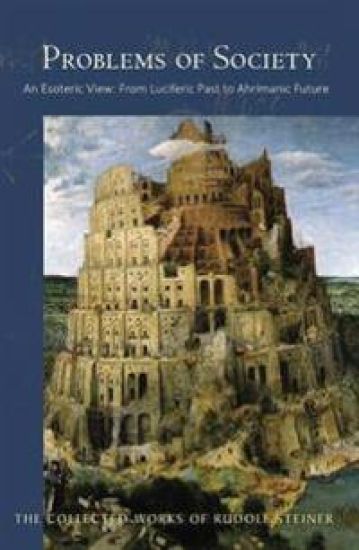
'Whatever turbulent outward events occur in the world, whatever form is taken by things seeking to work their way out of the depths of human evolution, we only really hearken to the true, underlying nature of these events ...if we observe the world from a spiritual perspective.' - Rudolf Steiner In seeking to heal the many social crises of our time, Rudolf Steiner urges us to turn away from 'fixed principles, theories or social dogmas' and to rediscover the real nature of the human being. This inner reality - that cannot be understood in materialistic or deterministic ways - is the only basis on which society can truly be founded. But it is not sufficient to speak of well-meaning ideas, he says, unless we are also active in working for change; change that begins with each of us. In 1919, a year marked by strong social and political upheavals, Steiner was deeply concerned with questions relating to society. Having published a book on the subject (Towards Social Renewal), he embarked on a major campaign to publicize his 'threefold' social ideas. In addition to public lectures, however, Steiner sought to deepen the subject in a series of talks to members of the Anthroposophical Society. These lectures, gathered in this volume, reveal the 'inner' or 'esoteric' aspects of the social question. They complement Steiner's very practical efforts to realize threefolding in the historical context of his time. Whilst Steiner's suggestions for social change may not seem self-evident to pragmatic thinking, they will strike a resonant chord in many who seek deeper answers to the social problems of our times - problems that politicians seem unable to remedy. Amidst the many themes tackled here, Steiner addresses the issue of nationalism as a retrograde tendency; the tasks of Central Europe and Britain in relation to the East; the incarnation of Ahriman in the West, and the historical incarnation of Lucifer in the third millennium BC.
Mantric Sayings

Mantric Sayings

Rudolf Steiner

SteinerBooks, Inc
2015
pokkari
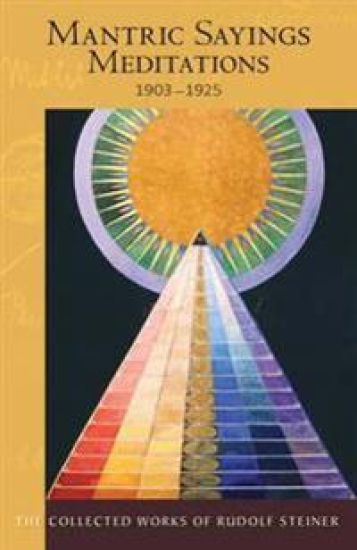
Soul exercises, 1903-1925 (CW 268)"Transform yourself for the sake of the world. Learn to practice thinking, feeling, sensing, and willing without egoism. Let your work be the shadow that your I casts when it is shone upon by the flame of your higher self." By "mantric sayings" (mantrische Spr che), Rudolf Steiner means content given by the spiritual world to be absorbed and experienced in meditation. Thus, the volume contains intuitive insights received "from the spiritual world" and, as such, the vehicle to return us to it. The meditations were often given personally to others for general use, as well as for specific situations or needs such as healing and strengthening, in relation to those who had died, or for anthroposophic work. In other words, these short texts are to be performed--to be experienced. In this sense, they are directive--enjoining us to "Do this "--and affirmative--positive, filled with hope, and oriented toward the other and the future. Mantric Sayings includes translations of scriptural passages and ancient versions of the Lord's Prayer that were part of Steiner's own meditative practice, as well as the 1913 lecture, "The Foundation Stone Address," for this, too, contains gifts of the spirit. Also included is Steiner's important "Macrocosmic (or Reverse) Lord's Prayer." Because meditation lies at the very heart of anthroposophy, as Steiner wished to see it practiced, there are many other collections of Steiner's meditation texts. What makes Mantric Sayings unique, however, is its range, extending from July 1903 to March 1925--virtually the entirety of Rudolf Steiner's life as a spiritual teacher--and its personal quality. It is very clear that many of these meditations, whether given to others or simply written in his notebooks or on loose note sheets, were meditations that Steiner himself not only received, but also worked with himself in meditation. In this sense, these meditations present a kind of intimate soul portrait; they are what he did and subsequently gave to others with, as one might imagine, great love and deep knowledge of the recipients. This book is a companion volume to Soul Exercises: Word and Symbol Meditations. Mantric Sayings is a translation from German of Mantrische Spr che. Seelen bungen II. 1903 -1925 (GA 268). Cover image: Altarpiece, No. 1, Group X, Altarpieces, 1915. Painting by Hilma af Klint (1862-1944), Stiftelsen Hilma af Klint Verk.

Karmic Relationships

Karmic Relationships

Rudolf Steiner

Rudolf Steiner Press
2015
nidottu
During 1924, before his last address in September, Rudolf Steiner gave over eighty lectures on the subject of karma to members of the Anthroposophical Society. These profoundly esoteric lectures examine the underlying laws of reincarnation and karma, and explore in detail the incarnations of certain named historical figures. In Rudolf Steiner's words, the study of karma is '?a matter of penetrating into the most profound mysteries of existence, for within the sphere of karma and the course it takes lie those processes which are the basis of the other phenomena of world-existence?' In this second volume of the series. Rudolf Steiner considers individual karmic relationships in history - for example Marx and Engels - as well as surveying karma in human life, the shaping of karma after death, and the "cosmic form" of karma.
The Early History of Eurythmy

The Early History of Eurythmy

Rudolf Steiner

SteinerBooks, Inc
2015
pokkari
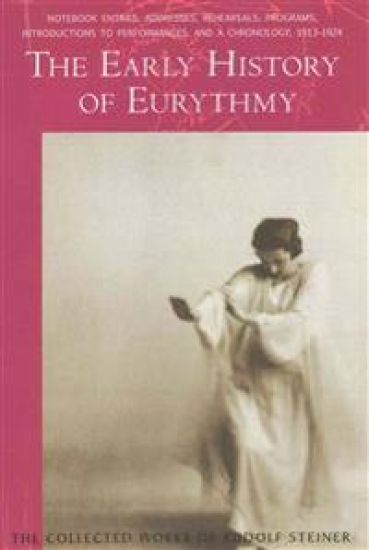
Notebook entries, addresses, rehearsals, programs, introductions to performances, and a Talks given before 16 eurythmy performances in Bottmingen, Dusseldorf, Munich, Berlin, Dornach, Stuttgart, Ilkley, and Penmaenmawr (CW 277c) The Early History of Eurythmy is the first of three volumes of Rudolf Steiner's "eurythmy addresses," short introductory talks preceding the earliest performances of this new art of movement. Of the nearly 300 transcripts that survive, few have thus far been translated into English. This volume presents, chronologically, the addresses related mostly to drama, generally, and specifically to stage performances of Goethe's Faust and Steiner's mystery dramas. In addition, it features all of Rudolf Steiner's notebook entries on eurythmy, along with all of the extant eurythmy programs from 1913 to 1925, which yield invaluable insights into Steiner's taste and aesthetics. Frederick Amrine's engaging introduction emphasizes that eurythmy is an important episode in the history of dance, but has been unjustly neglected. He contends that eurythmy is a continuation of an aesthetic revolution that began not in Europe but in America; that the original impulses leading to "new dance" were deeply spiritual; and that there are deep but largely unrecognized affinities between "new dance" and eurythmy. This counter-narrative about the prehistory of eurythmy within the history of dance should be of particular interest to English-speaking anthroposophists, because it identifies the pioneering work of three American women as the all-important context for the development of eurythmy: Loie Fuller, Isadora Duncan, and Ruth St. Denis. Drawing on extensive historical documentation, he states that it is eurythmy rather than modern dance that is the rightful heir of Fuller, Duncan, and St. Denis. The Early History of Eurythmy is a translation from German of part 3 from Eurythmie. Die Offenbarung der sprechenden Seele (GA 277). CONTENTS: Introduction: Eurythmy and the "New Dance," by Frederick Amrine 1. Notebook Entries and an Excerpt from a Letter2. Addresses and Other Texts Related to Eurythmy3. Two Rehearsed Readings of "Classical Walpurgis Night" from Goethe's Faust II4. Eurythmy Programs, Advertisements, and Announcements5. Chronology and Overview
Paths and Goals of the Spiritual Human Being

Paths and Goals of the Spiritual Human Being

Rudolf Steiner

Rudolf Steiner Press
2015
nidottu
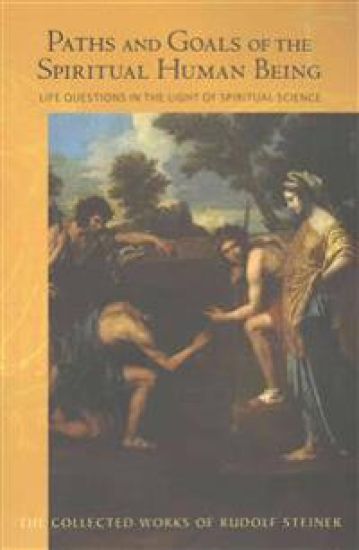
Speaking to audiences in Denmark, Germany and France, Rudolf Steiner discusses a wide range of topics: from positive and negative human soul capacities, true self-knowledge and karma, to changes in human consciousness, from ancient times to the modern era - all in the context of the incarnation of Christ on earth. The lectures illustrate the diversity of Steiner's approach when speaking to different audiences. Reflecting on the polymath Novalis, for example, he is urgent about the responsibility of spiritual science to help humanity awaken to the new age. A few months later, talking of Hegel and deploring the fact that an interest in spiritual matters often fails to be accompanied by an equal interest in logical thought, Steiner uses a dispassionate, philosophical tone. But throughout the lectures he is consistent in his view that spiritual science does not reject conventional science. Trained philosophical thinking leads to different conclusions than materialism, he says, but there is nothing in the field of spiritual science that need be rejected by rigorous scientific thought. Although the lectures were given to a variety of audiences, ideas recur from different perspectives and in different contexts, with strong thematic links binding them together. These include the relationship between philosophy and science; the nature of clairvoyance; Christ's presence in the etheric realm; reincarnation and karma; the mystery drama The Portal of Initiation; Christmas and its symbols; and the transformation of consciousness that occurred when Christ incarnated physically on earth. In the final lectures, Rudolf Steiner speaks inspiringly about the Christmas festival, contrasting the feeling of inwardness that people used to experience with the hectic cultural environment of modern cities. However, this does not lead Steiner to be nostalgic about the past. Rather, he states, we should seek to recreate a mood of inwardness in a new way, appropriate to our modern age and consciousness. These lectures give us the tools to bring such a contemporary spiritual approach to our lives.
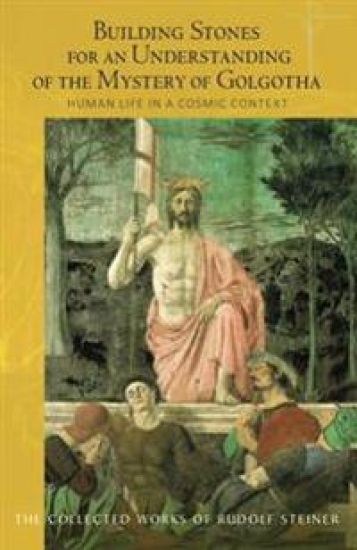
Building Stones for an Understanding of the Mystery of Golgotha
Speaking to audiences in Denmark, Germany and France, Rudolf Steiner discusses a wide range of topics: from positive and negative human soul capacities, true self-knowledge and karma, to changes in human consciousness, from ancient times to the modern era - all in the context of the incarnation of Christ on earth. The lectures illustrate the diversity of Steiner's approach when speaking to different audiences. Reflecting on the polymath Novalis, for example, he is urgent about the responsibility of spiritual science to help humanity awaken to the new age. A few months later, talking of Hegel and deploring the fact that an interest in spiritual matters often fails to be accompanied by an equal interest in logical thought, Steiner uses a dispassionate, philosophical tone. But throughout the lectures he is consistent in his view that spiritual science does not reject conventional science. Trained philosophical thinking leads to different conclusions than materialism, he says, but there is nothing in the field of spiritual science that need be rejected by rigorous scientific thought. Although the lectures were given to a variety of audiences, ideas recur from different perspectives and in different contexts, with strong thematic links binding them together. These include the relationship between philosophy and science; the nature of clairvoyance; Christ's presence in the etheric realm; reincarnation and karma; the mystery drama The Portal of Initiation; Christmas and its symbols; and the transformation of consciousness that occurred when Christ incarnated physically on earth. In the final lectures, Rudolf Steiner speaks inspiringly about the Christmas festival, contrasting the feeling of inwardness that people used to experience with the hectic cultural environment of modern cities. However, this does not lead Steiner to be nostalgic about the past. Rather, he states, we should seek to recreate a mood of inwardness in a new way, appropriate to our modern age and consciousness. These lectures give us the tools to bring such a contemporary spiritual approach to our lives.