Kirjojen hintavertailu – 12 903 725 kirjaa ja 27 kauppaa

Kirjailija

Rudolf Steiner

Kirjat ja teokset yhdessä paikassa: 1 477 kirjaa, julkaisuja vuosilta 1910–2026, suosituimpiin kuuluu The Cosmic New Year: A Course of Lectures by Rudolf Steiner. Vertaile teosten hintoja ja tarkista saatavuus suomalaisista kirjakaupoista.

1 477 kirjaa

Kirjojen julkaisuvuodet: 1910–2026.

From Limestone to Lucifer...

From Limestone to Lucifer...

Rudolf Steiner

Rudolf Steiner Press
1999
nidottu

Halvin toimitettuna 23,60 €

The remarkable discussions in this volume took place between Rudolf Steiner and workers at the Goetheanum, Switzerland. The varied subject-matter was chosen by his audience at Rudolf Steiner's instigation. Steiner took their questions and usually gave immediate answers. The astonishing nature of these responses - their insight, knowledge and spiritual depth - is testimony to his outstanding ability as a spiritual initiate and profound thinker. Accessible, entertaining and stimulating, the records of these sessions will be a delight to anybody with an open mind. In this particular collection, Rudolf Steiner deals with topics ranging from limestone to Lucifer! He discusses, among other things, technology; the living earth; natural healing powers; colour and sickness; rainbows; whooping cough and pleurisy; seances; sleep and sleeplessness; dreams; reincarnation; life after death; the physical, ether and astral bodies and the 'I'; the two Jesus children; Ahriman and Lucifer; the death, resurrection and ascension of Christ; Dante and Copernicus.

Staying Connected

Staying Connected

Rudolf Steiner

SteinerBooks, Inc
1999
nidottu
"This is what it comes down to: that we learn to experience that those who have passed through the gate of death have only assumed another form. Having died, they stand before our feelings like those who, through life experiences, have traveled to distant lands, whither we can follow them only later. We have therefore nothing to fear but a time of separation. Spiritual science must help us learn to feel and experience this in the most living way we can." --Rudolf Steiner"Living and working with the concepts and exercises in these talks and meditations has changed my life. This is a most practical book. Do what it recommends and you will experience the presence of the dead in your lives. You will know that the community of human beings on both sides of the threshold is not theory, but reality." --Christopher Bamford (from the introduction)The idea of "working with the dead" --maintaining, continuing, and enhancing one's relationships with those who have died--was fundamental to Steiner's work. This volume collects a rich harvest of his thoughts on the subject, gathered over many years. Steiner spoke directly from his own experience and formulated various meditation practices and verses that worked for him. We learn the usefulness of reading to the dead; the use of verbs (instead of nouns) when we speak with them; the importance of the sacred moments when falling asleep and awakening for asking questions and receiving answers; how our memories of the dead are like "art" to them; and of key moods we must cultivate--community with the world, gratitude, confidence in the current of life. We learn, too, of the many ways discarnate souls can help us in our earthly work, and of the many ways we can help them. Also included are many of the mantras Steiner gave to his students for connecting with those who have died. This important volume will help those who want to deepen their relationships to the living, to those who have died, or to the spiritual world itself. Contents: Introduction by Christopher Bamford Part 1: "Entry" Overcoming the Abyss The Life of the Dead Recovering the Connection The Presence of the Dead The Blessings of the Dead Works of Art, Acts of Grace Part 2: "Practice" How the Dead Influence the Living The Dead Are Always with Us Uniting with the Universal Spirit The Feeling of Community and the Experience of Gratitude Trust in Life and the Rejuvenation of the Soul The Language of the Heart Momento Mori Part 3: "Experience" First Experience with the Dead An Example of Working with the Dead Advice on Meditation The Importance of Self-Knowledge in the Life after Death Meditations Coda: The Dead Speak
Learning to See into the Spiritual World

Learning to See into the Spiritual World

Rudolf Steiner

SteinerBooks, Inc
1999
nidottu
"Truth and striving for truth must taste good to you; and lies, once you are conscious of them, must taste bitter and poisonous. You must not only know that human judgments have color, but also that printer's ink nowadays is mostly deadly nightshade juice. You must be able to experience this in all honesty and rectitude, and once you can do so, you will be in a state of spiritual transformation." -Rudolf Steiner In response to these questions, Rudolf Steiner delivered the informal lectures in this book to the workers at the Goetheanum: * What is the relationship between coming to see the secrets of the universe and one's own view of the world? * How far must one go before finding the higher worlds on the path of natural science? * Do cosmic forces influence all of humanity? * What connection do plants have with the human being and the human body? In answering these questions, Steiner covers a wide range of topics, from the development of independent thinking and the ability to think backward to the uses of what seems boring and the reversal of thinking between the physical and spiritual worlds, and from the "physiology" of dreams to living into nature and the spiritual dimension of various foods. As always in his lectures to the workers, Steiner's style is clear, direct, and accessible.
Modern Art of Education

Modern Art of Education

Rudolf Steiner

SteinerBooks, Inc
1999
nidottu
14 lectures and talks, Ilkley, Yorkshire, August 5-17, 1923 (CW 307) In this fine introduction to Waldorf education, written out of a series of lectures given in 1924, Steiner provides one of the most comprehensive introductions to his pedagogical philosophy, psychology, and practice. Steiner begins by describing the union of science, art, religion and morality, which was the aim of all his work and underlies his concept of education. Against this background, many of the lectures describe a new developmental psychology. On this basis, having established how children's consciousness develops, Steiner discusses how different subjects should be presented so that individuals can grow and flourish inwardly. Only if the child absorbs the right subject in the right way at the right time can the inner freedom so necessary for life in the modern world become second nature. Contents: Introduction by Christopher Bamford Science, Art, Religion, Morality The Principles of Greek Education Greek Education and the Middle Ages Spirit's Relationship to the Body Freeing Volition in the Human Organism Walking, Speaking, Thinking Rhythm, Sleep, Imitation Reading, Writing, Nature Study Arithmetic, Geometry, History Physics, Chemistry, Handwork, Language, Religion Memory, Temperaments, Physical Education, Art Education toward Inner Freedom The Three Eras of Human Religious Education Closing Address Index "Readers of Steiner's lectures printed here will be 'quietly astonished' and 'genuinely enthusiastic.' After an introduction, in which he speaks of reuniting science (intellectual knowledge), art, and morality once again, he turns to the principles of Greek education, in which body, soul, and spirit were still a unity. He then traces the development through the Middle Ages, during which new, evolving elements were added. In our time, he says, we must understand the concrete connection of the spirit with the human being, so that thinking, feeling, and willing can once more become alive. He relates this to the child's developmental stages, as well as the human basics such a sleeping and waking. Then he turns to the specifics of the curriculum: reading, writing, nature study, arithmetic, geometry, history physics, chemistry, crafts, language, and religion. Finally, he turns to memory, the temperaments, physical culture, art, and the actual organization of a Waldorf school--to which this volume is, all in all, one of the best introductions." --Christopher Bamford, from his introduction German source: Gegenw rtiges Geistesleben und Erziehung (GA 307). Previous English edition: Education and Modern Spiritual Life.
A Psychology of Body, Soul and Spirit

A Psychology of Body, Soul and Spirit

Rudolf Steiner

SteinerBooks, Inc
1999
nidottu
12 lectures, Berlin, Oct. 23, 1909-Dec. 16, 1911 (CW 115) This series of lectures provides the basis for an entirely new psychology. The first four lectures give a precise, dynamic understanding of the human soul in relation to the activity of the senses and to the subtle processes that make up the human being on Earth. The next four lectures focus on what we can know of the human soul based on direct observation alone. No theorizing takes place. To show what we can know of soul life through the immediacy of engaged observation of oneself and others, Rudolf Steiner refrains from using his own higher capacities of clairvoyance to form a picture of our soul life. The concluding lectures portray the relationship of soul life to spirit life, showing us how to awaken individual spirit life and how to distinguish between illusory and genuine spiritual experiences. Presented more than a century ago, we might be tempted to think that, insofar as psychology is concerned, the content of these lectures are outdated. It is also tempting to think that, because Steiner is not usually associated with the founders of modern psychology, his efforts must be considered, at best, an interesting aside. On the contrary, these lectures are actually a wellspring for the true stream of psychology, as the term itself means "soul study." A Psychology of Body, Soul, and Spirit should be read by anyone interested in psychology as well as by those interested in inner development. Whether we are involved in education, medicine, art, drama, economics, or business, the perspectives contained in this book have the potential to restore the frequently missing element of soul in psychology today. Robert Sardello's in-depth introduction places Steiner's lectures in the context of modern life and psychology and provides insights into how to read and use this text for inner development and a deeper understanding of spiritual science. Contents: Introduction by Robert Sardello Part 1 -- "Anthroposophy" The Human being and the Senses Supersensible Processes in the Human Senses The Higher Senses, inner Forces, and Creative Principles in the Human Organism Supersensible Currents, Group Soul, and the I in Human Beings and Animals Part 2 -- "Psychosophy" Aspects of Soul Life The Activities of Human Soul Forces The Senses, Feeling, and Aesthetic Judging Consciousness and Soul Life Part 3 -- "Pneumatosophy" Franz Brentano and Aristotle's Doctrine of the Spirit Truth and Error in Light of the Spiritual World Imagination-Imagination; Inspiration-Self-Fulfillment; Intuition-Conscience Nature, the Evolution of Consciousness, and Reincarnation "Steiner does not talk about soul; he speaks from soul. That is the entire method. There is, however, an entrance fee for doing psychology. The fee is that you need to leave behind your well-known-to-you self-identity. You must suffer the experience of leaving behind not only what you know, but also what you think you know of yourself. This requirement qualifies psychology as integral to the work of initiation. --Robert Sardello, from his introduction A previous translation of these lectures were published as Anthroposophy, Psychosophy, Pneumatosophy and as Wisdom of Man, of the Soul, and of the Spirit. This volume is a translation from German of Anthroposophie, Psychosophie, Pneumatosophie (GA 115)
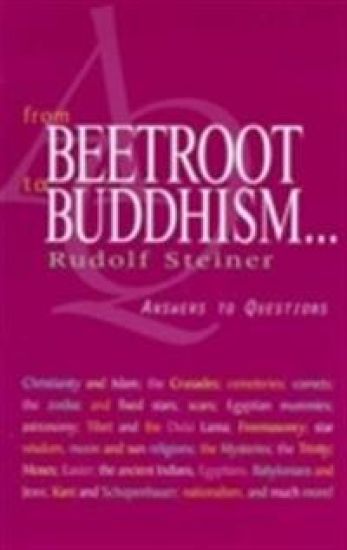
From Beetroot to Buddhism

From Beetroot to Buddhism

Rudolf Steiner

Rudolf Steiner Press
1999
nidottu
16 lectures, Dornach, March 1 to June 25, 1924 (CW 353)The remarkable discussions in this volume took place between Rudolf Steiner and workers at the Goetheanum, Switzerland. The varied subject-matter was chosen by his audience at Rudolf Steiner's instigation. Steiner took their questions and usually gave immediate answers. The astonishing nature of these responses - their insight, knowledge and spiritual depth - is testimony to his outstanding ability as a spiritual initiate and profound thinker. Accessible, entertaining and stimulating, the records of these sessions will be a delight to anybody with an open mind. In this particular collection, Rudolf Steiner deals with topics ranging from beetroot to Buddhism! He discusses, among other things, Christianity and Islam; the Crusades; cemeteries; comets; the zodiac and fixed stars; scars; Egyptian mummies; astronomy; Tibet and the Dalai Lama; Freemasonry; star wisdom, moon and sun religions; the Mysteries; the Trinity; Moses; Easter; the ancient Indians, Egyptians, Babylonians and Jews; Kant and Schopenhauer, and nationalism. This volume is a translation from German of Die Geschichte der Menschheit und die Weltanschauungen der Kulturvoelker (GA 353).
Towards Social Renewal

Towards Social Renewal

Rudolf Steiner

Rudolf Steiner Press
1999
nidottu
Written works, published 1919 (CW 23)Although this book was first published in 1919, it remains highly relevant to social problems encountered today. Uniquely, Steiner's social thinking is not based on intellectual theory, but on a profound perception of the archetypal spiritual nature of social life. As he suggests in this classic work, society has three distinct realms--the economic, the political (individual human rights), and the cultural (spiritual). While social life as a whole is a unity, the autonomy of these three sectors should be respected if our increasing social problems are to be resolved. Steiner relates the ideals of "liberty, equality and fraternity" to modern society. Economics calls for fraternity, political rights require equality, while culture should be characterized by liberty. The slogans of the French Revolution, he suggests, can become truly manifest only when our social thinking is transformed to correspond to the spiritual reality. CONTENTS: Introduction by Michael SpencePreface to the Fourth German Edition (1921)"Preliminary Remarks on the Purpose of this Book" by Rudolf Steiner1. The True Dimensions of the Social Question: A Contemporary Perspective2. Finding Real Solutions to Social Problems: Perceiving What Life Asks of Us3. Capitalism and Social Ideas: Capital, Human Labor4. International Relations between Social OrganismsAppendix: "To the German People and the Civilized World"by Rudolf SteinerAfterword by Terry Boardman: "On Rudolf Steiner's Appeal to the German People and the Civilized World"This volume is a translation from German of Die Kernpunkte der sozialen Frage in den Lebensnotwendigkeiten der Gegenwart und Zukunft (GA 23).
Founding a Science of the Spirit

Founding a Science of the Spirit

Rudolf Steiner

Rudolf Steiner Press
1999
nidottu
14 lectures, Stuttgart, August 22 to September 4, 1906 (CW 95) These lectures offer a fine introduction to the whole of Steiner's teaching. He speaks of the fundamental nature of the human being in relation to the cosmos, the evolution of the Earth, the journey of the soul after death, reincarnation and karma, good and evil, the modern path of meditative training, as well as giving answers to individual questions. Throughout the text, Steiner emphasizes the scientific exposition of spiritual phenomena. As he says in his final lecture, "The highest knowledge of mundane things is thoroughly compatible with the highest knowledge of spiritual truths." Previous translation: At the Gates of Spiritual Science
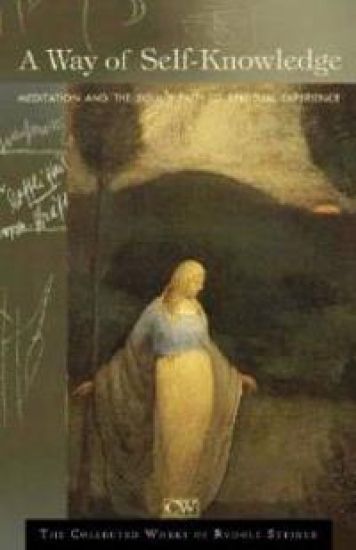
A Way of Self-Knowledge

A Way of Self-Knowledge

Rudolf Steiner

SteinerBooks, Inc
1999
nidottu

Halvin toimitettuna 32,40 €

"I hope that reading this book can become a kind of inner conversation. If this conversation unfolds in such a way that it reveals the hidden inner forces that can be awakened in every soul, then reading this book may lead to genu-ine, inner soul work. As a result you may find yourself gradually impelled to undertake the journey of the soul that truly leads to vision of the spiritual world." --Rudolf Steiner Part one, "A Way of Self-Knowledge": Eight meditations that take the reader on a journey through human experience. Beginning with ordinary experience, Steiner offers ways to imagine and understand the physical body, the elemental (or etheric) body, the elemental world, the Guardian of the Threshold, the astral body, the I-body (or thought body), the nature of experience in suprasensory worlds, and ways of perceiving previous earthly lives. Part two, "The Threshold of the Spiritual World": Sixteen short chapters in which Steiner provides aphoristic thoughts on trusting one's thinking, cognition of the spiritual world, karma and reincarnation, the astral body and luciferic beings, how to recognize suprasensory consciousness, the true nature of love, and more. These two complete books together represent Steiner's most personal statements about his own spiritual path. He speaks directly from experiences of cognitive research and explorations. Each of the meditations and aphorisms arises from his spiritual research and demonstrates how such spiritual research is to be undertaken. The "content" is Steiner's own, but readers can discover their own "content." Steiner's method of awareness--his path of attention to one's own experience--is universal and truly human. A Way of Self-Knowledge is a true sequel and complement to the classic of inner development, How to Know Higher Worlds. It lays out in a way that is accessible to anyone the road to self-knowledge and to the world of spirit. This Collected Works edition contains a new introduction, a chronology of Rudolf Steiner's life, and an index. Front cover image: Meditation by Jennifer Thomson (www.phoenixartsgroup.org) A Way of Self-Knowledge: And the Threshold of the Spiritual World is a translation of Ein Weg zur Selbsterkenntnis des Menschen: In acht Meditationen (GA 16) and Die Schwelle dre geistigen Welt: Aphoristische Ausf hrungen (GA 17).
The Christian Mystery

The Christian Mystery

Rudolf Steiner

SteinerBooks, Inc
1998
nidottu
In this major collection, Rudolf Steiner affirms the reality of esoteric Christianity and unveils many of its secret teachings. His lectures are on the significance of the Mystery of Golgotha and of the Blood that flowed on the Cross; the relationship of Christ and Lucifer (or Love and Knowledge); the various paths of initiation, including the Christian-Gnostic and Rosicrucian Paths; and Steiner's early interpretations of St. John's gospel and the sermon on the mount. All of Steiner's lectures on the Lord's Prayer are also included, as well as the version of the prayer that Steiner himself prayed throughout his life. This is an excellent book for all those who want to deepen their understanding of the Western stream of Christian esotericism and Rudolf Steiner's approach to Christianity as a spiritual practice. C O N T E N T S Introduction by Christopher Bamford 1. PrologueThe Mystical Meaning of the MassThe Significance of Christmas from the Perspective of Spiritual ScienceThe Origin of Religious Confessions and Forms of Prayers 2. The Christian MysteryThe Christian MysteryThe Mystery of GolgothaThe Promise of the Spirit of TruthThe World-historical Significance of the Blood that Flowed on the CrossThe Purification of the Blood from the Passion of Selfhood through the Mystery of Golgotha 3. Lucifer and ChristLucifer, the Bearer of Light; Christ, the Bringer of LoveThe Children of Lucifer: The Step from Love Based on Kinship to Spiritual LoveThe Intellect as a Gift from Lucifer 4. Paths of InitiationThe Three Paths of InitiationThe Yoga Path, Christian Gnostic Initiation, and the Esotericism of the RosicrucianHow Does One Gain Higher Knowledge in the Rosicrucian Sense? Who Are the Rosicrucians? Christian Initiation and Rosicrucian TrainingThe Schools for Adepts of the PastEarlier Initiation and Esoteric ChristianityChristian Gnostic Meditations 5. The Lord's PrayerThe Lord's Prayer as Prayed by Rudolf SteinerThe Lord's Prayer, 1 & 2The Lord's Prayer Considered Esoterically, 1 & 2 6. Gospel ReadingsJohn's GospelJohn's gospel as a Record of Initiation: The First Twelve ChaptersThe Sermon on the Mount 7. EpilogueChristianity Began as a Religion but is Greater than a Religion
Love and Its Meaning in the World

Love and Its Meaning in the World

Rudolf Steiner

SteinerBooks, Inc
1998
pokkari
Selected lectures and writings Although Steiner did not often speak or write about love explicitly, love is at the very heart of his whole body of work and the foundation of his hopes for humankind and the Earth. Steiner teaches that, without love, nothing is possible; with love, however, we can do everything. Love is always "love of the not-yet." To love is to create; it is to selflessly enter the current of time that flows toward us from the future. Reality, true knowledge of reality, is impossible without love. Only through love can we truly know as we are now and encounter the world and its beings in a living way. Without love, knowledge becomes manipulation, domination, control; the world becomes a space of dead things. But, when we know through love, we enter into a pattern of dynamic, potentially redemptive relations and the world becomes a living world of beings working for the good. This collection gathers all of Rudolf Steiner's main lectures and writings related to love. From earthly love to the nature and function of spiritual love, these pieces are essential reading for anyone concerned with the future of humanity and the Earth. Love and Its Meaning in the World is essential reading for anyone who'd like to gain a deeper understanding of our true mission as human beings and the purpose of evolution on Earth. CONTENTS Introduction by Christopher BamfordPrologue: The Mystery of Love 1. The Division of the Sexes2. Lucifer and Christ3. The Mission of Reverence4. Love: The Mission of the Earth--15. Love: The Mission of the Earth--26. Love: The Mission of the Earth--37. The Buddha's Teaching of Compassion and Love8. Faith, Love, and Hope Love & Its Meaning in the World" Epilogue: "I"-Feeling, the Soul's Capacity to Love, and Their Relationship to the Elemental WorldThree Prayers for the Dead
Aspects of Human Evolution

Aspects of Human Evolution

Rudolf Steiner

Rudolf Steiner Press
1998
nidottu
8 lectures, Berlin, May 29-July 24, 1917 (CW 176)How to Keep Your Soul Alive after Twenty-Seven This could have been the title of this book. The author shows that the natural development of the soul stops at around the age of twenty-seven. After that, nothing happens for our inner being unless we learn to make it happen. Part of the tragic nature of our time is that more and more people allow their soul life to die at twenty-seven, so that the remainder of their life becomes a kind of mummification. Steiner explains how, by exerting our thinking and feeling, we can keep our soul alive and growing. This is ultimately the only way we can make this incarnation a satisfactory one. Through such effort, we can continue to develop inwardly until a very advanced age--each year, becoming richer and more interesting than the one before. Aspects of Human Evolutionis a book that gives real meaning to the idea that we live in a state of becoming! This book is a translation from German of Menschliche und menschheitliche Entwicklungswahrheiten. Das Karma des Materialismus (vol. 176 in the Bibliographic Survey).
The Foundation Stone

The Foundation Stone

Rudolf Steiner

Rudolf Steiner Press
1998
nidottu
"The right ground in which we must lay today's Foundation Stone, the proper soil, this is our hearts in their harmonious cooperation, in their love-imbued good will to carry the will of anthroposophy through the world together with one another." --Rudolf SteinerThis volume brings together for the first time two classic booklets: "The Foundation Stone" and "The Life, Nature, and Cultivation of Anthroposophy." The first contains Steiner's comments of "The Foundation Stone Meditation," made during the reestablishment of the Anthroposophical Society at the Christmas Conference of 1923-24. "The Foundation Stone Meditation" is central in the meditative life of many students of spiritual science. Part two, "The Life, Nature, and Cultivation of Anthroposophy," contains letters that Steiner wrote to members of the Anthroposophical Society following the Christmas Conference. They contain thoughts and guidelines regarding the Anthroposophical Society and its members' conduct in the world. An excellent companion to this book is Constitution of the School of Spiritual Science: An Introductory Guide. CONTENTSPart One The Foundation StoneIntroduction by Michael WilsonThe Laying of the foundation Stone of the Anthroposophical SocietyWorking With the MeditationThe Right Entry into the Spiritual WorldThe Original Printed German Version of the VersesAlternative Translations of the Printed VersesPart Two The Life, Nature, and Cultivation of AnthroposophyThe Founding of the General Anthroposophical Society at the Christmas Conference of 1923Letters to the Members