Kirjailija
Rudolf Steiner
Kirjat ja teokset yhdessä paikassa: 1 477 kirjaa, julkaisuja vuosilta 1910–2026, suosituimpiin kuuluu The Cosmic New Year: A Course of Lectures by Rudolf Steiner. Vertaile teosten hintoja ja tarkista saatavuus suomalaisista kirjakaupoista.
1 477 kirjaa
Kirjojen julkaisuvuodet: 1910–2026.
From his clairvoyant reading of the Akashic Record -- the cosmic memory of all events, actions, and thoughts -- Rudolf Steiner was able to speak of aspects of the life of Jesus Christ that are not contained in the four biblical Gospels. Such research can be spoken of as a fifth gospel. After an intense inner struggle to verify the exact nature of these events, and checking the results of his research, Steiner describes many detailed episodes from the Akashic Record. This new edition has been retranslated and features six lectures that have never before been published in English.
11 lectures, various cities, January-May, 1909 (CW 109)These talks reveal a particular aspect of how humankind have been guided spiritually throughout history--by the life forces and astral bodies of the great initiates and avatars that were preserved, duplicated, and interwoven with the leading personalities of history. Steiner gives numerous examples of this process, but he says that such inspired people are rare today. Nevertheless, we have the possibility of elevating ourselves in the future to the point where we can receive into ourselves the "I-being" of the Christ, which is indeed our greatest goal--"not I but Christ in me." Contents: * The Principle of Spiritual Economy in Connection with Questions of Reincarnation * Christianity in Human Evolution, Leading Individualities, and Avatar Beings * More Intimate Aspects of Reincarnation * Results of Spiritual Scientific Investigations of the Evolution of Humanity * On the Occasion of the Dedication of the Francis of Assisi Branch * The Macrocosmic and Microcosmic Fire: The Spiritualization of Breath and Blood * The Event of Golgotha -- The Brotherhood of the Holy Grail * Ancient Revelations and Learning: How to Ask Modern Questions * The God of the Alpha and the God of the Omega * From Buddha to Christ
This volume contains Rudolf Steiner"s leadin g thoughts and letters written for the Anthroposophical Soci ety. In brief paragraphs they succinctly present Steiner"s s cience of the spirit '
2 lectures, Basel, Jan. 11 and Oct. 15, 1916 (CW 35)These lectures offer an excellent introduction to some of the leading themes of Anthroposophy. Steiner carefully corrects certain misunderstandings that arose regarding his spiritual-scientific research, showing how Anthroposophy has nothing to do with mysticism or spiritualism. Nor is it merely a revival of ancient esoteric teachings. Rather, Anthroposophy is a truly modern spiritual teaching for Western humanity, building on the achievements of science and developing an exact methodology for developing the investigation of spiritual realities by awakening higher organs of perception.
Religious and spiritual writings have always made reference to beings from the spiritual hierarchies, especially those known in Christian tradition as Angels. These spirits are the closest to human beings and act as our invisible guides and companions. They influence the life of the individual as well as the evolution of humanity and the cosmos. From his own clairvoyant vision, Rudolf Steiner confirmed the existence of such spiritual beings and showed how modern minds could gain access to their world. As he explains in these inspiring lectures, it is important for us to understand and cooperate with the work of the Angels today as this is crucial for the further development of humanity.
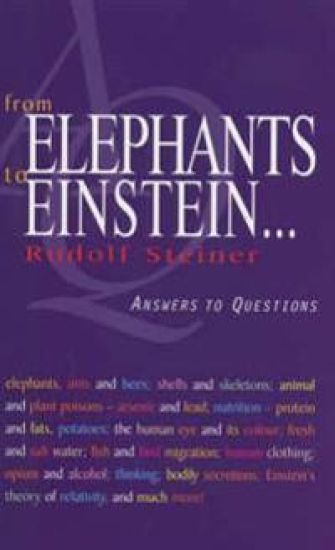
In this collection, Rudolf Steiner deals wit h topics ranging from elephants to Einstein. He discusses, a mong other things, ants and bees, shells and skeletons, anim al and plant poisons, nutrition, the human eye and its colou r, and thinking '
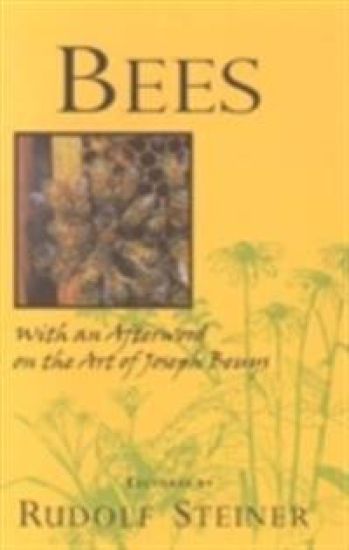
8 Lectures in Dornach, Nov 26, 1923 to Dec 22, 1923 (CW 351)In 1923 Rudolf Steiner predicted the dire state of today's honeybee. He stated that, within fifty to eighty years, we would see the consequences of mechanizing the forces that had previously operated organically in the beehive. Such practices include breeding queen bees artificially. The fact that over sixty percent of the American honeybee population has died during the past ten years, and that this trend is continuing around the world, should make us aware of the importance of the issues discussed in these lectures. Steiner began this series of lectures on bees in response to a question from an audience of workers at the Goetheanum. From physical depictions of the daily activities of bees to the most elevated esoteric insights, these lectures describe the unconscious wisdom of the beehive and its connection to our experience of health, culture, and the cosmos. Bees is essential reading for anyone interested in understanding the true nature of the honeybee, as well as those who wish to heal the contemporary crisis of the beehive. Bees includes an essay by David Adams, "From Queen Bee to Social Sculpture: The Artistic Alchemy of Joseph Beuys." The art and social philosophy of Joseph Beuys (1921-1986) is among the most influential of the twentieth century. He was strongly influenced by Rudolf Steiner's lectures on bees. The elemental imagery and its relationship to human society played an important role in Beuys's sculptures, drawings, installations, and performance art. Adams' essay on Beuys adds a whole new dimension to these lectures, generally considered to be directed more specifically to biodynamic methods and beekeeping. Read Bobby Matherne's review of this book
Rudolf Steiner schildert in seinen Vorträgen über die praktische Ausbildung des Denkens eine Reihe von konkreten Übungen, die das Denken immer tiefer ins Herz der Wirklichkeit führen.
5 lectures, Bern, April 13-17, 1924 (CW 309) These lectures on Waldorf education were given as a course during Easter week, 1924, in Bern. Although these talks were given more than eighty years ago, they remain remarkably contemporary. Every word still resonates with passion and dedication to the human adventure. "We must develop an art of education that can lead us out of the social chaos into which we have fallen during the last few years and decades.... There is no escaping this chaos unless we can find a way to bring spirituality into human souls through education, so that human beings may find a way to progress and to further the evolution of civilization out of the spirit itself." --Rudolf Steiner At the time of these lectures, Steiner had only eleven months left to live in this world. The first Waldorf school had been established five years earlier, and the intervening period witnessed Steiner's tireless activity in every area of that school's life. Now it was, in a sense, time to bring the ripe fruit of this work to the public. Together with its companion course The Essentials of Education, presented three days earlier, this book provides a stimulating synthesis of the Waldorf approach to education. Teachers, parents, and anyone interested in education will discover the fundamental characteristics of a new art of education. The lectures: Lecture 1: A new education requires a new knowledge of the whole human being in body, soul, and spirit. The change of teeth signals the end of the first stage of childhood. Soul and spirit descend into a body provided by inheritance, which is used as the model for the "second" human being. During the first stage the child is a sense organ that perceives moral influences. The influence of the teacher's temperament. Lecture 2: The goal of Waldorf education is to reveal new methods of teaching. The power of spiritual perception for understanding children and adults. Sleeping and waking. The seasons reflected in the human being. Thinking as an etheric "grasping." Materialistic ideas and insomnia. Psychic influences and physical effects. Lecture 3. Memory before and after the change of teeth. The physical and etheric bodies. The etheric body and sculpting. The astral body and music. The I-being and speech. The musical scale and the human body. The teacher as therapist. Doctors and the school. Teaching letters. Lecture 4. The sense organization and moral development at the change of teeth. Mathematics begins with the whole. The child's natural religious impulse. The need for images after seven. The need to feel a connection with destiny after fourteen. The child's relationship with the world. Lecture 5. The three divisions of the middle stage of childhood. Nature and history. Children after puberty go into life. The experience of immortality. Punishment. Reading the child. The need for a living experience of one another today. Moon and Sun forces in the plant world. Spiritual science reveals the unity of the human being with the world. These lectures are contained in the German Anthroposophische P dagogik und ihre Voraussetzungen (GA 309), published by Rudolf Steiner Verlag, Dornach, Switzerland.
5 lectures, Stuttgart, April 8-11, 1924 (CW 308) These talks were given during an educational conference in 1924. They are the last public lectures given by Rudolf Steiner in Germany. According to one member of his audience, "Seventeen hundred people listened to him; the prolonged applause from this great crowd at the end of every lecture was deeply moving, while at the end of the last lecture the applause became an ovation that seemed as if it would never end." This kind of adoration was the result not only of who Steiner was as an individual but of what he accomplished as well. People had already begun to realize the potential and the promise for the future that Waldorf education held out to the children of the world. The Essentials of Education, together with its companion book, The Roots of Education, present a remarkable synthesis of what Waldorf education is and what it can become. The Waldorf "experiment" had matured for five years since 1919, when Steiner helped to establish the first Waldorf school. He had guided that school from its beginning, observing very closely all that happened. As a result, he was able to distill and present the essentials of Waldorf education with elegance as well as with the urgency he felt for the coming times. German source: Die Methodik des Lehrens und die Lebensbedingungen des Erziehens (GA 308).
An Outline of Esoteric Science
Rudolf Steiner
SteinerBooks, Inc
1997
nidottu
Halvin toimitettuna 22,90 €
Written in 1909 (CW 13)"Esoteric science is the science of what takes place esoterically, in the sense that it is perceived not outside in nature but where one's soul turns when it directs its inner being toward the spirit. Esoteric science is the opposite and counterpart of natural science." --Rudolf SteinerThis masterwork of esotericism places humankind at the very heart of the vast, invisible processes of cosmic evolution. When we use the term "natural science," don't we mean that we are dealing with human knowledge of nature? Steiner worked and reworked his Rosicrucian cosmology to make it increasingly precise and accurate. An Outline of Esoteric Science is as vital and relevant now as it was when first published in 1910 and remains the most comprehensive and effective presentation of a spiritual alternative to contemporary, materialistic cosmologies and a strict Darwinian view of human nature and evolution. In this foundational work of spiritual science, we see how the creation and evolution of humanity is embedded at the heart of the vast, invisible web of interacting cosmic beings, through whom the alchemical processes of cosmic evolution continue to evolve. Included are descriptions of the physical-spiritual makeup of the human being; the relationships of the different "bodies" of the human being to sleep and death; and a detailed, practical guide to methods and exercises, including the "Rose Cross Meditation," through which we can attain knowledge of the spiritual worlds. The most remarkable and revolutionary aspect of this work is the central function that Steiner attributes to the Christ and his involvement in human and earthly evolution through the Mystery of Golgotha. Contents: Introduction by Clopper Almon Preface by Rudolf Steiner The Character of Esoteric Science The Makeup of the Human Being Sleep and Death Cosmic Evolution and the Human Being Knowledge of Higher Worlds--Initiation Cosmic and Human Evolution--Now and in the Future Details from the Field of Spiritual Science Appendix: Rudolf Steiner's Early Introductions Further Reading This is essential reading for all serious students of esoteric spirituality. Previous translations: An Outline of Occult Science and Occult Science: An Outline. An Outline of Esoteric Science is a translation of Die Geheimwissenschaft im Umriss (GA 13).
These dazzling, radical lectures were given one month before the opening of the first Waldorf School--following two years of intense preoccupation with the social situation in Germany as World War I ended and society sought to rebuild itself. Well aware of the dangerous tendencies present in modern culture that undermine a true social life--such as psychic torpor and boredom, universal mechanization, and a growing cynicism--Steiner recognized that any solution must address not only economic and legal issues but also that of a free spiritual life. Steiner also saw the need to properly nurture in children the virtues of imitation, reverence, and love at the appropriate stages of development in order to create mature adults who are inwardly prepared to fulfill the demands of a truly healthy society--adults who are able to assume the responsibilities of freedom, equality, and brotherhood. Relating these themes to an understanding of the human as a threefold being of thought, feeling, and volition, and against the background of historical forces at work in human consciousness, Steiner lays the ground for a profound revolution in the ways we think about education. Also included here are three lectures on the social basis of education, a lecture to public school teachers, and a lecture to the workers of the Waldorf Astoria Cigarette Company, after which they asked him to form a school for their children. German sources: Die Erziehungsfrage als soziale Frage (GA 296); lectures 4, 5, and 6, the "Volksp dagogik" lectures in Geisteswissenschaftliche Behandlung sozialer und p dagogischer Fragen (GA 192); lectures 2 and 11, Neugestaltung des sozialen Organismus (GA 330-331).
15 discussions with teachers of the Stuttgart Waldorf School, Aug. 21 - Sept. 6, 19193 lectures on the curriculum, Sept. 6, 1919 (CW 295) "In spiritual science we divide the human being into 'I'-being, astral body, etheric body, and physical body. In an ideal human being, the harmony predestined by the cosmic plan would naturally predominate among these four human principles. But in reality, this is not so with any individual. Thus, it can be seen that the human being, when given over to the physical plane, is not yet really complete; education and teaching, however, should serve to make the human being complete. One of the four elements rules in each child, and education and teaching must harmonize these four principles" (Rudolf Steiner). For two weeks, prior to the opening of the first Waldorf school in Stuttgart, Rudolf Steiner intensively prepared the individuals he had chosen to become the first Waldorf teachers. At 9:00 a.m. each day, he gave the course now translated as Foundations of Human Experience; at 11:00 a.m., Practical Advice to Teachers; and then, after lunch, from 3:00 p.m. to 6:00 p.m., he held the informal "discussions" published in this book. The tone is spontaneous and relaxed. Steiner does not prescribe specific methods but introduces topics and situations, offering guidelines and allocating practical assignments that are taken up and discussed in the next session. The discussions are filled with insights and suggestions in many different areas of teaching--history, geography, botany, zoology, form drawing, mathematics, and more. Speech exercises are included. This edition also includes, for the first time in English, three important lectures on the curriculum, given the day just before the school opened. These fifteen discussions constitute an essential part of the basic training material for Waldorf teachers. Discussions with Teachers is a translation from German of Erziehungskunst. Seminarbesprechungen und Lehrplanvortr ge (vol. 295 in the Bibliographical Survey, published by Rudolf Steiner Verlag, Dornach, Switzerland, 1961).

10 lectures in various cities, February 3-March 29, 1913 (CW 145)On February 3, 1913, the first General Meeting of the newly formed Anthroposophical Society was convened in Berlin. Six weeks later, in Holland, Rudolf Steiner spoke for the first time to an anthroposophic audience in a detailed, intimate way about individual esoteric training and the subtle effects of spiritual development on every level of one's being. Beginning with questions regarding the body's experience of food and drink--meat, coffee, alcohol, and so on--he lays out the progression of anthroposophic spiritual inner work, up to direct perception of "Paradise" and the Holy Grail. He discusses the role of human beings in our evolution that takes place between the forces of Lucifer and Ahriman. Included is Steiner's important lecture "The Being of Anthroposophy," which this volume introduces to the English-speaking world. This edition also includes Steiner's "introductory words," previously available only as an unpublished German typescript. The Effects of Esoteric Development is a translation from the German of Welche Bedeutung hat die okkulte Entwicklung des Menschen f r seine H llen--physischen Leib, therleib, Astralleib--und sein Selbst? (GA 145).
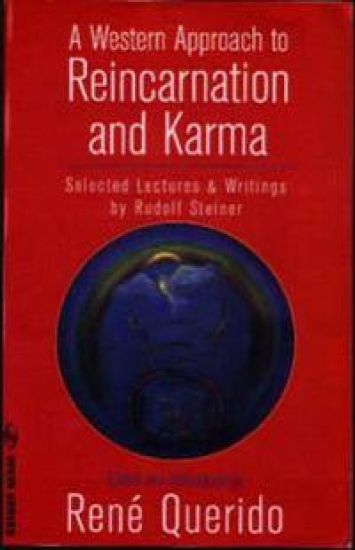
The soul's immortality and its repeated earthly births are not new ideas in Western thought. They are implicit in the Pythagorean and Platonic traditions, as well as in some branches of esoteric Judaism and Cabbala. But it was not until the early years of this century that the West was given a detailed, modern, evolutionary philosophy of human life based on the reality of reincarnation and karma. This turning point occurred when Rudolf Steiner began to make public the results of his spiritual scientific researches. He viewed the revelation of reincarnation and karma as one of his most important life tasks. Steiner's contribution, however, remains unique in its understanding of the human being as an evolving, developing being of body, soul, and spirit. On the basis of his researches--presented in numerous books and lectures--we begin to understand how the complex interaction of human lives between birth and death and between death and a new birth gives new meaning not only to individual lives lived on Earth in community with others, but also to human history and evolution and to earthly and cosmic events. This book collects many of Steiner's major statements on reincarnation and karma. The primary purpose of this volume is to help readers meet the challenge of spiritual research in the area of individual evolution of the soul and spirit in the context of cultural and universal evolution. Such a study can be tremendously revealing and provide spiritual understanding in a time of increasing intellectual confusion and spiritual poverty. The notion of reincarnation and karma is generally associated in most minds with spiritual traditions of the East, especially Hinduism and Buddhism. Ren Querido's in-depth, sixty-page introduction, however, places these concepts within the context of Western spiritual development and esoteric tradition, showing us a panoramic view of how such ideas have developed over the centuries in the West. Contents: Introduction by Ren Querido: 1 Our Present Dilemma 2 Historical Survey of Reincarnation and Karma 3 Rudolf Steiner's Original Contributions The lectures: 1 Natural and Chance Illnesses in the Human Being 2 Elemental Events, Volcanic Eruptions, Earthquakes & Epidemics in Relation to Karma 3 Death and Rebirth in Relation to Karma 4 Knowledge of Reincarnation and Karma 5 Examples of Karma Working between Two Incarnations 6 Vital Questions in the Light of Reincarnation and Karma 7 The Formation of Karmic Forces 8 Reincarnation of the Spirit and Destiny