Kirjojen hintavertailu – 12 903 725 kirjaa ja 27 kauppaa

Kirjailija

Charles River

Kirjat ja teokset yhdessä paikassa: 4 673 kirjaa, julkaisuja vuosilta 2013–2022, suosituimpiin kuuluu William Powell and Myrna Loy: The Lives and Careers of One of Classical Hollywood's Most Iconic Duos. Vertaile teosten hintoja ja tarkista saatavuus suomalaisista kirjakaupoista.

4 673 kirjaa

Kirjojen julkaisuvuodet: 2013–2022.

The Battle of Shanghai: The History and Legacy of the Battle that Started the Second Sino-Japanese War
*Includes pictures*Includes a bibliography for further readingOn October 29, 1937, a large crowd of people gathered on the bank of the Wusong River in Shanghai to watch a spectacle, a life and death struggle unfolding directly in front of them across the river. The crowd was a curious blend of Chinese, European, and American civilians and journalists. Their focus was on the Sihang Warehouse across the river, but it wasn't the warehouse itself that fascinated the onlookers. Instead, it was the men inside the warehouse, the men of the 524th Regiment, the 88th Division of the Chinese Nationalist Army. The soldiers were elite, and they were widely considered the best of the Nationalist Army. They proudly called themselves "the Generalissimo's Own," after Jiang Jieshi, the generalissimo of the Nationalist government and leader of China. The Chinese soldiers were prepared to fight and die to the last man, and they were making their last stand there. By then, the city of Shanghai was in shambles. The Imperial Japanese Military had invaded Shanghai on August 13, 1937, rapidly reducing the once-prosperous city to a pile of burning rubble after three months of brutal urban combat. Countless blazing fires raged throughout the city, some of which had been caused by the fighting, but most had been set by the retreating Chinese Army in a futile effort to stall the Japanese invaders. The Chinese Nationalist Army had fought valiantly against the Japanese, but the Chinese were hopelessly outgunned. Possessing few heavy weapons, aircraft, and artillery, the Nationalist Army could not hope to defeat the Japanese, who possessed superior firepower in every engagement against the Chinese troops. Causality rates for the Nationalist Army were horrific, with some units being completely wiped out in the fighting. Many Nationalist Army units would be completely annihilated in the three months of house-to-house fighting. As spectators watched from across the river, a barrage of Japanese artillery slammed the warehouse, creating enormous craters on the walls and sending shockwaves throughout the building. The Sihang Warehouse was six stories tall and made from thick concrete, making it the ideal building to defend against an enemy with superior firepower, but the Chinese soldiers could only hope to hold out for so long. The bulk of their army had already retreated, leaving the 524th the only Chinese unit left in the city. Rubble and the smell of cordite filled the air around the warehouse as the Japanese pressed their attack. Light tanks supported waves of infantry as the might of Imperial Japan focused its rage against a single Chinese warehouse. People watched nervously from across the river as the Japanese soldiers advanced. Some bystanders put up large signs bearing Chinese characters large enough to be seen across the river like some bizarre sporting event. They were mean to warn the soldiers in the warehouse of any approaching Japanese attacks. There were whispers among the people watching that the soldiers in the warehouse were called "The Lost Battalion." The Western newspapers had dubbed the battle for the warehouse the Chinese Alamo. The Battle of Shanghai was a brutal testament to a new era of modern warfare which, according to many historians, signified the beginning of the Second Sino-Japanese War, and hence World War II. Despite the stand, China was a nation broken into petty warlord fiefdoms and wracked by civil war between Nationalist and Communist forces. This civil war became inextricably intertwined with the Second Sino-Japanese War and World War II, and the sheer scale of the horrors of the conflict remain hard to believe today, even as action in that theater is often overlooked because of events in Europe. Indeed, the Japanese launched a brutal campaign across the fragmented realms that made up China, committing atrocities just as horrendous as their Axis ally in Europe.
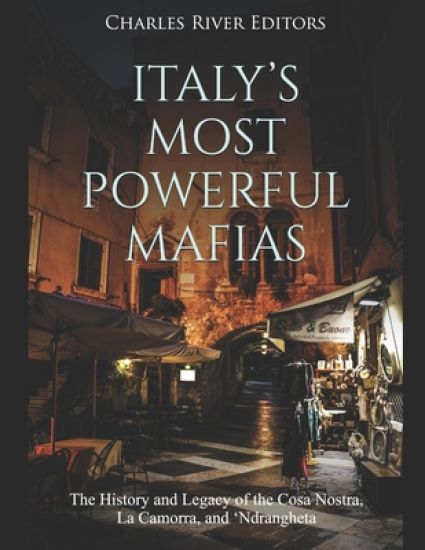
Italy's Most Powerful Mafias: The History and Legacy of the Cosa Nostra, La Camorra, and 'Ndrangheta

Italy's Most Powerful Mafias: The History and Legacy of the Cosa Nostra, La Camorra, and 'Ndrangheta

Charles River

Independently Published
2019
nidottu

Halvin toimitettuna 23,20 €

*Includes pictures*Includes a bibliography for further readingThe word "mafia," Sicilian in origin, is synonymous with Italy, but Italy is home to several different mafias, with three being particularly notorious. While the Cosa Nostra of western Sicily is the most infamous, other powerful groups include the ferocious 'Ndrangheta of Calabria and the Camorra, the third-largest mafia, which is active in Naples and the Campania region. A "mafia" is loosely defined as a criminal organization that is interested in social, economic and political power, combining elements of a traditional secret society with those of a business, but further levels of nuance are necessary in order to understand these groups. In a general sense, this is because each mafia creates a myth about the development of the organization, which becomes like an unquestionable truth. In essence, part of what makes its members so completely loyal to it is also what makes outsiders so utterly afraid of it. Over the course of the 19th century, the people of Sicily found themselves at the center of a struggle for freedom, one that ended up being long and often very bloody. It was during these crucial years of struggle that the Sicilian mafia, La cosa nostra ("Our thing"), started to take shape. The original word "mafia" was a part of Palermitan slang, and although the origins of the word are not completely certain, some linguistic historians believe it originally meant "flashy." One historian of the mafia, Salvatore Lupo, helpfully suggests that it was used in its earliest iterations to vaguely refer to a "pathological relationship among politics, society and criminality." In the particular case of the Camorra, the difficulty of understanding an underground criminal association is made all the more intense because it is so heterogeneous in terms of its development, its different functions, and the diversity of economic sectors in which it operates. To reflect that diversity, some scholars like to refer to it as Camorre, the plural version of Camorra. This decision is more than just a question of semantics, because using the plural form helps emphasize the internal differences and conflicts within the Neapolitan mafia, which, in turn, helps explain the very nature of the organization itself. The Neapolitan mafia is famous for its pervasive nature, which is due to the fact that it is organized in a horizontal, decentralized way. This means there is not one single "boss" who dictates policy and can be more strategic in how and when violence is deployed. Unlike other mafias, in the Camorra there has been no long-term reigning family, nor extensive coordination between families to form an alliance and function as a unified mafia for their shared benefit. The 'Ndrangheta (pronounced an-drang-et-ah) is a close neighbor of the Cosa Nostra and currently considered the most powerful (and difficult to spell) criminal organization in Italy. The 'Ndrangheta is centered around Calabria, the most southwestern region of Italy, almost touching the Sicilian city of Messina. Though it began as far back as the late 19th century, it was not until the 1950s that the 'Ndrangheta started to spread its tentacles throughout Italy and then across the entire globe, forming an empire that now ranges from Australia and Turkey to Chile to Canada. The fact that the 'Ndrangheta is overshadowed by the Sicilian Cosa Nostra, as well as by the Neapolitan mafia, the Camorra, allowed it to grow and develop outside of the public eye. For years, people actually considered the Calabrian mafia to be part of the Cosa Nostra as a mere appendage, rather than its own entity. This false belief was perpetuated by the high-profile Sicilian pentito, Tommaso Buscetta, and it was not until the beginning of the 21st century that the 'Ndrangheta came into the public eye due to two dramatic killings, the assassination of a politician and the "Duisburg massacre."
Italy's Most Powerful Mafias: The History and Legacy of the Cosa Nostra, La Camorra, and 'Ndrangheta

Italy's Most Powerful Mafias: The History and Legacy of the Cosa Nostra, La Camorra, and 'Ndrangheta

Charles River

Independently Published
2019
nidottu

Halvin toimitettuna 22,40 €

*Includes pictures*Includes a bibliography for further readingThe word "mafia," Sicilian in origin, is synonymous with Italy, but Italy is home to several different mafias, with three being particularly notorious. While the Cosa Nostra of western Sicily is the most infamous, other powerful groups include the ferocious 'Ndrangheta of Calabria and the Camorra, the third-largest mafia, which is active in Naples and the Campania region. A "mafia" is loosely defined as a criminal organization that is interested in social, economic and political power, combining elements of a traditional secret society with those of a business, but further levels of nuance are necessary in order to understand these groups. In a general sense, this is because each mafia creates a myth about the development of the organization, which becomes like an unquestionable truth. In essence, part of what makes its members so completely loyal to it is also what makes outsiders so utterly afraid of it. Over the course of the 19th century, the people of Sicily found themselves at the center of a struggle for freedom, one that ended up being long and often very bloody. It was during these crucial years of struggle that the Sicilian mafia, La cosa nostra ("Our thing"), started to take shape. The original word "mafia" was a part of Palermitan slang, and although the origins of the word are not completely certain, some linguistic historians believe it originally meant "flashy." One historian of the mafia, Salvatore Lupo, helpfully suggests that it was used in its earliest iterations to vaguely refer to a "pathological relationship among politics, society and criminality." In the particular case of the Camorra, the difficulty of understanding an underground criminal association is made all the more intense because it is so heterogeneous in terms of its development, its different functions, and the diversity of economic sectors in which it operates. To reflect that diversity, some scholars like to refer to it as Camorre, the plural version of Camorra. This decision is more than just a question of semantics, because using the plural form helps emphasize the internal differences and conflicts within the Neapolitan mafia, which, in turn, helps explain the very nature of the organization itself. The Neapolitan mafia is famous for its pervasive nature, which is due to the fact that it is organized in a horizontal, decentralized way. This means there is not one single "boss" who dictates policy and can be more strategic in how and when violence is deployed. Unlike other mafias, in the Camorra there has been no long-term reigning family, nor extensive coordination between families to form an alliance and function as a unified mafia for their shared benefit. The 'Ndrangheta (pronounced an-drang-et-ah) is a close neighbor of the Cosa Nostra and currently considered the most powerful (and difficult to spell) criminal organization in Italy. The 'Ndrangheta is centered around Calabria, the most southwestern region of Italy, almost touching the Sicilian city of Messina. Though it began as far back as the late 19th century, it was not until the 1950s that the 'Ndrangheta started to spread its tentacles throughout Italy and then across the entire globe, forming an empire that now ranges from Australia and Turkey to Chile to Canada. The fact that the 'Ndrangheta is overshadowed by the Sicilian Cosa Nostra, as well as by the Neapolitan mafia, the Camorra, allowed it to grow and develop outside of the public eye. For years, people actually considered the Calabrian mafia to be part of the Cosa Nostra as a mere appendage, rather than its own entity. This false belief was perpetuated by the high-profile Sicilian pentito, Tommaso Buscetta, and it was not until the beginning of the 21st century that the 'Ndrangheta came into the public eye due to two dramatic killings, the assassination of a politician and the "Duisburg massacre."
Los hicsos: La historia de los invasores extranjeros que conquistaron el Antiguo Egipto y establecieron la dinastía XV
Desde aproximadamente el a o 3100 AEC hasta alrededor del 1075 AEC, el antiguo Egipto fue gobernado por veinte dinast as diferentes. La duraci n de las dinast as vari algunas, como aquellas durante el Primer y Segundo per odos intermedios fueron bastante cortas, mientras que las dinast as XIII y XVIII contuvieron cada una m s de una docena de reyes, y gobernaron sobre el valle del Nilo durante doscientos a os cada una, aproximadamente. Si bien las primeras veinte dinast as egipcias variaron en n mero de gobernantes y duraci n, la mayor a compart a un atributo importante: eran todas dinast as nativas de Egipto. La nica excepci n importante vino durante el Segundo Periodo Intermedio, cuando un misterioso grupo de extranjeros, conocidos como los hicsos, conquistaron Egipto y establecieron las dinast as XV y XVI poco tiempo despu s del 1700 AEC. Durante siglos, el gobierno de los hicsos sobre Egipto fue un enigma envuelto en mitos y medias verdades. Los hicsos fueron algunas veces asociados err neamente con los israelitas b blicos, pero fueron mayormente olvidados en tiempos modernos debido a la escasez de textos escritos que puedan ser datados a su periodo de dominio. Fue solo a mediados del siglo XX que los egipt logos, utilizando textos reci n descubiertos y traducidos, arrojaron nueva luz sobre los hicsos para revelar detalles acerca de su origen y gobierno sobre Egipto. Una investigaci n revela que, si bien los hicsos fueron inicialmente extranjeros para Egipto, probablemente no vinieron de muy lejos, y una vez que se establecieron como gobernantes, tuvo lugar cierto grado de aculturaci n, hasta que los gobernantes extranjeros se hicieron gradualmente cada vez m s egipcios. Los hicsos finalmente fueron expulsados del valle del Nilo por los nativos egipcios, pero su influencia continu resonando en Egipto durante siglos. Por ejemplo, los egipcios adaptaron algunas de las t cnicas b licas exitosas que hab an aprendido de los hicsos, para poder establecer su imperio del Nuevo Reino en la dinast a XVIII. M s adelante, los hicsos resultar an ser un buen contraste u "hombre del saco" para la literatura egipcia en el Nuevo Reino y Periodo Tard o. Verdaderamente, puede que los hicsos no hayan gobernado Egipto durante un largo periodo, pero su r gimen dej una contundente impresi n en la sociedad egipcia durante siglos. Los hicsos: La historia de los invasores extranjeros que conquistaron el Antiguo Egipto y establecieron la dinast a XV examina la controvertida y misteriosa historia del grupo que conquist Egipto y estableci una nueva dinast a a mediados del segundo milenio antes de la Era Com n. En conjunto con fotograf as de personas, lugares y eventos importantes, aprender sobre los hicsos como nunca antes.
Los hicsos: La historia de los invasores extranjeros que conquistaron el Antiguo Egipto y establecieron la dinastía XV
Desde aproximadamente el a o 3100 AEC hasta alrededor del 1075 AEC, el antiguo Egipto fue gobernado por veinte dinast as diferentes. La duraci n de las dinast as vari algunas, como aquellas durante el Primer y Segundo per odos intermedios fueron bastante cortas, mientras que las dinast as XIII y XVIII contuvieron cada una m s de una docena de reyes, y gobernaron sobre el valle del Nilo durante doscientos a os cada una, aproximadamente. Si bien las primeras veinte dinast as egipcias variaron en n mero de gobernantes y duraci n, la mayor a compart a un atributo importante: eran todas dinast as nativas de Egipto. La nica excepci n importante vino durante el Segundo Periodo Intermedio, cuando un misterioso grupo de extranjeros, conocidos como los hicsos, conquistaron Egipto y establecieron las dinast as XV y XVI poco tiempo despu s del 1700 AEC. Durante siglos, el gobierno de los hicsos sobre Egipto fue un enigma envuelto en mitos y medias verdades. Los hicsos fueron algunas veces asociados err neamente con los israelitas b blicos, pero fueron mayormente olvidados en tiempos modernos debido a la escasez de textos escritos que puedan ser datados a su periodo de dominio. Fue solo a mediados del siglo XX que los egipt logos, utilizando textos reci n descubiertos y traducidos, arrojaron nueva luz sobre los hicsos para revelar detalles acerca de su origen y gobierno sobre Egipto. Una investigaci n revela que, si bien los hicsos fueron inicialmente extranjeros para Egipto, probablemente no vinieron de muy lejos, y una vez que se establecieron como gobernantes, tuvo lugar cierto grado de aculturaci n, hasta que los gobernantes extranjeros se hicieron gradualmente cada vez m s egipcios. Los hicsos finalmente fueron expulsados del valle del Nilo por los nativos egipcios, pero su influencia continu resonando en Egipto durante siglos. Por ejemplo, los egipcios adaptaron algunas de las t cnicas b licas exitosas que hab an aprendido de los hicsos, para poder establecer su imperio del Nuevo Reino en la dinast a XVIII. M s adelante, los hicsos resultar an ser un buen contraste u "hombre del saco" para la literatura egipcia en el Nuevo Reino y Periodo Tard o. Verdaderamente, puede que los hicsos no hayan gobernado Egipto durante un largo periodo, pero su r gimen dej una contundente impresi n en la sociedad egipcia durante siglos. Los hicsos: La historia de los invasores extranjeros que conquistaron el Antiguo Egipto y establecieron la dinast a XV examina la controvertida y misteriosa historia del grupo que conquist Egipto y estableci una nueva dinast a a mediados del segundo milenio antes de la Era Com n. En conjunto con fotograf as de personas, lugares y eventos importantes, aprender sobre los hicsos como nunca antes.
Los invasores extranjeros del antiguo Egipto: la historia de los hicsos, los pueblos del mar, los nubios, los babilonios y los asirios
Desde aproximadamente el a o 3100 AEC hasta alrededor del 1075 AEC, el antiguo Egipto fue gobernado por veinte dinast as diferentes. La duraci n de las dinast as vari algunas, como aquellas durante el Primer y Segundo per odos intermedios fueron bastante cortas, mientras que las dinast as XIII y XVIII contuvieron cada una m s de una docena de reyes, y gobernaron sobre el valle del Nilo durante doscientos a os cada una, aproximadamente. Si bien las primeras veinte dinast as egipcias variaron en n mero de gobernantes y duraci n, la mayor a compart a un atributo importante: eran todas dinast as nativas de Egipto. La nica excepci n importante vino durante el Segundo Periodo Intermedio, cuando un misterioso grupo de extranjeros, conocidos como los hicsos, conquistaron Egipto y establecieron las dinast as XV y XVI poco tiempo despu s del 1700 AEC. Durante siglos, el gobierno de los hicsos sobre Egipto fue un enigma envuelto en mitos y medias verdades. Los hicsos fueron algunas veces asociados err neamente con los israelitas b blicos, pero fueron mayormente olvidados en tiempos modernos debido a la escasez de textos escritos que puedan ser datados a su periodo de dominio. Fue solo a mediados del siglo XX que los egipt logos, utilizando textos reci n descubiertos y traducidos, arrojaron nueva luz sobre los hicsos para revelar detalles acerca de su origen y gobierno sobre Egipto. En el centro de este periodo de agitaci n hab a un grupo de personas conocido hoy como los Pueblos del Mar, la traducci n al espa ol del nombre que les dieron los egipcios. No obstante, a pesar de su papel prominente en la historia, los Pueblos del Mar siguen siendo tan misteriosos como fueron influyentes; aunque los egipcios documentaron su presencia y las guerras contra ellos, nunca ha estado claro d nde exactamente se originaron los Pueblos del Mar, o qu los movi a invadir varias partes de la regi n en n meros masivos. Durante los varios siglos en que el antiguo Egipto se irgui como una de las m s grandes civilizaciones, si no la m s grande, del mundo antiguo, los conflictos con sus enemigos jugaban a menudo un rol central en textos jerogl ficos y arte de los templos y tumbas. Los tres principales enemigos de los egipcios eran los libios que ocupaban el desierto occidental y sus oasis, los llamados asi ticos que viv an en el Levante, y finalmente los nubios al sur de Egipto. Entre los tres pueblos, los nubios eran los m s "egipcianizados" y, en momentos, fueron integrales para el desarrollo de la historia egipcia. Verdaderamente, los nubios fueron el m s grande de todos los pueblos subsaharianos en tiempos premodernos y merecen ser estudiados por derecho propio, aparte de la historia antigua egipcia. Un examen en profundidad de los antiguos nubios revela que, si bien estaban estrechamente relacionados de muchas formas a los egipcios, produjeron una cultura que ten a muchos atributos propios nicos y estaba mucho m s avanzada que cualquier otra cultura en el frica subsahariana. Aunque los antiguos nubios han recibido menos atenci n que los egipcios y, por ende, no son tan bien conocidos para el p blico en general, fueron verdaderamente un pueblo destacable que dej un legado cultural que ha resistido el paso del tiempo. Por supuesto, el gran lapso de historia entre Babilonia en su punto m ximo de poder y nuestra poca ha generado muchas preguntas hist ricas y controversia. Una de las cosas con las que la gente relaciona m s estrechamente a Babilonia son los Jardines Colgantes, que, como la Gran Pir mide de Giza, se consideraron una maravilla tecnol gica y una obra maestra est tica. Los historiadores antiguos cre an que los Jardines Colgantes se hab an construido alrededor del siglo VII AC despu s del segundo auge de Babilonia, lo que los convertir a en la segunda maravilla m s antigua de las Siete Maravillas del Mundo Antiguo, y fueron creados por el b blico Nabucodonosor II.
Los invasores extranjeros del antiguo Egipto: la historia de los hicsos, los pueblos del mar, los nubios, los babilonios y los asirios
Desde aproximadamente el a o 3100 AEC hasta alrededor del 1075 AEC, el antiguo Egipto fue gobernado por veinte dinast as diferentes. La duraci n de las dinast as vari algunas, como aquellas durante el Primer y Segundo per odos intermedios fueron bastante cortas, mientras que las dinast as XIII y XVIII contuvieron cada una m s de una docena de reyes, y gobernaron sobre el valle del Nilo durante doscientos a os cada una, aproximadamente. Si bien las primeras veinte dinast as egipcias variaron en n mero de gobernantes y duraci n, la mayor a compart a un atributo importante: eran todas dinast as nativas de Egipto. La nica excepci n importante vino durante el Segundo Periodo Intermedio, cuando un misterioso grupo de extranjeros, conocidos como los hicsos, conquistaron Egipto y establecieron las dinast as XV y XVI poco tiempo despu s del 1700 AEC. Durante siglos, el gobierno de los hicsos sobre Egipto fue un enigma envuelto en mitos y medias verdades. Los hicsos fueron algunas veces asociados err neamente con los israelitas b blicos, pero fueron mayormente olvidados en tiempos modernos debido a la escasez de textos escritos que puedan ser datados a su periodo de dominio. Fue solo a mediados del siglo XX que los egipt logos, utilizando textos reci n descubiertos y traducidos, arrojaron nueva luz sobre los hicsos para revelar detalles acerca de su origen y gobierno sobre Egipto. En el centro de este periodo de agitaci n hab a un grupo de personas conocido hoy como los Pueblos del Mar, la traducci n al espa ol del nombre que les dieron los egipcios. No obstante, a pesar de su papel prominente en la historia, los Pueblos del Mar siguen siendo tan misteriosos como fueron influyentes; aunque los egipcios documentaron su presencia y las guerras contra ellos, nunca ha estado claro d nde exactamente se originaron los Pueblos del Mar, o qu los movi a invadir varias partes de la regi n en n meros masivos. Durante los varios siglos en que el antiguo Egipto se irgui como una de las m s grandes civilizaciones, si no la m s grande, del mundo antiguo, los conflictos con sus enemigos jugaban a menudo un rol central en textos jerogl ficos y arte de los templos y tumbas. Los tres principales enemigos de los egipcios eran los libios que ocupaban el desierto occidental y sus oasis, los llamados asi ticos que viv an en el Levante, y finalmente los nubios al sur de Egipto. Entre los tres pueblos, los nubios eran los m s "egipcianizados" y, en momentos, fueron integrales para el desarrollo de la historia egipcia. Verdaderamente, los nubios fueron el m s grande de todos los pueblos subsaharianos en tiempos premodernos y merecen ser estudiados por derecho propio, aparte de la historia antigua egipcia. Un examen en profundidad de los antiguos nubios revela que, si bien estaban estrechamente relacionados de muchas formas a los egipcios, produjeron una cultura que ten a muchos atributos propios nicos y estaba mucho m s avanzada que cualquier otra cultura en el frica subsahariana. Aunque los antiguos nubios han recibido menos atenci n que los egipcios y, por ende, no son tan bien conocidos para el p blico en general, fueron verdaderamente un pueblo destacable que dej un legado cultural que ha resistido el paso del tiempo. Por supuesto, el gran lapso de historia entre Babilonia en su punto m ximo de poder y nuestra poca ha generado muchas preguntas hist ricas y controversia. Una de las cosas con las que la gente relaciona m s estrechamente a Babilonia son los Jardines Colgantes, que, como la Gran Pir mide de Giza, se consideraron una maravilla tecnol gica y una obra maestra est tica. Los historiadores antiguos cre an que los Jardines Colgantes se hab an construido alrededor del siglo VII AC despu s del segundo auge de Babilonia, lo que los convertir a en la segunda maravilla m s antigua de las Siete Maravillas del Mundo Antiguo, y fueron creados por el b blico Nabucodonosor II.
Peter Skene Ogden: The Controversial Life and Legacy of the Canadian Fur Trader Who Explored the Pacific Northwest
*Includes pictures*Includes a bibliography for further readingThe westward movement of Americans in the 19th century was one of the largest and most consequential migrations in history, and among the paths that blazed west, the most well-known is the Oregon Trail, which was not a single trail but a network of paths that began at one of four "jumping off" points. The eastern section of the Oregon Trail, which followed the Missouri River through Kansas, Nebraska, and Wyoming, was shared by people traveling along the California, Bozeman, and Mormon Trails. These trails branched off at various points, and the California Trail diverged from the Oregon Trail at Fort Hall in southern Idaho. From there, the Oregon Trail moved northward, along the Snake River, then through the Blue Mountains to Fort Walla Walla. From there, travelers would cross the prairie before reaching the Methodist mission at The Dalles, which roughly marked the end of the Trail. The fur industry was by extension the face of every world power pursuing a stake in the West, and the rivalries were ruthless. The Mexican border during this era lay far north of its present position, and the Canadian border was as yet nonexistent, pending the outcome of competing British, American, Russian and Spanish interests. Despite the American outpost established early at the mouth of the Columbia River in what would become Astoria, Britain ruled as the preeminent military power in the region. That authority was evident in the vast Hudson's Bay Company, which imposed its own judicial structure wherever it went, on land or by sea. The Americans responded with rival companies operating out of the Midwest and traveling over Lewis and Clark's original route. Among the most prodigious and influential personalities to emerge from that protracted battle was Peter Skene Ogden, a Canadian fur trader and explorer. As a zealous member of Canada's North West Fur Company, his vicious campaign against Hudson's Bay Company members marked him as one of the most dangerous personalities on the continent, unpredictable and capable of the lowest tactics for unseating the great British power. So talented was Ogden that when the rivals finally merged in the following decade, he rose to the top echelons of his greatest rival's industry. During that period, he traveled the continent in several extensive expeditions, and with the solidification of the American-Canadian border, well to the north of what was originally anticipated, it was Ogden the negotiator who held Russia at bay in the Alaskan country. More than any other individual, Ogden spent years shaping the international dynamics of the beaver fur trade, "continental in reach, and in] rapacious competition for wealth," yet no comprehensive biography has been produced for a man who not only served as a central catalyst for a continent, but did so in such a colorful manner. As a youth, he was known as "a brawling North Wester" who was likely to commit even capital crimes in pursuit of the slightest advantage, and in the end Ogden took his place as one of the "great captains of industry." With his newfound prestige came an apparent softening of his former hatred for the Native Americans, and even claims that he had converted adversarial relationships into productive (if not lasting) friendships. Whether or not such suggestions are true, Ogden eventually traded in his youthful flair for intimidation for the edifice of a wise and irreplaceable man of industry. Peter Skene Ogden: The Controversial Life and Legacy of the Canadian Fur Trader Who Explored the Pacific Northwest looks at the turbulent career of the man who greatly influenced the frontier in the early 19th century. Along with pictures depicting important people, places, and events, you will learn about Ogden like never before.
Peter Skene Ogden: The Controversial Life and Legacy of the Canadian Fur Trader Who Explored the Pacific Northwest
*Includes pictures*Includes a bibliography for further readingThe westward movement of Americans in the 19th century was one of the largest and most consequential migrations in history, and among the paths that blazed west, the most well-known is the Oregon Trail, which was not a single trail but a network of paths that began at one of four "jumping off" points. The eastern section of the Oregon Trail, which followed the Missouri River through Kansas, Nebraska, and Wyoming, was shared by people traveling along the California, Bozeman, and Mormon Trails. These trails branched off at various points, and the California Trail diverged from the Oregon Trail at Fort Hall in southern Idaho. From there, the Oregon Trail moved northward, along the Snake River, then through the Blue Mountains to Fort Walla Walla. From there, travelers would cross the prairie before reaching the Methodist mission at The Dalles, which roughly marked the end of the Trail. The fur industry was by extension the face of every world power pursuing a stake in the West, and the rivalries were ruthless. The Mexican border during this era lay far north of its present position, and the Canadian border was as yet nonexistent, pending the outcome of competing British, American, Russian and Spanish interests. Despite the American outpost established early at the mouth of the Columbia River in what would become Astoria, Britain ruled as the preeminent military power in the region. That authority was evident in the vast Hudson's Bay Company, which imposed its own judicial structure wherever it went, on land or by sea. The Americans responded with rival companies operating out of the Midwest and traveling over Lewis and Clark's original route. Among the most prodigious and influential personalities to emerge from that protracted battle was Peter Skene Ogden, a Canadian fur trader and explorer. As a zealous member of Canada's North West Fur Company, his vicious campaign against Hudson's Bay Company members marked him as one of the most dangerous personalities on the continent, unpredictable and capable of the lowest tactics for unseating the great British power. So talented was Ogden that when the rivals finally merged in the following decade, he rose to the top echelons of his greatest rival's industry. During that period, he traveled the continent in several extensive expeditions, and with the solidification of the American-Canadian border, well to the north of what was originally anticipated, it was Ogden the negotiator who held Russia at bay in the Alaskan country. More than any other individual, Ogden spent years shaping the international dynamics of the beaver fur trade, "continental in reach, and in] rapacious competition for wealth," yet no comprehensive biography has been produced for a man who not only served as a central catalyst for a continent, but did so in such a colorful manner. As a youth, he was known as "a brawling North Wester" who was likely to commit even capital crimes in pursuit of the slightest advantage, and in the end Ogden took his place as one of the "great captains of industry." With his newfound prestige came an apparent softening of his former hatred for the Native Americans, and even claims that he had converted adversarial relationships into productive (if not lasting) friendships. Whether or not such suggestions are true, Ogden eventually traded in his youthful flair for intimidation for the edifice of a wise and irreplaceable man of industry. Peter Skene Ogden: The Controversial Life and Legacy of the Canadian Fur Trader Who Explored the Pacific Northwest looks at the turbulent career of the man who greatly influenced the frontier in the early 19th century. Along with pictures depicting important people, places, and events, you will learn about Ogden like never before.
The War of the Spanish Succession: The History of the Conflict Between the Bourbons and Habsburgs that Engulfed Europe
*Includes pictures*Includes a bibliography for further readingThe War of the Spanish Succession, fought at the beginning of the 18th century, was the last major war engaged in by French King Louis XIV, the legendary Sun King, and it was also the most famous of all military conflicts during his reign. While the length and the scope of the conflict are the primary reasons why people have given so much attention to it, another reason for its historical popularity is no doubt the fact that its outcome humbled the French king, to the delight of his many critics. He was, after all, the one who had given himself the lofty nickname of "the Sun King." During this lengthy European conflict, King Louis XIV of the Bourbon dynasty was pitted against Emperor Leopold of the Habsburg Dynasty of Austria, as well as Leopold's British and Dutch Allies. Lasting 13 years, the war spread from France and Austria to involve countries across the globe, and all of it centered on what would become of Spain's massive empire after the death of King Carlos II, who had no obvious successor to his crown. As an only child who had no children himself, Carlos II had been sickly his entire life, but as enfeebled as he was, he did preside over a rich empire that spread all the way across the Iberian Peninsula and included European territories in Italy and the Low Countries, land in North Africa, North and South America, and even as far away as the Philippines. Such an immense and wealthy empire needed a ruler, and as King Carlos II aged and weakened, everyone wanted to know who that would be. Considering the age-old rivalry between the kingdom of France and the Austrian Empire, it is no surprise that those two powers both set their sights on the Spanish throne. As each side started to advance a claim that they were the legitimate heir to the throne, the initial idea across the continent was to find a peaceable solution that would manage to avoid a full-blown conflict. At the end of the 17th century, it seemed as though diplomacy would prevail, and that King Louis XIV would emerge victorious, but the prideful king made some unexpected mistakes that pushed the continent and then the globe into a lengthy war. Indeed, the War of the Spanish Succession ended up being one of the largest wars the world had ever seen, with fighting taking place all across Western Europe, southern Germany, the Balearic Islands in the Mediterranean, a significant portion of the Italian Peninsula, and even Scotland, the West Indies, and French Canada. Despite the massive scope of the conflict and the magnitude of the stakes, historians mostly concur that the War of the Spanish Succession was fought in a civilized manner, such that even prisoners of war were well treated, generally speaking. The generals in command on each side actually knew one another, counting some of their "enemies" as friends and even family. When the war finally came to an end, the Spanish people found themselves happy with the king who declared victory, a satisfactory solution after 13 bloody and expensive years. The War of the Spanish Succession: The History of the Conflict Between the Bourbons and Habsburgs that Engulfed Europe looks at the events that brought about the war, the major battles, and the results. Along with pictures depicting important people, places, and events, you will learn about the War of the Spanish Succession like never before.
The War of the Spanish Succession: The History of the Conflict Between the Bourbons and Habsburgs that Engulfed Europe
*Includes pictures*Includes a bibliography for further readingThe War of the Spanish Succession, fought at the beginning of the 18th century, was the last major war engaged in by French King Louis XIV, the legendary Sun King, and it was also the most famous of all military conflicts during his reign. While the length and the scope of the conflict are the primary reasons why people have given so much attention to it, another reason for its historical popularity is no doubt the fact that its outcome humbled the French king, to the delight of his many critics. He was, after all, the one who had given himself the lofty nickname of "the Sun King." During this lengthy European conflict, King Louis XIV of the Bourbon dynasty was pitted against Emperor Leopold of the Habsburg Dynasty of Austria, as well as Leopold's British and Dutch Allies. Lasting 13 years, the war spread from France and Austria to involve countries across the globe, and all of it centered on what would become of Spain's massive empire after the death of King Carlos II, who had no obvious successor to his crown. As an only child who had no children himself, Carlos II had been sickly his entire life, but as enfeebled as he was, he did preside over a rich empire that spread all the way across the Iberian Peninsula and included European territories in Italy and the Low Countries, land in North Africa, North and South America, and even as far away as the Philippines. Such an immense and wealthy empire needed a ruler, and as King Carlos II aged and weakened, everyone wanted to know who that would be. Considering the age-old rivalry between the kingdom of France and the Austrian Empire, it is no surprise that those two powers both set their sights on the Spanish throne. As each side started to advance a claim that they were the legitimate heir to the throne, the initial idea across the continent was to find a peaceable solution that would manage to avoid a full-blown conflict. At the end of the 17th century, it seemed as though diplomacy would prevail, and that King Louis XIV would emerge victorious, but the prideful king made some unexpected mistakes that pushed the continent and then the globe into a lengthy war. Indeed, the War of the Spanish Succession ended up being one of the largest wars the world had ever seen, with fighting taking place all across Western Europe, southern Germany, the Balearic Islands in the Mediterranean, a significant portion of the Italian Peninsula, and even Scotland, the West Indies, and French Canada. Despite the massive scope of the conflict and the magnitude of the stakes, historians mostly concur that the War of the Spanish Succession was fought in a civilized manner, such that even prisoners of war were well treated, generally speaking. The generals in command on each side actually knew one another, counting some of their "enemies" as friends and even family. When the war finally came to an end, the Spanish people found themselves happy with the king who declared victory, a satisfactory solution after 13 bloody and expensive years. The War of the Spanish Succession: The History of the Conflict Between the Bourbons and Habsburgs that Engulfed Europe looks at the events that brought about the war, the major battles, and the results. Along with pictures depicting important people, places, and events, you will learn about the War of the Spanish Succession like never before.
The Chisholm Trail: The History and Legacy of 19th Century America's Most Famous Cattle Drive Route
*Includes pictures*Includes a bibliography for further readingThe Lewis and Clark Expedition, notwithstanding its merits as a feat of exploration, was also the first tentative claim on the vast interior and the western seaboard of North America by the United States. It set in motion the great movement west that began almost immediately with the first commercial overland expedition funded by John Jacob Astor's Pacific Fur Company and would continue with the establishment of the Oregon Trail and California Trail. The westward movement of Americans in the 19th century was one of the largest and most consequential migrations in history, but the journey itself was fraught with risk. It's easy for people with modern transportation to comfortably reminisce about the West, but many pioneers discovered that the traveling came with various kinds of obstacles and danger, including bitter weather, potentially deadly illnesses, and hostile Native Americans, not to mention an unforgiving landscape that famous American explorer Stephen Long deemed "unfit for human habitation." 19th century Americans were all too happy and eager for the transcontinental railroad to help speed their passage west and render overland paths obsolete. Around the time that the Civil War ended in 1865, the open ranges of south Texas were full of the cattle, known as longhorns. Hundreds of thousands of the distinctive steer, with their horns spanning as much as seven feet from tip to tip, roamed free on the range, so cattle ranchers took advantage of the bounty and claimed the wild longhorns as their own. With a beef shortage on the East Coast, the demand for cattle was high, so the ranchers just needed to get the cattle north from Texas to the nearest railroad. Tennessee native Jesse Chisholm was a trader, not a cattleman, but the trail he blazed from his trading post in Wichita, Kansas to the Red River in Texas became crucial to cattle drivers. The trail was straight, with few river crossing and no large hills to navigate, and in some spots it was over 400 yards wide. This made the Chisholm Trail ideal for both trade wagons and driving cattle. Between 1867 and 1872, over one million head of cattle were herded from Texas to Kansas, where they were then loaded onto a train and shipped east. In due time, cattle drives became a hallmark sight of the West, and they've frequently been depicted in modern media alongside typical Western images such as cowboys, saloons, mining towns, and Native Americans. Thus, even as the existence of paths like the Chisholm Trail proved brief, the Chisholm Trail provided a vital link in the cattle industry in a pivotal point in American history, ensuring it remains intimately associated with the legends of the Old West. The Chisholm Trail: The History and Legacy of 19th Century America's Most Famous Cattle Drive Route examines how the various paths were forged, the people most responsible for them, and the most famous events associated with the trail's history. Along with pictures depicting important people, places, and events, you will learn about the Chisholm Trail like never before.
The NYPD: The History and Legacy of the New York City Police Department
*Includes pictures*Includes a bibliography for further readingOf all the great cities in the world, few personify their country like New York City. As America's largest city and best known immigration gateway into the country, NYC represents the beauty, diversity and sheer strength of the United States, a global financial center that has enticed people chasing the "American Dream" for centuries. America's prototypical metropolis was once a serene landscape in which Native American tribes farmed and fished, but when European settlers arrived its location on the Eastern seaboard sparked a rapid transformation. Given its history of rapid change, it is ironic that the city's inhabitants often complain about the city's changing and yearn for things to stay the same. The website EV Grieve, whose name plays on the idea that the East Village "grieves" for the history and character the neighborhood loses every day to market forces and gentrification, regularly features a photo of some site, usually of little interest: an abandoned store, a small bodega, a vacant lot. The caption says, simply, that this is what the site looked like on a given day. The editors of the website are determined to document everything and anything for future generations. While America's biggest city constantly changes, the largest police force in the United States, the New York Police Department, is no stranger to the limelight. Quite the contrary, the NYPD has become immutably entrenched in American culture, past and present. The acronym itself, while a mouthful, is effortlessly musical and therefore commands a certain presence. It is also the most internationally renowned police department, recognizable even to non-Americans and non-native English speakers, thanks to the virtually incalculable depictions of the department in various forms of literature, movies, and television shows. Chances are people across the world have stumbled on media depictions of the NYPD, such as Sidney Lumet's Serpico, the Die Hard franchise, NYPD Blue, and even lighthearted comedies like Brooklyn Nine-Nine. Of course, the limelight is much like a double-edged sword, and there is a noticeable rift in New Yorkers' perception of their homegrown police force. To some, NYPD officers - excluding a few bad eggs - have, throughout history, endeavored above and beyond time and again to fulfill their duty to protect and serve. Their valiance is best exemplified by the unparalleled heroism they exhibited during the devastating terrorist attacks on 9/11, during which 23 NYPD officers died after rushing to the horrific scene to aid people. Dozens more have since succumbed to the incurable, mostly lung-related illnesses they contracted during the rescue operations at Ground Zero. These unflinching first responders helped save up to 25,000 others around the area that day. On the opposite end of this rift are those who are anything but fond of the NYPD. Many critics consider the NYPD's reputation permanently marred by the scores of scandals that the department has been mired in since its very inception, including evidence tampering, various forms of corruption, and especially police brutality and violence stemming from institutional racism. Not only has the NYPD been accused of disproportionately targeting and harassing African-Americans, Muslims, and other minorities, one of its officers was involved in one of the many tragedies that propelled the rise of the Black Lives Matter movement. As this suggests, the NYPD's history is anything but straightforward. The NYPD: The History and Legacy of the New York City Police Department examines how the department took shape and grew, and some of the most important people and events in its history. Along with pictures depicting important people, places, and events, you will learn about the NYPD like never before.
The NYPD: The History and Legacy of the New York City Police Department
*Includes pictures*Includes a bibliography for further readingOf all the great cities in the world, few personify their country like New York City. As America's largest city and best known immigration gateway into the country, NYC represents the beauty, diversity and sheer strength of the United States, a global financial center that has enticed people chasing the "American Dream" for centuries. America's prototypical metropolis was once a serene landscape in which Native American tribes farmed and fished, but when European settlers arrived its location on the Eastern seaboard sparked a rapid transformation. Given its history of rapid change, it is ironic that the city's inhabitants often complain about the city's changing and yearn for things to stay the same. The website EV Grieve, whose name plays on the idea that the East Village "grieves" for the history and character the neighborhood loses every day to market forces and gentrification, regularly features a photo of some site, usually of little interest: an abandoned store, a small bodega, a vacant lot. The caption says, simply, that this is what the site looked like on a given day. The editors of the website are determined to document everything and anything for future generations. While America's biggest city constantly changes, the largest police force in the United States, the New York Police Department, is no stranger to the limelight. Quite the contrary, the NYPD has become immutably entrenched in American culture, past and present. The acronym itself, while a mouthful, is effortlessly musical and therefore commands a certain presence. It is also the most internationally renowned police department, recognizable even to non-Americans and non-native English speakers, thanks to the virtually incalculable depictions of the department in various forms of literature, movies, and television shows. Chances are people across the world have stumbled on media depictions of the NYPD, such as Sidney Lumet's Serpico, the Die Hard franchise, NYPD Blue, and even lighthearted comedies like Brooklyn Nine-Nine. Of course, the limelight is much like a double-edged sword, and there is a noticeable rift in New Yorkers' perception of their homegrown police force. To some, NYPD officers - excluding a few bad eggs - have, throughout history, endeavored above and beyond time and again to fulfill their duty to protect and serve. Their valiance is best exemplified by the unparalleled heroism they exhibited during the devastating terrorist attacks on 9/11, during which 23 NYPD officers died after rushing to the horrific scene to aid people. Dozens more have since succumbed to the incurable, mostly lung-related illnesses they contracted during the rescue operations at Ground Zero. These unflinching first responders helped save up to 25,000 others around the area that day. On the opposite end of this rift are those who are anything but fond of the NYPD. Many critics consider the NYPD's reputation permanently marred by the scores of scandals that the department has been mired in since its very inception, including evidence tampering, various forms of corruption, and especially police brutality and violence stemming from institutional racism. Not only has the NYPD been accused of disproportionately targeting and harassing African-Americans, Muslims, and other minorities, one of its officers was involved in one of the many tragedies that propelled the rise of the Black Lives Matter movement. As this suggests, the NYPD's history is anything but straightforward. The NYPD: The History and Legacy of the New York City Police Department examines how the department took shape and grew, and some of the most important people and events in its history. Along with pictures depicting important people, places, and events, you will learn about the NYPD like never before.
The Young Turks: The History and Legacy of the Political Movement that Attempted to Reform the Ottoman Empire Before Its Collapse
*Includes pictures*Includes a bibliography for further readingIn August 2017, Turkey's President Recip Tayyip Erdogan gave a directive to the Foreign Ministry to go into ravaged Syria and rescue an 87-year-old Turkish man stranded in Damascus by the civil war. The elderly gentleman lived his life simply and quietly. He disliked drawing attention to himself, and he was grieving for his wife who had just died. The man called himself Dundar Abdulkerim Osmanoglu, but many affixed the title Sehzade ("Prince") to his name, for he was Head of the imperial House of Osman and heir to the defunct throne of the Ottoman Empire. His ancestors had created an Empire that had lasted for over 600 years and caused the greatest rulers of both the Muslim East and the Christian West to tremble. Osmanoglu was the great grandson of Sultan Abdul Hamid II (1841-1918), who was notable for introducing constitutional government to the Ottoman Empire. He had been brought reluctantly to this act by a revolution guided by a group of political activists known as the Young Turks. They believed they could save the dying Ottoman state by instituting reforms that would transform the empire into a secular constitutional state on par with the Great Powers of Europe. They also believed that the path to such a change lay with Turkish nationalism rather than imperialism. Abdu Hamid did not share that vision, so he was eventually deposed. Erdogan is the political heir of the Young Turks. Turkey developed into a secular and seemingly Western state, a member of the NATO alliance and an aspirant for membership in the European Union, but Erdogan seems to be reaching back to the imperial past, and he appeals more to the authoritarianism of Abdul Hamid II than the liberalism of the Young Turks. Similarly, Erdogan's Justice and Development Party opposes the secularism that has dominated Turkish national life for almost 100 years. Dundar Ali has never expressed any desire to return to the throne of his ancestors - in fact, he did not wish to leave Damascus, where he had been born and where he worked. It is ironic then, that a great-grandson of the revolution has reached out to the great-grandson of the enemy of the revolution and embraced his legacy as his own. Dundar Ali now lives in Istanbul, the former imperial capital once known internationally as Constantinople. Interest in the former imperial family and the legacy of the Ottoman Empire is increasing within Turkey, encouraged by Erdogan, and there now seems to be a rivalry growing between secularists and Ottomanists, not unlike that which arose between the Young Turks and the Ottomanists in the 19th century. The empire's inclusiveness, which marked it as a direct successor of the Byzantine Empire, was most certainly challenged by an aging leadership, and the Ottoman Empire's inability to create a shared identity, a weak central state, and growing inner dissensions were some of the main factors explaining its long demise. Such a failure also explains the need for the creation of a new form of identity, which was ultimately provided by Mustafa Kemal, the founding father of modern Turkey, a firm critic of the Young Turks. As this all suggests, the story of the Young Turks and the last years of the Ottoman Sultanate is a complex and interesting one. It is the history of a state struggling to survive against seemingly impossible odds, featuring a long battle for the minds and souls of the inhabitants of a declining empire between nationalism and liberal imperialism. It is a struggle that has produced not only modern Turkey but several states in the Balkans and the Middle East as they exist today. The Young Turks were triumphant, but in many ways it was a Pyrrhic victory, because this triumph led to the further disintegration of the Ottoman Empire and its final collapse when they disastrously plunged the empire into the First World War.
The Young Turks: The History and Legacy of the Political Movement that Attempted to Reform the Ottoman Empire Before Its Collapse
*Includes pictures*Includes a bibliography for further readingIn August 2017, Turkey's President Recip Tayyip Erdogan gave a directive to the Foreign Ministry to go into ravaged Syria and rescue an 87-year-old Turkish man stranded in Damascus by the civil war. The elderly gentleman lived his life simply and quietly. He disliked drawing attention to himself, and he was grieving for his wife who had just died. The man called himself Dundar Abdulkerim Osmanoglu, but many affixed the title Sehzade ("Prince") to his name, for he was Head of the imperial House of Osman and heir to the defunct throne of the Ottoman Empire. His ancestors had created an Empire that had lasted for over 600 years and caused the greatest rulers of both the Muslim East and the Christian West to tremble. Osmanoglu was the great grandson of Sultan Abdul Hamid II (1841-1918), who was notable for introducing constitutional government to the Ottoman Empire. He had been brought reluctantly to this act by a revolution guided by a group of political activists known as the Young Turks. They believed they could save the dying Ottoman state by instituting reforms that would transform the empire into a secular constitutional state on par with the Great Powers of Europe. They also believed that the path to such a change lay with Turkish nationalism rather than imperialism. Abdu Hamid did not share that vision, so he was eventually deposed. Erdogan is the political heir of the Young Turks. Turkey developed into a secular and seemingly Western state, a member of the NATO alliance and an aspirant for membership in the European Union, but Erdogan seems to be reaching back to the imperial past, and he appeals more to the authoritarianism of Abdul Hamid II than the liberalism of the Young Turks. Similarly, Erdogan's Justice and Development Party opposes the secularism that has dominated Turkish national life for almost 100 years. Dundar Ali has never expressed any desire to return to the throne of his ancestors - in fact, he did not wish to leave Damascus, where he had been born and where he worked. It is ironic then, that a great-grandson of the revolution has reached out to the great-grandson of the enemy of the revolution and embraced his legacy as his own. Dundar Ali now lives in Istanbul, the former imperial capital once known internationally as Constantinople. Interest in the former imperial family and the legacy of the Ottoman Empire is increasing within Turkey, encouraged by Erdogan, and there now seems to be a rivalry growing between secularists and Ottomanists, not unlike that which arose between the Young Turks and the Ottomanists in the 19th century. The empire's inclusiveness, which marked it as a direct successor of the Byzantine Empire, was most certainly challenged by an aging leadership, and the Ottoman Empire's inability to create a shared identity, a weak central state, and growing inner dissensions were some of the main factors explaining its long demise. Such a failure also explains the need for the creation of a new form of identity, which was ultimately provided by Mustafa Kemal, the founding father of modern Turkey, a firm critic of the Young Turks. As this all suggests, the story of the Young Turks and the last years of the Ottoman Sultanate is a complex and interesting one. It is the history of a state struggling to survive against seemingly impossible odds, featuring a long battle for the minds and souls of the inhabitants of a declining empire between nationalism and liberal imperialism. It is a struggle that has produced not only modern Turkey but several states in the Balkans and the Middle East as they exist today. The Young Turks were triumphant, but in many ways it was a Pyrrhic victory, because this triumph led to the further disintegration of the Ottoman Empire and its final collapse when they disastrously plunged the empire into the First World War.
Mysterious Polynesia: The Myths, Legends, and Mysteries of the Polynesians
*Includes pictures*Includes a bibliography for further readingTaking into account similarities of appearance, customs and languages spread across a vast region of scattered islands, it was obvious that the Polynesian race emerged from a single origin, and that origin Cook speculated was somewhere in the Malay Peninsula or the "East Indies." In this regard, he was not too far from the truth. The origins of the Polynesian race have been fiercely debated since then, and it was only relatively recently, through genetic and linguistic research, that it can now be stated with certainty that the Polynesian race originated on the Chinese mainland and the islands of Taiwan, the Philippines, Malaysia and Indonesia. Oceania was, indeed, the last major region of the Earth to be penetrated and settled by people, and Polynesia was the last region of Oceania to be inhabited. The vehicle of this expansion was the outrigger canoe, and aided by tides and wind patterns, a migration along the Malay Archipelago, and across the wide expanses of the South Pacific, began sometime between 3000 and 1000 BCE, reaching the western Polynesian Islands in about 900 BCE. The name Polynesia derives from the ancient Greek meaning "many islands." The word was first used to describe the entirety of the South Sea Islands by the 18th century French writer and traveler Charles de Brosses, but technically, Polynesia refers specifically to an area described by a vast triangle that stretches across the southern Pacific, with Hawaii, Easter Island and New Zealand serving as the points. Close to the center of this triangle lies Tahiti, with the west limit defined by Samoa and Tonga, with a slight irregularity in the western edge of the triangle that serves to exclude Fiji, the Solomon Islands, the New Hebrides, and a handful of Melanesian and Micronesian islands. The Melanesian demographic tends to differ quite dramatically from the Polynesian in both appearance and culture, the former tending to be of darker complexion, while the latter is more characteristic of the South Seas islanders of popular mythology. Furthermore, not all of the islands included in the broad delineation of Polynesia are the tiny islets and atolls of popular imagination, resplendent with blue lagoons, white sand beaches and pristine coral reefs. Most are located within the tropics and have all the characteristics of an island paradise, but many others, such as Easter Island, the Chatham Islands, and New Zealand, lie well to the south and are, as a consequence, temperate in climate and biology. While the timing of the populations' movements can be accurately plotted, the motivations and methodology have tended to come to light only through the study of the oral tradition and the folklore associated with many dispersed, but culturally associated peoples. Indeed, when scholars go through the traditions and mythology passed down by people who are dispersed across thousands of miles of water and islands, they are amazed at the striking similarities. Typically, the cultural memories related to these waves of migration speak of warfare and internecine quarrels, often with the defeated chief or king leading an expedition away and thereafter assuming the role of the "first man" in the creation of a new society and political structure. Mysterious Polynesia: The Myths, Legends, and Mysteries of the Polynesians chronicles some of these remarkable stories, as well as lingering mysteries across the region. Along with pictures of important people, places, and events, you will learn about Polynesia like never before.
The Roma: The History of the Romani People and the Controversial Persecutions of Them across Europe
*Includes pictures*Includes a bibliography for further reading"We are all wanderers on this earth. Our hearts are full of wonder, and our souls are deep with dreams." - Old Romani ProverbIn the 21st century, cultural differences and individuality are often celebrated and protected across much of the world, and given society's conscientious awareness of such phenomena, it is therefore all the more surprising when considering the ignorance or indifference that the world at large exhibits towards the Romani people. Otherwise known as the "Roma," or by their popular misnomer, "the gypsies," the members of this highly undervalued and grossly misrepresented community have long been considered outcasts. More often than not, the Romani are branded by even those who fancy themselves liberals as "pikeys," "gyppos," and "gips." There's also a regrettably common term, "gypped," meaning "to cheat, or swindle," which perpetuates the damaging stereotype that the Roma are dishonest nuisances and societal pests. Even well-intentioned attempts to shine the spotlight on the community have sometimes been counterproductive, for they are often reduced to no more than exotic, whimsical entertainers for the privileged. According to a shocking email authored by an anonymous whistleblower in 2012, the staff at the Laurieston Job Center in Glasgow's Southside regularly referred to their Romani customers as "gypos, scum, beggars, suicide bombers, thieves, and pedophiles]." The whistleblower cited the staff's disturbing comments regarding an unnamed Romani woman, who had brought her two children along to the job center: "The staff were all joking and saying they should sanction her for claiming whilst pimping out her kids. They then went on to make horrible remarks about the children, saying they were 'mongs.'"On August 5th of the same year, over 700 far-right "activists" stormed the heavily Romani-populated Hungarian village of Devescer. "Gypsy criminals," the mob chanted as they hurled rocks, paving stones, and other projectiles at the homes of their prey. "We will set your homes on fire. You will burn inside your homes " The police, who were called to the scene, supposedly stood on the sidelines with their arms crossed, unwilling to intervene. The dangerous blanket statements issued by various European politicians in recent years are also a cause for concern. In 1992, Bert Karlsson, a prominent member of the Swedish New Democracy Party, claimed that "Gypsies were] responsible for 90% of crime against senior citizens." In June 2008, the conservative Italian Prime Minister Silvio Berlusconi ordered the fingerprinting of the 150,000 Romani, children included, as a way to crack down on street crime. In France, political parties from either end of the spectrum have blamed the Romani for the nation's problems, economic and otherwise. The Gypsies, asserted one interior minister, were responsible for one in every 10 crimes. It's fair to wonder why the abhorrent treatment of the Romani continues to slip below the radar of many social justice warriors, particularly in this age of globalization. This is all the more confounding given that many are aware of the ways the Roma have been persecuted over several centuries, most notoriously during the Holocaust. The Roma: The History of the Romani People and the Controversial Persecutions of Them across Europe examines their history, from their origins to today. Along with pictures depicting important people, places, and events, you will learn about the Roma like never before.