Kirjailija
Dante Alighieri
Kirjat ja teokset yhdessä paikassa: 1 370 kirjaa, julkaisuja vuosilta 1972–2027, suosituimpiin kuuluu The Divine Comedy. Vertaile teosten hintoja ja tarkista saatavuus suomalaisista kirjakaupoista.
1 370 kirjaa
Kirjojen julkaisuvuodet: 1972–2027.
The Divine Comedy is a long Italian narrative poem by Dante Alighieri, begun c. 1308 and completed in 1320, a year before his death in 1321. It is widely considered to be the pre-eminent work in Italian literature 1] and one of the greatest works of world literature. 2] The poem's imaginative vision of the afterlife is representative of the medieval world-view as it had developed in the Western Church by the 14th century. It helped establish the Tuscan language, in which it is written, as the standardized Italian language. 3] It is divided into three parts: Inferno, Purgatorio, and Paradiso. The narrative takes as its literal subject the state of souls after death and presents an image of divine justice meted out as due punishment or reward, 4] and describes Dante's travels through Hell, Purgatory, and Paradise or Heaven, 5] while allegorically the poem represents the soul's journey towards God, 6] beginning with the recognition and rejection of sin (Inferno), followed by the penitent Christian life (Purgatorio), which is then followed by the soul's ascent to God (Paradiso). Dante draws on medieval Roman Catholic 7] 8] 9] 10] 11] theology and philosophy, especially Thomistic philosophy derived from the Summa Theologica of Thomas Aquinas. 12] Consequently, the Divine Comedy has been called "the Summa in verse". 13] In Dante's work, 14] the pilgrim Dante is accompanied by three guides: 4] Virgil (who represents human reason), 15] Beatrice (who represents divine revelation, 16] theology, faith, and grace), 17] and Saint Bernard of Clairvaux (who represents contemplative mysticism and devotion to Mary). 18] Erich Auerbach said Dante was the first writer to depict human beings as the products of a specific time, place and circumstance as opposed to mythic archetypes or a collection of vices and virtues; this along with the fully imagined world of "The Divine Comedy", different from our own but fully visualized, suggests that the Divine Comedy could be said to have inaugurated modern fiction citation needed]. The work was originally simply titled Comed a (pronounced komeˈdiːa]; so also in the first printed edition, published in 1472), Tuscan for "Comedy", later adjusted to the modern Italian Commedia. The adjective Divina was added by Giovanni Boccaccio, and the first edition to name the poem Divina Comedia in the title was that of the Venetian humanist Lodovico Dolce, 19] published in 1555 by Gabriele Giolito de' Ferrari.
The Divine Comedy
Dante Alighieri
Indoeuropeanpublishing.com
2020
sidottu
Halvin toimitettuna 42,40 €
The Divine Comedy (Italian: La Divina Commedia) is an epic poem written by Dante Alighieri between 1308 and his death in 1321. It is widely considered the preeminent work of Italian literature, and is seen as one of the greatest works of world literature. The poem's imaginative and allegorical vision of the Christian afterlife is a culmination of the medieval world-view as it had developed in the Western Church. It helped establish the Tuscan dialect in which it is written as the Italian standard. It is divided into three parts, the Inferno, Purgatorio, and Paradiso. On the surface the poem describes Dante's travels through Hell, Purgatory, and Heaven; but at a deeper level it represents allegorically the soul's journey towards God. At this deeper level, Dante draws on medieval Christian theology and philosophy, especially the teachings of Thomas Aquinas. At the surface level, the poem is understood to be fictional.
Reproduction of the original: The New Life by Dante Alighieri
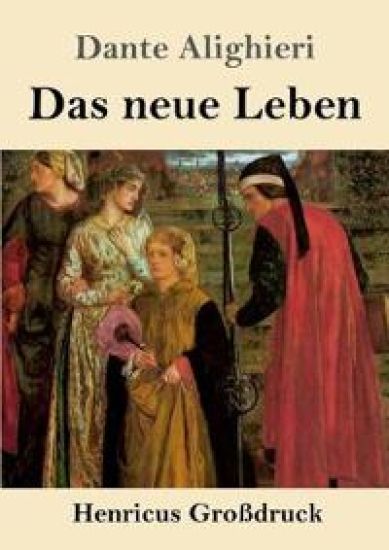
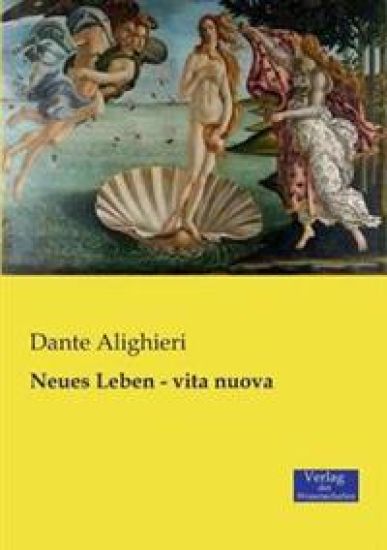
Dante Alighieri: Das neue Leben Lesefreundlicher Gro druck in 16-pt-Schrift Gro format, 210 x 297 mm Berliner Ausgabe, 2020 Durchgesehener Neusatz mit einer Biographie des Autors bearbeitet und eingerichtet von Theodor Borken Vita nova. Entstanden bis 1293. Erstdruck 1576. Hier nach der bersetzung von Richard Zoozmann, Freiburg im Breisgau, Herder, 1908. Umschlaggestaltung von Thomas Schultz-Overhage unter Verwendung des Bildes: Dante Gabriel Rossetti, Beatrice gr t Dante, 1859. Gesetzt aus der Minion Pro, 16 pt. Henricus Edition Deutsche Klassik UG (haftungsbeschr nkt)
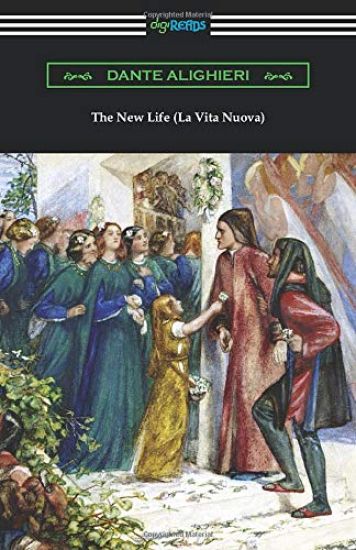
"The New Life" or "La Vita Nuova" is the first of two collections of verse and prose written by the Italian poet, Dante Alighieri. Since the Middle Ages, Dante has been cherished as the "Supreme Poet" of Italy, and is most widely recognized for his allegorical masterpiece "The Divine Comedy". "The New Life" contains works written over a period of ten years, from before 1283 to roughly 1293, and is the semi-autobiographical account of Dante's lifelong love for a woman he called Beatrice. It explores the emotions of courtly love, its powerful ability to inspire, and Dante's affirmations of his own religious convictions. The piece transformed European vernacular poetry, and established the Tuscan dialect in which it is written as the Italian standard. Today it is not only enjoyed for its imaginative and sensitive love story, but also for its exploration of poetry and religious experience, and the overarching connection between them all. This edition is printed on premium acid-free paper.
This book has been considered by academicians and scholars of great significance and value to literature. This forms a part of the knowledge base for future generations. So that the book is never forgotten we have represented this book in a print format as the same form as it was originally first published. Hence any marks or annotations seen are left intentionally to preserve its true nature.
The Inferno (Canon Classics Worldview Edition)
Dante Alighieri; Brian Phillips
Canon Press
2019
pokkari
"I love Dante almost as much as the Bible. He is my spiritual food, the rest is ballast." -James Joyce"Many authors have taken their readers on fascinating journeys into the afterlife, venturing to heaven, hell, hades, or other spirit worlds. And while such stories are numerous, none of them approach the beauty and influence of Dante Alighieri's Divine Comedy-an epic poem that has stood the test of time, captured imaginations for centuries, and calls the reader to ponder life's (and death's) most important questions." -From Brian Phillips's IntroductionDante's epic journey to Hell and back is full of grotesque images to rival any horror movie. However, these images are not merely served up to disgust the reader, but to reveal the ugliness and hatefulness of sin. Dante travels through seven circles in which each of the seven deadly sins is punished, but surprisingly none of the inhabitants of hell regret their location. As C. S. Lewis once said, "Hell is locked from the inside." This sulfurous Canon Classic is one of the greatest poems of world literature, and at its heart is a deeply Christian theme. The Canon Classics series presents the most definitive works of Western literature in a colorful, well-crafted, and affordable way. Unlike many other thrift editions, our classics are printed on thicker text stock and feature individualized designs that prioritize readability by means of proper margins, leading, characters per line, font, trim size, etc. Each book's materials and layout combine to make the classics a simple and striking addition to classrooms and homes, ideal for introducing the best of literary culture and human experience to the next generation. This Worldview Edition features an introduction divided into sections on The World Around, About the Author, What Other Notables Said, Setting, Characters, & Plot Summary, Worldview Analysis, and 21 Discussion Questions & Answers.