Kirjojen hintavertailu – 12 903 724 kirjaa ja 27 kauppaa
Kirjailija
Office of Air Force History
Kirjat ja teokset yhdessä paikassa: 219 kirjaa, julkaisuja vuosilta 1983–2015, suosituimpiin kuuluu Pearl to V-J Day: World War II in the Pacific. Vertaile teosten hintoja ja tarkista saatavuus suomalaisista kirjakaupoista.
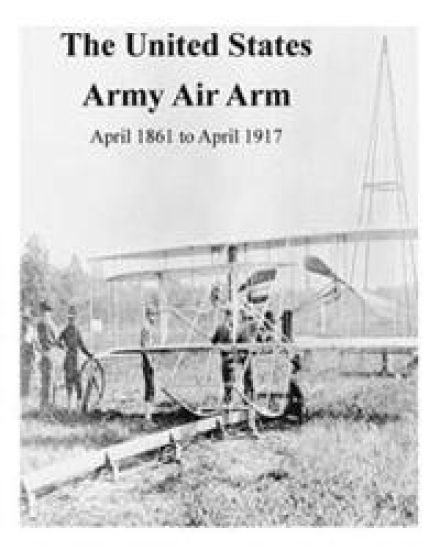
THIS MONOGRAPH, written by Mrs. Juliette A. Hennessy of the USAF Historical Division, recounts the development of aviation in the United States Army from April 1861, when the Army first became interested in balloons as a means of observation, to April 1917, when America entered World War I. The origins and organizations of the Army's air arm are told in detail, with particularemphasis on early air force personnel, planes, and experiments. In the process the monograph traces the early development of what today is The United States Air Force. Of necessity, the monograph tends strongly toward the chronological variety. This is owing to several factors, the thinness of aviation activities for most of the long period covered and an equal thinness in records being the principal factors. Only a few books which deal with this early period of Army aviation have been written, and all of them together do not cover the period. This, then, is the first attempt to put the story into a single volume. Because the story of the air arm from April 1917 to the beginning of World War II also has not been fully covered it is expected that the present monograph will be the first of three, which, when completed, will become the basis for a published history of the Army Air Arm, 1861-1939. Like other Historical Division studies, this history is subject to revision, and additional information or suggested corrections will be welcomed.
USAF Manpower Trends, 1960-1963, is an account of Air Force efforts to adjust to requirements for a high quality technical and professional force and to the ever-growing demands from the Administration and Congress for greater economy in the use of manpower. Continuing technological developments and changes in national military strategy dictated the recruiting and holding of better trained people, shifts in personnel assignments, and modifications in the mission of many Air Force units. Perhaps most immediatelysignificant were preparations to meet the Berlin and Cuban crises of 1961 and 1962 and to counter the Communist threat to wage "wars of national liberation." The author has approached the various subjects discussed in this study from the viewpoint of the highest echelons of the Air Force--Headquarters USAF and the Office of the Secretary--attempting to explain how they met new problems and conditions, particularly how they adjusted to the demands of the Administration and Congress.
The Changing Character of Air Force Manpower, 1958-1959, is an account or the Air Force's efforts to fit its personnel to its changing weapons. This meant a search for higher quality of abilities in both its military and civilian manpower and a quest tor improved manpower controls. The education for future careers in the Air Force involved new concepts in all phases of training. And the problems or the reserve forces required growing attention from the Air Force. Prepared as a chapter for inclusion in the History of Headquarters USAF, Fiscal Year 1959, this study is being issued separately to make it more readily available throughout the Air Force. Like all the studies produced by the USAF Historical Division Liaison Office, it is presented with an invitation for suggestions from its readers.
In a Memorandum to the Chief of Staff, USAF, dated 16 July 1962, the Office of the Assistant Secretary of the Air Force (Research and Development) requested that the USAF Historical Division Liaison Office (AFCHO) be directed to accomplish a "two pronged project" which would document and analyze the "Air Force in-house laboratory posture." The first AFCHO response to this request, the Memorandum stated, should be "a review of actions taken by the Air Force since the 14 October memorandum of the Secretary of Defense in strengthening the in-house laboratories." The study presented in the followingpages endeavors to meet the first of the two requirements which were assigned to AFCHO by the Vice Chief of Staff, USAF. A second and considerably larger study will be issued by AFCHO during calendar year 1963. This forthcoming study will, within the terms of reference contained in the 16 July Memorandum, be "an historical analysis of policies, actions, attitudes and results relating to in-house laboratories since the Von Karman report was issued in 1946. It should be a much longer range project which will bring together for the first time all the information on this subject and will be most useful in analyzing and portraying the Air Force's use and support of the in-house laboratories overthe past two decades." Mr. Carl Berger, the author of this first, briefer, and essentially current study on Air Force in-house laboratories, will also prepare the second, more comprehensive, and longer range AFCHO study covering this highly important and often controversial area of Air Force activity.
The Air Force and Contract Management, 1961-1965 deals with the impact of a study project initiated by the Office of the Secretary of Defense to improve the management of Department of Defense contracts. It briefly describes the Air Force's contract management organization and general approach to performing the function, the recommendations emerging from the study, and the decision by OSD to centralize contract management within a new Defense agency. USAF organizational changes that followed--including transfer of thousands of USAF contract management personnel and some 38,000contracts to the new agency--are discussed. The Air Force's post-reorganization responsibilities formanagement of contracts for major weapon systems, and other support functions, are also examined.
In our continuing effort to document the use of airpower in Southeast Asia, we present in this volume two major contributions to the "airpower story." Monograph 4, "The Vietnamese Air Force, 1951-1975, An Analysis of its Role in Combat," was written by General William W. Momyer, USAF (Ret), former commander of air forces in Vietnam. It presents an objective review of the South Vietnamese Air Force (VNAF) and the role played by the U. S. Air Force in VNAF's short 14-year life span. To provide the necessary perspective to this complex subject, the author presents a comparative analysis of the successes and failures of airpower during the three major enemy offensives of 1968, 1972 and 1975. The conclusions touch upon some of the fundamental doctrinal principles of airpower and highlight areas that must be carefully considered in any future employment. The events presented in Monograph 5, although not directly related to the war in Vietnam, took place in Southeast Asia, and were performed by the same men, organizations, and machines which fought so gallantly in that war. It is almost a step-by-step account of the "Mayaguez Affair" and the role of airpower in its successful outcome. Particular emphasis is given to the courage anddetermination of the young helicopter pilots during the delivery and recovery of U. S. Marines from Kho Tang Island. These two monographs provide the student of airpower with an excellent case study in the tactical employment of air resources at two widely separated points in the spectrum of conflict. For the general reader, they provide a vivid and substantive discussion on the use of combat airpower and should give some understanding of the magnitude and complexity of any airpower operation, large or small.
The first paper tells the story of GPS. It is not only a story of scientific and technical achievement, but also one of suspense that illustrates the difficulties of introducing revolutionary technologies. The failures and successes in that program attest to the vision and perseverance of the people who made it happen. The GPS finally solved the problem that had challenged seafarers since antiquity. It has also enabled a multitude of civilian and military applications. The second paper looks at a development that has revolutionized the employment of air power. The use of laser research and the GPS has enabled ever-increasing precision strikes at ever-increasing distances. From tens of bombers dropping hundreds of bombs to hit a singletarget in World War II, now a single aircraft can strike several targets. Precision also raises expectations for minimizing collateral damage and puts high priority on detecting targets, identifying them correctly, and tracking them. Advances in electro-optical/infrared imaging, in radar, and in lasers have become the triad for remote sensing, where the objective has been to "overcome the problems of great distances, weather, and darkness," articulated by von K rm n. The third paper focuses on infrared cameras from their first beginnings to their employment inunmanned aerial vehicles such as the Predator and Global Hawk. The fourth paper looks at airborne radar, whether in AWACS or in Joint STARS, two systems that have revolutionized the conduct of air-to-air and air-to-ground operations. Soon after the first powered flight in 1903, the effects of the high altitude environment on the performance of pilots became a concern. Research on the effects of hypoxia went back to balloonists in the late nineteenth century. With the creation in 1918 of the Air Service Medical Research Laboratory, it became possible to establish the scientific foundation for the development of a wide variety of equipment, from oxygen masks to the pressure suits of today, that would enable air crews to fly higher and for longer periods of time. The fifth paper traces that history and the accomplishments of such pioneers as Armstrong, Stapp, and Kittinger. The paper also includes the story of a particular mission of the SR-71, an aircraft that flew at 80,000 feet, at the edge of space, at three times the speed of sound-an extreme environment indeed. The sixth paper, not presented at the symposium, describes the Air Force research in weather, not only the effort to understand terrestrial weather, but also space weather. The launching of U. S. satellites, which started in 1958, led to the discovery of the Van Allen belts. This was a major scientific discovery that began the mapping of the space environment, a necessary condition for sending unmanned and manned spacecraft to space. To reach space, whether for scientific, military, or commercial purposes, a launch capability was needed. In the early years of the space age, this capability was provided by theAir Force's long-range ballistic missiles-Atlas, Titan, and Thor. The seventh paper records the history and the systems that have allowed the U. S. to launch satellites that have provided extraordinary sensing capabilities and global communications. The evolution of military satellite communications from concept to reality, an indispensable capability for today's Air Force, is documented in the eighth paper. Finally, as we start the second century of powered flight, the Air Force is once more expandingits capabilities using advanced technology. The wave of the future is directed energy that isexpected to revolutionize the science and art of warfare. Since the invention of the laser in the1960s, the Air Force has been conducting research and development for an operational platformthat would use lasers to destroy ground or air launched missiles.
WHEN JAPAN ATTACKED PEARL HARBOR on December 7, 1941, and Germany and Italy joined Japan four days later in declaring war against theUnited States, intelligence essential for the Army Air Forces to conduct effective warfare in the European and Pacific theaters did not exist. Piercing the Fog tells the intriguing story of how airmen built intelligence organizations to collect and process information about the enemy and to produce and disseminate intelligence to decision makers and war fighters in the bloody, horrificcrucible of war. Because the problems confronting and confounding air intelligence officers, planners, and operators fifty years ago still resonate, Piercing the Fog is particularly valuable for intelligence officers, planners, and operators today and for anyone concerned with acquiring and exploiting intelligence for successful air warfare. More than organizational history, this book reveals the indispensable and necessarily secret role intelligence plays in effectively waging war. It examines how World War II was a watershed period for Air Force Intelligence and for the acquisition and use of signals intelligence, photo reconnaissance intelligence, human resources intelligence, and scientific and technical intelligence. Piercing the Fog discusses the development of new sources and methods of intelligence collection; requirements for intelligence at the strategic, operational, and tactical levels of warfare; intelligence to support missions for air superiority, interdiction, strategic bombardment, and air defense; the sharing of intelligence in a coalition and joint service environment; the acquisition of intelligence to assess bomb damage on a target-by-target basis and to measure progress in achieving campaign and war objectives; and the ability of military leaders to understand the intentions and capabilities of the enemy and to appreciate the pressures on intelligence officers to sometimes tell commanderswhat they think the commanders want to hear instead of what the intelligence discloses. The complex problems associated with intelligence to support strategic bombardment in the 1940s will strike some readers as uncannily prescient to global Air Force operations in the 1990s. A half century ago, accurate, timely intelligence contributed significantly to victory and hastened the end of World War II. Such a legacy is worth reading and thinking about by all those responsible for building, maintaining, and employing air power. How well intelligence is integrated with air operations is even more important today than it was in the past. It will continue to prove as critical in the next century as it has been in this one
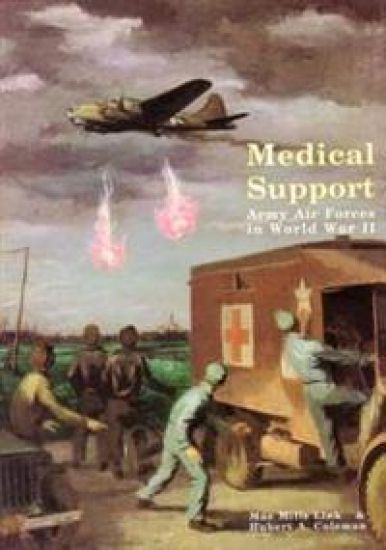
PART 2 of 2Medical Support of the Army Air Forces In World War II has been prepared to fill a gap in the medical history of that period. Its purpose is to present a unified narrative of the total performance of the AAF medical service in support of the Air Forces combat mission. Fundamentally a reference book, this volume is based almost exclusively upon unpublished documents in custody of the U. S. Air Force, with occasional citation of published sources. Since this volume, like other comparable military publications in World War II, is based upon masses of archival material, the project has been in a very true sense a group project. During World War II professionally trained historians carried out basic research and writing while professional specialists in aviation medicine prepared highlytechnical materials. And while as authors we must assume final responsibility for the historical and technical accuracy of the presentation and interpretation of the present volume, it has been our intention insofar as is humanly possible to establish and acknowledge individual contributions. In the order of sequence in which these group efforts appear, first mention is made of Chapter III, "School of Aviation and Related Programs" which represents a collation of edited data based upon the series of 6-month histories prepared in the Army Air Forces Training Command under the direction of Col. Neeley Mashburn (MC), by the School of Aviation Medicine, and by the four continental air forces. Chapter IV, "Research and Development" represents in part a collation of materials from the same source, together with a draft prepared by the staff of the Aero Medical Laboratory. Chapter V, "The Air Evacuation Mission" is a collation of data gathered from the histories of the School of Air Evacuation, the School of Aviation Medicine, and the Wing histories of the Air Transport Command. None of these chapters represents original research or writing on the part of the editors. The overseas theaters, on the other hand, have been approached somewhat differently. Two historians on the wartime staff were originally scheduled to prepare monographs on the Mediterranean and European Theaters respectively. John S. G. Carson, Ph. D., who was to prepare the final draft of the AAF/MediterraneanTheater medical history was called back to his academic post before his research and writing was completed. Chapter VI, however, incorporates much of his draft material. It also includes, withminor editing, a section on the North African Landings and early Twelfth Air Force prepared in the theater under the direction of Col. William Cook (MC). Another Headquarters historian, Wiley Hodges, Ph. D., was scheduled to prepare a monograph on the European Theater but he too was called back to his academic post before his task was completed. A large section of Chapter VIII dealing with the "Special Problems of Aviation Medicine in Europe'', however, remains substantially as written by him. The section on the Ninth Air Force, with slight editing, incorporates the periodic histories prepared in the theater. And while the editors have taken extensive liberties with his manuscript, authorship credit for the chapter on the Pacific and Southwest Pacific belongs to Lt. Col. Charles G. Mixter, Jr. (MC)who was Malaria Control Officer in that area during the war and later called to Headquarters, AAF, to prepare the official report. Finally to Bruce Berman, M. A., who is presently a member of the historical staff, goes collaborative credit in preparation of the chapter on ChinaBurma- India. This is in addition to his assistance in editing thevolume.
PART 1 of 2Medical Support of the Army Air Forces In World War II has been prepared to fill a gap in the medical history of that period. Its purpose is to present a unified narrative of the total performance of the AAF medical service in support of the Air Forces combat mission. Fundamentally a reference book, this volume is based almost exclusively upon unpublished documents in custody of the U. S. Air Force, with occasional citation of published sources. Since this volume, like other comparable military publications in World War II, is based upon masses of archival material, the project has been in a very true sense a group project. During World War II professionally trained historians carried out basic research and writing while professional specialists in aviation medicine prepared highlytechnical materials. And while as authors we must assume final responsibility for the historical and technical accuracy of the presentation and interpretation of the present volume, it has been our intention insofar as is humanly possible to establish and acknowledge individual contributions. In the order of sequence in which these group efforts appear, first mention is made of Chapter Ill, "School of Aviation and Related Programs" which represents a collation of edited data based upon the series of 6-month histories prepared in the Army Air Forces Training Command under the direction of Col. Neeley Mashburn (MC), by the School of Aviation Medicine, and by the four continental air forces. Chapter IV, "Research and Development" represents in part a collation of materials from the same source, together with a draft prepared by the staff of the Aero Medical Laboratory. Chapter V, "The Air Evacuation Mission" is a collation of data gathered from the histories of the School of Air Evacuation, the School of Aviation Medicine, and the Wing histories of the Air Transport Command. None of these chapters represents original research or writing on the part of the editors. The overseas theaters, on the other hand, have been approached somewhat differently. Two historians on the wartime staff were originally scheduled to prepare monographs on the Mediterranean and European Theaters respectively. John S. G. Carson, Ph. D., who was to prepare the final draft of the AAF/MediterraneanTheater medical history was called back to his academic post before his research and writing was completed. Chapter VI, however, incorporates much of his draft material. It also includes, withminor editing, a section on the North African Landings and early Twelfth Air Force prepared in the theater under the direction of Col. William Cook (MC). Another Headquarters historian, Wiley Hodges, Ph. D., was scheduled to prepare a monograph on the European Theater but he too was called back to his academic post before his task was completed. A large section of Chapter VIII dealing with the "Special Problems of Aviation Medicine in Europe'', however, remains substantially as written by him. The section on the Ninth Air Force, with slight editing, incorporates the periodic histories prepared in the theater. And while the editors have taken extensive liberties with his manuscript, authorship credit for the chapter on the Pacific and Southwest Pacific belongs to Lt. Col. Charles G. Mixter, Jr. (MC)who was Malaria Control Officer in that area during the war and later called to Headquarters, AAF, to prepare the official report. Finally to Bruce Berman, M. A., who is presently a member of the historical staff, goes collaborative credit in preparation of the chapter on ChinaBurma- India. This is in addition to his assistance in editing thevolume.
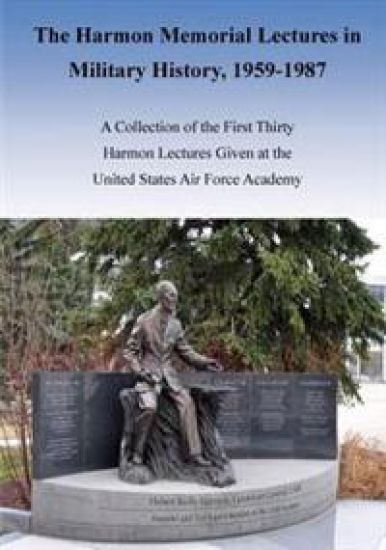
In 1959 the United States Air Force Academy's Department of History began the Harmon Memorial Lecture Series on Military History in memory of Lt. Gen. Hubert R. Harmon, first superintendent and "father" of the Academy. The series supported two goals: to further encourage the awakened interest in military history that evolved after World War II and to stimulate cadets to develop a lifelong interest in the history of the military profession. Each year thereafter, a committee of nationally known civilian historians and Academy representatives selected an outstanding military historian to be the annual lecturer. Beginning in 1970, the Harmon Lecture also served as the keynote address for the Academy's biennial Military History Symposium. This collection of the first thirty Harmon Memorial Lectures reflects the evolution in scholarship of prominent scholars working in military history over the past three decades. In keeping with the purpose of the series, the Academy publishes and distributes each lecture to Air Force and Department of Defense agencies, university libraries, and scholars throughout the United States and abroad. A number of lectures are used in courses at the Academy, and we receive many requests for them from civilian scholars and military personnel. Consequently, the Academy's Department of History and the Office of Air Force History have decided to publish the first thirty lectures under one cover, thereby making them more available. In this way, we continue to honor the memory of General Harmon, who during his lifetime developed a deep and abiding interest in military history and contributed so much to establishing the United States Air Force Academ
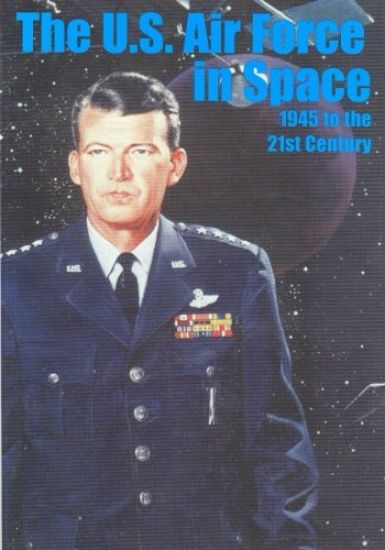
On September 21 and 22, 1995, the Air Force Historical Foundation convened a historical symposium on the United States Air Force's experience in the development of space systems and their military applications. Held at theAndrews Air Force Base Officers' Club, Maryland, the symposium was the culmination of nearly a year-long planning effort headed by a committee chaired by Lt. Gen. Bradley Hosmer, USAF (Ret.). Other committee members included Donald R. Baucom, BMDO historian; George W. Bradley III, Air Force Space Command historian; Col. Louis H. Cummings, USAF (Ret.), the Foundation's executive director; R. Cargill Hall and Jacob Neufeld, senior historians at the Air Force History Support Office; and Maj. John Kreis, USAF (Ret.), a Foundation trustee. The symposium was co-sponsored by the Office of the Air Force Historian, in association with the Air Force Space Command and the Air University. Dozens of individuals affiliated with these organizations pitched in graciously and expertly whenever the committee solicited their assistance. We wish to acknowledge especially Lt. Gen. Patrick P. Caruana, vice commander of Air Force Space Command, who introduced one of the panels, and Major Kreis, who introduced another. Gen. Bryce Poe II, USAF (Ret.), the Foundation president at the time, introduced the symposium. He was followed by the then Air Force Chief ofStaff, Gen. Ronald R. Fogleman, who gave the keynote address. Secretary of the Air Force Dr. Sheila E. Widnall and the Vice Chief of Staff, Gen. Thomas S. Moorman, placed the subject in perspective and peeked into the future. Severalother distinguished civilian and military officials related their experiences and perspectives, while scholars provided historical context. A perusal of the table of contents discloses a virtual "Who's Who" in Air Force space history. The symposium was arranged in three chronological sessions beginning with the threshold of space in 1945 to 1961, the year that the Air Force became executive agent for space research and development. Gen. Bernard A. Schriever, USAF (Ret.), the service's leading missiles and space pioneer, provided invaluable recollections and observations. Panel two traced the evolution of space systems from R&D to operational status up to their employment in the Persian Gulf War. Former Air Force Secretary John L. McLucas and Gen. Donald J. Kutyna riveted the audience's attention with their personal assessments. Finally, former Air Force Secretary Edward C. "Pete" Aldridge was among a select panel of senior leaders who looked at space "today and tomorrow." The consensus among the two hundred men and women who attended was that this was a unique and extremely useful symposium and that its proceedings deserved to be published and disseminated widely.
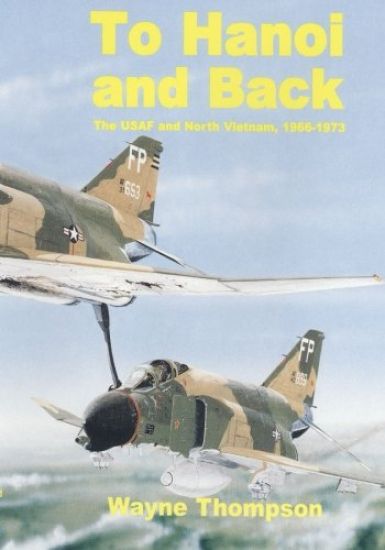
No experience etched itself more deeply into Air Force thinking than the air campaigns over North Vietnam. Two decades later in the deserts of Southwest Asia, American airmen were able to avoid the gradualism that cost so many lives and planes in the jungles of Southeast Asia. Readers should come away from this book with a sympathetic understanding of the men who bombed North Vietnam. Those airmen handled tough problems in ways that ultimately reshaped the Air Force into the effective instrument on display in the Gulf War. This book is a sequel to Jacob Van Staaveren's Gradual Failure: The Air War over North Vietnam, 1965-1966, which we have also declassified and are publishing. Wayne Thompson tells how the Air Force used that failure to build a more capable service-a service which got a better opportunity to demonstrate the potential of air power in 1972. Dr. Thompson began to learn about his subject when he was an Army draftee assigned to an Air Force intelligence station in Taiwan during theVietnam War. He took time out from writing To Hanoi and Back to serve in the Checkmate group that helped plan the Operation Desert Storm air campaign against Iraq. Later he visited Air Force pilots and commanders in Italy immediately after the Operation Deliberate Force air strikes in Bosnia. During Operation Allied Force over Serbia and its Kosovo province, he returned toCheckmate. Consequently, he is keenly aware of how much the Air Force has changed in some respects-how little in others. Although he pays ample attention to context, his book is about the Air Force. He has written a well-informed account that is both lively and thoughtful.
The history of the United States Air Force is inextricably bound up in the history of aerospace technology. Major revolutions have influenced the evolution of Air Force capabilities and systems, most notably those of atomic weaponry, the turbojet revolution, supersonic flight, avionics, aerial refueling, spaceflight, precision weaponry, electronic flying controls, composite materials, andstealth. It is worthwhile to take a retrospective look at some of the aerospace challenges and opportunities the Air Force faced and how it took advantage - or failed to take advantage - of them. With this in mind, the Air Force History and Museums Program organized a symposium on October 23 and 24, 1995, in which leading historians, technologists, and military decision makers met at Andrews Air Force Base, Maryland, to present case studies on a series of technological challenges, opportunities, and problems. This symposium, co-sponsored by the Air Force Historical Foundation, covered relevant technological histories ranging from the turbojet revolution of the 1930s to the stealth revolution of the 1990s. This volume presents the texts of the papers in the order they were given. Many people within the Air Force History and Museums Program helped put this program together. I especially wish to acknowledge the contributions of Jacob Neufeld of the Air Force History Support Office for his efforts in bringing both the symposium and thispublication to fruitio
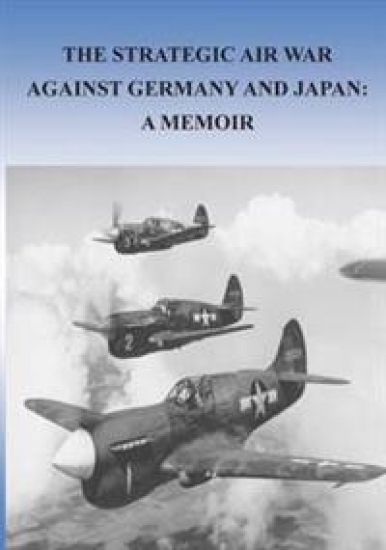
This book seeks to recount the air experience and development before World War II, to describe the objectives, plans and effects of strategic air warfare in Europe and in the Pacific, and to offercriticism, opinion, and lessons of that great conflict. In retrospect I find that I have been singularly fortunate in my associations and assignments. I have been associated with many great men and have been in position to observe great events. In the decade before World War II, I had a priceless opportunity to work with Bob Olds, Harold Lee George, Ken Walker, Don Wilson, and Muir "Santy" Fairchild, under the guidance, inspiration, and benign protection of the Commandant of the Air Corps Tactical School at Maxwell Field, Col. John F. Curry. My associates also included Ira C. Eaker, who combined great ability as a staff executive with superlative leadership as Commanding General of the Eighth Air Force inEngland. I worked under that superb airman, Carl "Tooey" Spaatz, Commanding General, United States Strategic Air Forces in Europe. I was caught up in the dedication and driving spirit of Henry H. "Hap" Arnold, Commanding General, U. S. Army Air Forces, Air Member of the Joint Chiefs of Staff, and Commanding General, Twentieth Air Force. And I had the special privilege of working for the greatest soldier of our day, and perhaps of any day, a man of superb integrity and highest character: Army Chief of Staff Gen. George Catlett Marshall. The observations contained in this book constitute a memoir, with all the shortcomings of faulty memory, bias, personal viewpoint, personal experience, and inadequate research that are implied in the term. They lead to speculation on probable results of alternative actions or conditions, and that speculation is likewise suspect because it reflects personal judgment. But the compendium may lead others to derive lessons and conclusions which fit into a broader mosaic.
The Quest for an Advanced Manned Strategic Bomber: USAF Plans and Policies 1961-1966, is an account of the USAF effort to find a replacement for the B-52 and, though with lesser urgency, the B-58. Although three successive Chiefs of Staff, Generals Thomas D. White, Curtis E. LeMay and John P. McConnell, have given top priority to this effort, the Air Force has not yet obtained permission to develop an advanced manned bomber. Instead, it has received approval for a bomber version of the F-111 to replace the older model B-52's. This study examines the principal manned bomber programs in progress between 1961 and 1966. One section, therefore, is devoted to each of three undertakings: the B-70, a supersonic, high-altitudebomber that was completed as an experimental type; the advanced manned strategic aircraft, judged technologically less ambitious than the B-70 but better able to penetrate enemy defenses;and the FB-111, which the Air Force considers an interim bomber, adequate to replace the B-52C through B-52F. The last section also treats the planned phase out of the older B-52's and the B-58's and recounts Secretary of Defense Robert S. McNamara's views on the role of the manned bomber.
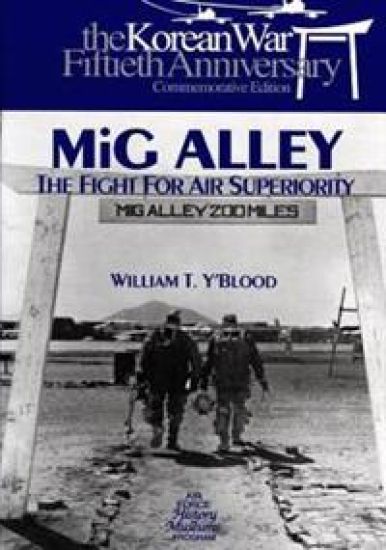
The fight for air superiority began the day the Korean War started and only ended with the armistice three years later. Once the shock ofthe North Koreans' invasion wore off, it did not take long for the United States Air Force, assisted by other United Nations air forces, to destroy the North Korean Air Force. The arrival of the MiG-15 in November 1950, often flown by Soviet pilots, changed things considerably however. For the remainder of the war, bitterly contested air battles were fought almost daily. Yet despite a decided numerical superiority in jet fighters, the Communists were never able to gain air superiority, testament to the skill and training of the UN fighter pilots, primarily those U. S. Air Force airmen flying the magnificent F-86 Sabre.
The United States military space program began at the end of World War II when a few people realized that space flight was now achievable and could be employed to military advantage. Science and technology in the form of advanced radar, jet propulsion, ballistic rockets such as the V-2, and nuclear energy had dramatically altered the nature of war. Army Air Forces Commanding General Henry H. "Hap" Arnold wrote in November1945 that a space ship "is all but practicable today" and could be built "within the foreseeable future." The following month the Air Force Scientific Advisory Group concluded that long-range rockets were technically feasible and that satellites were a "definite possibility." The U. S. Navy also expressed interest in space flight. In November 1945 the Navy Bureau of Aeronautics produced a satellite report, and, on March 7, 1946proposed an interservice space program. The idea was presented to the joint Army-Navy Aeronautical Board on April 9. Major General Curtis E. LeMay, the Director of Research and Development for the Army Air Forces, however, viewed space operations as an exclusive Air Forcedomain, and he ordered an independent study.
This study highlights USAF plans, policies, and operations in Southeast Asia during 1965, especially as they were significantly changed by the President's key decisions to bomb North Vietnam and transform the U. S. advisory role in South Vietnam to one of active military support. The author focuses on USAF participation in the development of policy for prosecuting the war, the build-up of U. S. military strength in the theater, and the gradually intensified air operations against enemy forces in South Vietnam, North Vietnam, and Laos. USAF Plans and Operations in Southeast Asia, 1965 follows two other recent studies by the USAF Historical Division Liaison Office dealing specifically with the war: USAF Plans and Policiesin South Vietnam and Laos, 1964 and USAF Plans and Policies in South Vietnam, 1961-1963. In addition, the USAF Historical Division Liaison Office is currently preparing a companion study of Air Force plans and policies dealing with personnel, logistics, construction, and other activities during 1965 in support of the operational forces in Southeast Asia.
USAF Logistic Preparations for Limited War, 1958-1961, discusses a vital military problem that faced the Air Force during these years of international crises. When the full meaning of the limited war threat was recognized it became necessary to provide logistic readiness for limited war operations while firmly maintaining the capability to wage general war. The author, Charles H. Hildreth, has discussed the causes for the change in policy, efforts to improve the war readiness materiel posture, availability of conventional weapons, procurement of aircraft, training of crews, and airlift capability. This study is part of the larger History of Headquarters USAF, Fiscal Year 1960. It is classified Secret to conform with the classification assigned to sources of information used herein.