Kirjojen hintavertailu – 12 903 724 kirjaa ja 27 kauppaa

Kirjailija

Office of Air Force History

Kirjat ja teokset yhdessä paikassa: 219 kirjaa, julkaisuja vuosilta 1983–2015, suosituimpiin kuuluu Pearl to V-J Day: World War II in the Pacific. Vertaile teosten hintoja ja tarkista saatavuus suomalaisista kirjakaupoista.

219 kirjaa

Kirjojen julkaisuvuodet: 1983–2015.

Bernard A. Schriever: Challenging the Unknown

Bernard A. Schriever: Challenging the Unknown

Office of Air Force History; U. S. Air Force

Createspace Independent Publishing Platform
2015
nidottu
When, on June 5, 1998, Falcon Air Force Base, ten miles east of Colorado Springs, Colorado, was renamed in honor of General Bernard A. Schriever, USAF (Ret.), it marked a singular event. Normally, such an honor is bestowed posthumously, but in this case, the renaming ceremony proved the exception. Although World War II had sparked an effusion of scientific and technical developments, among them radar, electronic warfare, jet engines, air-to-air and air-to-ground missiles, and data-processing technology, the two innovations ofunprecedented character that had the greatest affect on the Air Force and the world balance of power were nuclear weapons and ballistic missiles. Gen. Henry H. "Hap" Arnold, who led the Army Air Forces in World War II, believed correctly that the Air Forces' future lay in adapting scientific andengineering advances to air warfare. He was determined to continue in peacetime the cooperation between the Air Force, university scientists, and industry that had paid such handsome dividends during the war. One of the men selected to help fashion the technology of the postwar Air Force was a young colonel named Bernard Schriever, who combined some uncommon personal attributes with engineering training and combat experience. Schriever was to become the officer most closely associated with the development of ballistic missiles. Ultimately, he would be responsible for research, development, and acquisition of all new weapons used by the United States Air Force

Separate and Unequal: Race Relations in the AAF During World War II

Separate and Unequal: Race Relations in the AAF During World War II

U. S. Air Force; Office of Air Force History

Createspace Independent Publishing Platform
2015
nidottu
Race relations between white and black Americans in the Army Air Forces (AAF) during World War II ran the gamut from harmonious to hostile, depending upon the unique circumstances existing within each unit, command, and theater. In analyzing racial policy as it was implementedthroughout the chain of command, are a number of themes relevant for an understanding of the utilization of African Americans during the war. First, the AAF never willingly accepted black soldiers. This service had totally excluded them for over two decades before they were permittedto enter, and then used them only reluctantly. The fact that the AAF even opened its doors to African Americans and proceeded to make additional opportunities available to them was due to pressures aimed at the War Department and the AAF. Individuals and organizations within the black community and white liberals in and out of Congress were quite vocal and were able to exert sufficient pressure to force the War Department and AAF to examine and modify their policies and practices throughout the war. Another recurring theme was that leadership within the War Department and AAF assumed that segregation was the most efficient system of race relations and accepted the "separate-but-equal" doctrine. Even if we accept "separate-but-equal" as the law of the land, the AAF did not, in fact, maintain equal facilities for black soldiers, and they were not afforded equal treatment. Thus, the policy of segregation was unsatisfactory for African Americans, and the duplicated facilities that were necessary to maintain the system were far too expensive in terms of the results obtained. And because of deeply ingrained racist beliefs, theAmerican public and the military were willing to accept the additional financial burden, social unrest, and inefficiency of segregation in an attempt to keep African Americans "in their place." During the war, the U. S. military inherited from American society and from its own traditions a difficult problem in attempting to absorb large numbers of African Americans into a war apparatus, and racial issues plagued the AAF. Although the AAF fervently defended segregation, its leaders failed to understand that this implied second-class citizenship for blacks. Additionally, blacks were no longer willing to accept the demeaning status to which they had been relegated, and using the military as a vehicle for their protests, voiced their objection to discriminatory treatment and segregation. Their protests were for military leaders a constant source of frustration and annoyance. However, one can discern a decided shift in the approach of the War Department in 1943. Until then, officials in the War Department and the AAF reflected society's traditional racist attitude toward the utilization of African Americans. The military did not consider black soldiers as part of the American military tradition and used them only when absolutely necessary for the defense of the country or when political pressure forced their use. With mounting pressure upon War Department officials, there was change in outlook from 1943 through the end of the war to recognizeand alleviate the race problem. The U. S. government sought to utilize black soldiers fairly rather than to view them merely as embarrassments and problems. Unfortunately, this change in attitude did not filter down through the AAF chain of command. Throughout the war, many AAF commanders demonstrated a reluctance to treat blacks with full equality and to show a sincere commitment to abide by positive War Department racial directives.
Air Power and the Fight for Khe Sanh

Air Power and the Fight for Khe Sanh

U. S. Air Force; Office of Air Force History

Createspace Independent Publishing Platform
2015
nidottu
The 1968 fight for Khe Sanh pitted some 6,000 U. S. Marines and South Vietnamese Rangers against an enemy force roughly three times as large. For more than 70 days North Vietnamese troops maintained pressure on Khe Sanh's defenders, who had dug in around the base's airstrip. The original purpose for deploying the Marines and South Vietnamese into the northwestcorner of South Vietnam was to block Communist troop movements along Highway 9 toward Quang Tri City and the heavily populated coastal areas. When U. S. intelligence detected large enemy forces assembling near Khe Sanh, the senior American commander in Vietnam, Gen. William C. Westmoreland, ordered the Marines to hold the base. General Westmoreland suspected that North Vietnam's Defense Minister, Gen. Vo Nguyen Giap, might be tempted to mount a major attack against the base in hopes of achieving "a climactic victory, such as he had done in 1954at Dien Bien Phu." If Giap did order such an attack, General Westmoreland believed it would provide U. S. air power "a singular opportunity" to destroy a massed enemy force in a relatively uninhabited, isolated region of South Vietnam. In late January 1968 General Westmoreland advised the Chairman of the Joint Chiefs of Staff in Washington, D. C., of his decision to defendKhe Sanh. The Chiefs backed him unanimously. During the siege that followed, U. S. strike aircraft rained nearly 100,000 tons of munitions down upon the North Vietnamese while other planes primarily U. S. Air Force transports-flew in essential supplies of food, ammunition, and other necessities to Khe Sanh's defenders. The Leathernecks also used their own aircraft to provision Marine outposts which denied theenemy the high ground overlooking the base. Other military elements participating in the battle included U. S. Army artillerymen dug in east of Khe Sanh, who fired deadly concentrations against the besieging forces. Marine howitzersand mortars added to the heavy U. S. fire, while Army engineers joined Navy Seabees in helping prepare airstrips which supported the allieddefense effort. Finally, the relief of Khe Sanh though spearheaded by Army troops-also involved American Marines and soldiers of the Army of the Republic of Vietnam.
The American Military and the Far East

The American Military and the Far East

U. S. Air Force; Office of Air Force History

Createspace Independent Publishing Platform
2015
nidottu
Every symposium in this series has broken new ground and accumulated new debts. The ninth symposium, however, perhaps more conspicuously than past symposia, has struck off boldly in new directions. The two men most responsible for this symposium, (then) Colonel Alfred F. Hurley and Major Harry R. Borowski, were not constrained in their planning by a narrow definition of "military" history. Their willingness to include questions of foreign policy, cross-cultural interaction, and national perceptions and misperceptions, within the context of military history, has helped us all to expand our vision and understanding. Debts of gratitude are owed to many people, but to none more than the outstanding group of scholars and military officers who deliveredpapers and served as moderators and commentators in the various sessions. Whatever success the symposium enjoyed, and whatever use the proceedings may have, are certainly a credit to the superb collection of experts on East Asia who gathered at the Air Force Academy last October. The Department of History is once again most thankful to the Association of Graduates of the United States Air Force Academy for generous financial assistance in support of the symposium. Support came from other quarters as well. The organizers of the symposium received constant and enthusiastic cooperation from Lieutenant General Kenneth L. Tallman, Superintendent of the Air Force Academy, and from Brigadier General William A. Orth, Dean of the Faculty. The Department of History could not successfully host the symposia series without the backing of the entire Academy. Neither could the symposia be held withoul the hard work and sacrifice offered by the individual members of the Department of History. A standing joke among members of thedepartment is that someday there may be enough time available during a symposium to actually attend the sessions. Special thanks go to Lieutenant Colonel Carl W. Reddel, presently Head of the Department of History, for his assistance and encouragementin the editing of these proceedings. The proceedings would not have appeared, of course, without the patience and expertise of Mrs. Dode Jones and Ms. Rae Hellen, who typed the manuscript. The manuscript was deftly transformed into a printed volume under the watchful eye of Mr. Lawrence J. Paszek, Office of Air Force History.
Autonomy of the Air Arm

Autonomy of the Air Arm

U. S. Air Force; Office of Air Force History

Createspace Independent Publishing Platform
2015
nidottu
The question of how best to organize the United States Army's air arm had been contentious from the time of the First World War. Legislation to give the air arm greater autonomy or even independence had been introduced in the Congress in the interwar years. Although independence would not be achieved until after World War II, the air arm during the interwarperiod made remarkable progress towards this goal. In 1926 the Army Air Corps was established, and in 1934 the Baker Board directed the formation of the General Headquarters Air Force, giving the Army air arm a measure of autonomy. On the eve of the Second World War, the War Department createdthe Army Air Forces. Although falling short of independence, these were important steps forward on the road to the creation of today's global Air Force. R. Earl McClendon's classic Autonomy of the Air Arm describes the Army air arm's struggle for autonomy over almost forty years, from 1907 tothe close of World War II McClendon's narrative details the contentious evolution of the Army Air Forces (AAF) in March 1942 as a fully coequalbranch with the Army Ground Forces (AGF). Following the end of the war, President Harry S. Truman firmly positioned himself in favor of "air parity" and an independent Air Force. Mcclendon emphasizes that "for the first time in the history of American aviation the Commander-in-Chief of the armed forces definitely took a stand in favor of an independent military air arm." Truman's firm leadership on this issue ultimately resulted in passage of the National Security Act of 1947. After four decades of prolonged gestation, the United States Air Force was born.
Aviation in the U.S. Army 1919-1939

Aviation in the U.S. Army 1919-1939

U. S. Air Force; Office of Air Force History

Createspace Independent Publishing Platform
2015
nidottu
Historians generally agree that the birth of American air power occurred in the two decades between the world wars, when airmen in the U. S. Army and Navy forged the aircraft, the organization, the cadre of leadership, andthe doctrines that formed a foundation for the country to win the air war in World War II. Nearly every scholarly study of this era focuses on these developments, or upon the aircraft of the period; very few works describe precisely what the flyers were doing and how they overcame the difficulties they faced in creating air forces. In this detailed, comprehensive volume, Dr. Maurer Maurer, retired senior historian of the United States Air Force Historical Research Center, fills this void for land-based aviation. As Dr. Maurer explains in his personal note, this book grew out of his previous editing of the documents of the American Air Service in World War I. He decided to write a descriptive rather than an analytical book, taking the vantage point of the Army flyers themselves. While policy, organization, and doctrine form the background, they are not addressed or explained explicitly. Instead, Dr. Maurer focuses on men and planes, describing in the process how the Army Air Corps came to possess a supporting structure and thenationwide network of airfields. He exposes the difficulties encountered in training and organizing tactical units. However, Dr. Maurer does not writesolely about problems and setbacks. In his capable narrative hands, readers cross the country and the continents on the many dramatic record flights with the flyers of the Army Air Corps. The value of this book is twofold: the wealth of detail Dr. Maurer provides about the scope, structure, and activities of interwar Army aviation; and the comprehensive portrait that emerges of a military service strugglingwith limited resources to develop a new weapon of tremendous destructive potential. As such, the book fills a gap in the literature and contributes toknowledge about the history of the Army air arm.
Air Power and Warfare: The Proceedings of the 8th Military History Symposium United States Air Force Academy 18-20 October 1978

Air Power and Warfare: The Proceedings of the 8th Military History Symposium United States Air Force Academy 18-20 October 1978

U. S. Air Force; Office of Air Force History

Createspace Independent Publishing Platform
2015
nidottu
The co-sponsor of this symposium series, the Department of History at the U. S. Air Force Academy, has had a special commitment since itsinception in 1954 to the teaching of the history of air power. For many years, however, the very limited amount of scholarly work in this fieldhas hampered the effective teaching of the subject at the Academy and elsewhere and stymied proposals to present a symposium on the topic. Then, as the 75th Anniversary of the Wright Brothers' flight approached, scholarly efforts began to increase. Enough American and foreign scholars, both civilian and military; and some of the surviving shapers of the history of air power could now be brought together at least, as a minimum, to assess what has been done and to stimulate new work. In the event, the contributors to this volume have gone well beyond the minimum by providing herein a collection of essays, commentaries, and reminiscences that should enhance both the teaching and the public understanding of the record and potential of air power. Furthermore, future researchers and writers will appreciate the conscientious work of scholarly commentatorswho responded especially well to the invitation to identify the work yet to be done. The symposium committee structured this event so as to deal with the topic within as broad a framework as a two-day meeting would permit. Thus, the sweep of the papers extends chronologically from a study of British views on air power even before 1903 through a major pioneer's perceptions of the future role of air power in the defense of the United States and its allies. Geographically, the participants on the program addressed the air power record on three continents, specifically dealing with the experiences of six nations. To make the most of the available time, the planners began the symposium with an evening lecture and experimented with simultaneoussessions during the next two days. While there was the inevitable disappointment among our more than 250 attendees from outside the Academy, as well as among the members of the Academy community, at not being able to hear each of the speakers, the editors believe that these published proceedings will justify the experiment. In addition, they sought to round out these proceedings by inviting comments from individuals not on the program about topics a volume such as this should at least mention.
AIR POWER FOR PATTON'S ARMY The XIX Tactical Air Command in the Second World War

AIR POWER FOR PATTON'S ARMY The XIX Tactical Air Command in the Second World War

U. S. Air Force; Office of Air Force History

Createspace Independent Publishing Platform
2015
nidottu
This insightful work by David N. Spires holds many lessons in tactical air-ground operations. Despite peacetime rivalries in the drafting of service doctrine, in World War II the immense pressures of wartime drove army and air commanders to cooperate in the effective prosecution of battlefield operations. In northwest Europe during the war, the combination of the U. S. Third Army commanded by Lt. Gen. George S. Patton and the XIX Tactical Air Command led by Brig. Gen. Otto P. Weyland proved to be the most effective allied air-ground team of World War II. The great success of Patton's drive across France, ultimately crossing the Rhine, and then racing across southern Germany, owed a great deal toWeyland's airmen of the XIX Tactical Air Command. This deft cooperation paved the way for allied victory in Westren Europe and today remains a classic example of air-ground effectiveness. It forever highlighted the importance of air-ground commanders working closely together on the battlefield. The Air Force is indebted to David N. Spires for chronicling thislandmark story of air-ground cooperation.
Gulf War Air Power Survey: Chronology of the Gulf War (Volume 5 of 6 Part 2 of 2)

Gulf War Air Power Survey: Chronology of the Gulf War (Volume 5 of 6 Part 2 of 2)

U. S. Air Force; Office of Air Force History

Createspace Independent Publishing Platform
2015
nidottu
This chronology outlines many of the principal events of clear, direct, and tangible relevance to the planning and conduct of theater air operations during the 1990-1991 Gulf War. It begins in the months prior to the Iraqi invasion of Kuwait, on 2 August 1990, and ends with events immediately following the ceasefire on February 28, 1991. To enhance an understanding of contemporary perceptions of the pace and significance of these events, the most authoritative data and analysis available at the time were selected, with no post mortem analysis of their objectivity or accuracy. Further, while major national and international political events of the conflict were unquestionably relevant to air operations, they are covered in other sources and, thus, are enumerated only in the barest form. Once again, this chronology is not offered as a general data-pool of the conflict but rather as a tool for grasping the constituent elements of air war planning and operations at the theater and service component command levels (USENTCOM and USCENTAF). Entries have been categorized according to the following scheme: Background Events: Relevant domestic and international political events. Leaders: Assignments, movements, and activities of top U. S. military leaders. Scud War: Scud and anti-Scud operations. Intelligence: Contemporary reports of Iraqi military and political capabilities, actions and intentions. Air Order of Battle: Force summaries and key unitarrivals and movements in the theater. Ground Order of Battle: Force summaries and keyarrivals and movements in the theater. Support Activities: Movements and mission activities of maintenance, civil engineer, communications, intelligence, logistics, weather, staff and other support organizations and systems. Medical: Movements and activities of USCENTAF and theater medical units and facilities. Civil Engineers: Movements, activities and reports of civil engineer units and organizations in support of air operations. Security: Movements, activities and reports of USCEWAF Security Police and other organizations providing ground security for air operations and bases. Logistics: Movements, activities and reports emanating from supply and transportation units and organizations (USENTCOMN4, USTRANSCOM, MAC, etc.)Planning: Planning criteria and actions in support of air operations. Air Operations: Flying training and combat operations events and statistics. Other Activities: Non-flying activities and operations of importance to air operations
Gulf War Air Power Survey A Statistical Compendium (Volume 5 of 6 Part 1 of 2)

Gulf War Air Power Survey A Statistical Compendium (Volume 5 of 6 Part 1 of 2)

U. S. Air Force; Office of Air Force History

Createspace Independent Publishing Platform
2015
nidottu
This report draws upon the wealth of information collected about the Gulf War to present a compilation of statistical data that traces thecourse of the crisis, marks the progress of the war, and illustrates some of their most salient features. It is neither all inclusive nor infallible. When one considers that historians are still analyzing the events of World War II, and even World War I, the scant twenty-four months since the end of the Gulf War is far too brief an interval to aim for either of those goals. This report offers only those statistics that the Gulf War Air Power Survey considers to be most important in describing and analyzing air power in the Gulf War. It is not intended to portray other facets of Operations Desert Shield and Desert Storm except as they concern aerial operations. While constrained by time and availability of data, the authors selected data based on a few broad criteria. First, they included data from the various operational reporting mechanisms in the commands, such as situation reports (SITREPS) or individual mission reports (MISREPS) because they contained information directly concerned with the conduct of air operations as those commands perceived it at the time. Second, this report contains data that depict the tempo of mobilization, buildup, and operations to illustrate the depth and breadth of the underlying supporteffort as well as the scope of the Desert Storm air campaign. Finally, this report presents data that concentrate on the operational employment of air power and focus on information needed by those who plan future operations or shape future air force structure. As a result, space considerations mandated that much useful information could not be included in this report, and readers should consult the other reports for more detailed information. The authors had to choose at times between competing sources of information. In this war, as in most, even original records produced by participants at the time of the action were often erroneous. This should not be surprising, given the conditions of uncertainty and time pressure under which most wartime records are produced. Nonetheless, GWAPS is confident that no more comprehensive or reliable set of statistics on the air war has yet been produced.
Gulf War Air Power Survey: Planning and Command and Control (Volume 1 of 6)

Gulf War Air Power Survey: Planning and Command and Control (Volume 1 of 6)

U. S. Air Force; Office of Air Force History

Createspace Independent Publishing Platform
2015
nidottu
The focus of air planners was to envision the use of air power in achieving coalition objectives and military strategy. This report begins with the genesis of that plan with some background to place it within an historical perspective and traces its development through what existed on 16 January 1991. The planning task force addresses three specific questions. First, what were the origins of the air campaign plan that was developed prior to the outbreak of the Gulf War in late July 1990? In brief, there were two: one, a series of contingency plans, the 1002 family of plans developed by planners for the region. In early August, however, the plan proved unable to provide the answers to the Iraqi invasion of Kuwait and threatened attack of Saudi Arabia. The second set of origins was thescenario rehearsed during Exercise Internal Look, a Central Command (CENTCOM) wargame conducted only days before the Kuwaiti invasion. Though time prevented planners from implementing solutions to problems encountered, the exercise did focus their attention on the Gulf and provided them with a precursor of the final air campaign.
A Guide to Documentary Sources

A Guide to Documentary Sources

U. S. Air Force; Office of Air Force History

Createspace Independent Publishing Platform
2015
nidottu
Although the U. S. Air Force emerged as a separate military arm of the government only a quarter of a century ago, its history goes back to the Civil War when the Union Army sent men aloftin balloons to observe the movements of the Confederate Army. Documents dealing with these early "air operations in the department of aeronautics"-as well as the subsequent activities of successor aeronautical agencies including the Air Force-are preserved in several dozen public and private repositories -throughout the nation. They include not only the official government documents on the Air Force but also the personal papers of individuals who helped develop the service and those of military commanders and pilots who flew into combat in two World Wars, Korea, and Vietnam. This guide seeks to aid scholars and researchers to locate collectionsof primary and secondary documents on the Air Force. The first part deals with official Air Force depositories, which are essential to the historian writing about its operations worldwide. Thesecond part describes the equally important collections of the National Archives and its depositories, including the pertinent papersin the Presidential Libraries. The third part covers university and college collections of personal papers of various military and civilian leaders, as well as other documents, which deal with the Air Force. Other governmental depositories-federal, state, and local-plus a number of private collections where Air Force material may be foundare listed in part four. Finally, the last section describes a variety of other collections where primary and secondary materials on military, naval, and civil aviation-which directly or indirectly have impinged on the development of the Air Force-may be found. This guide was compiled by Mr. Lawrence J. Paszek of the Office of Air Force History. Information for it was solicited from archivists, museum curators, and librarians in the Air Force and other government agencies, in universities, historical societies, and public libraries. Some depositories may have been unknowingly omitted, while information on holdings of others is not as complete as a researcher may desire. All assistance provided has been greatly appreciated, since preparation of this guide would have been impossible without the excellent cooperation of the officials and staffs of depositories. Air Force field historians and the cadets of the Air Force Reserve Officers Training Corps (AFROTC) detachments throughout the United States also responded generously to appeals to search and describe manuscript collections in their universities or areas. Personnel of several depositories reviewed pertinent portions of themanuscript and offered valuable suggestions regarding their collections. Dr. Maurer Maurer, Chief, the Albert F. Simpson Historical Research Center, Maxwell AFB, Ala., and Dr. E. G. Campbell of the National Archives, Washington, D. C., commented on major sections of the manuscript. Within the Office of Air Force History, almost all staff members assisted with comments and suggestions, but especially significant contributions were made by Dr. Thomas G. Belden, Mr. Carl Berger, and Mrs. Mary Ann Cresswell.
Fulcrum of Power: Essays on the United States Air Force and National Security
Fulcrum of Power: Essays on the United States Air Force and National Security
U. S. Air Force; Office of Air Force History

Createspace Independent Publishing Platform
2015
nidottu
In the twentieth century, the impact of flight reached into every corner of American society. However, nowhere has its impact been more dramatic than in the realm of military affairs. Over the past one hundred years, the evolution of military aviation technology has altered the way Americans have looked at national security. The development of military aviation has had an enormous impact upon the battlefield which, in turn, has transformed international politics and thecrafting of national security policy. The question of how best to protect the United States against external military threats has come to involve the projection of military power abroad. With the passage of time and accelerated advancement of military aviation technology, the organization and development of air forces have assumed greater urgency and significance. In 1934, James H. "Jimmy" Doolittle noted that "the future security of our nation is dependent upon an adequate air force...this will become increasingly importantas the science of aviation advances." Today, the United States Air Force (USAF) is the world's premier air arm. Among major nations, it is also the youngest, having been established inSeptember 1947 in the wake of World War II. During the first half of the twentieth century, as part of the United States Army, the air arm was constantly striving for autonomy. Consequently, the question of how to organize military aviation increasingtly occupied the nation's legislators.
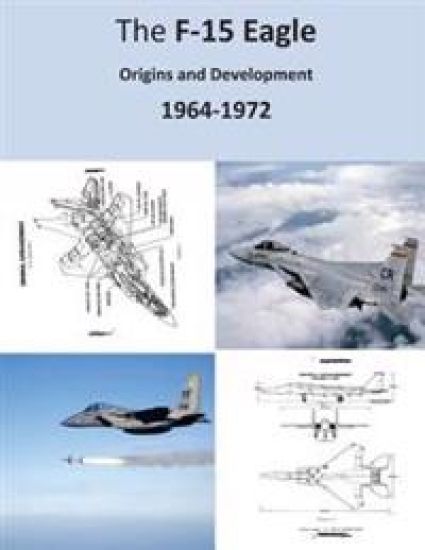
The F-15 Eagle: Origins and Development 1964-1972

The F-15 Eagle: Origins and Development 1964-1972

U. S. Air Force; Office of Air Force History

Createspace Independent Publishing Platform
2015
nidottu
This study traces the evolution of the F-15Eagle air superiority fighter from its beginning in1964 through the aircraft's first flight in July 1972. It examines the military, technological, economic, and political influences on the weapon systemacquisition process. Among the more innovativeelements of this research and development program were: the energy maneuverability theory of Col. John R. Boyd and Thomas Christie; a contractual arrangement loosely billed as the "fly-before-buy" philosophy; and the definite Air Force commitment to building the aircraft first manifest in the appointment of Brig. Gen. Roger K. Rhodarmer as Washington F-15 spokesman. then through the support given Maj. Gen. Benjamin N. Bellis, the F-15's strong program director. The story ends with air superiority reaffirmed as a major mission, but not yet fully defined
The Office of the Secretary of the Air Force 1947-1965

The Office of the Secretary of the Air Force 1947-1965

U. S. Air Force; Office of Air Force History

Createspace Independent Publishing Platform
2015
nidottu
If power in Washington is often thought of as a zero-sum game, success is best achieved by creating "win-win" propositions. The Secretary ofthe Air Force, placed at the nexus of several power centers and responsible for fashioning a consensus, reports to the Secretary of Defense, deals with various deputy secretaries as peers, and interacts with the Air Force Chief of Staff, who supervises the service. The Secretary has real but circumscribed influence, yet must, to be effective, move individuals and agencies, with little more than limited or indirect authority over them. This work traces the history of the Office of the Secretary of the Air Force from its formation in the 1920s (as the Office of the Assistant Secretaryof War for Air) through World War II, under Robert A. Lovett. It concentrates on the period from 1947, when the Air Force became independent of the Army, to 1965, when the United States became involved in the Vietnam War. During this time several laws significantly reshaped the U. S. military establishment: the National Security Act of 1947, its amendmentsof 1949, Reorganization Plan No. 6 of 1953, and the Department of Defense Reorganization Act of 1958. These laws gradually strengthened the Department of Defense and firmly established civilian control over the military services. Author George Watson details how these laws affected the functioning of the first seven Secretaries of the Air Force, from W. Stuart Symington to Eugene M. Zuckert. The Air Force and its Secretaries struggled over autonomy, roles, and missions; fought the Korean War and the Cold War; procured advanced aircraft, missiles, and other weapons; and wrestled withmany issues involving budgets, force size and structure, racial integration, morale, and congressional and public relations. The Secretaries of the Air Force have each brought unique leadership styles to office. This study provides a context for understanding the complex changes that confronted them as the United States successively moved through the jet, atomic, and space ages. It should prove useful to both civilian and military Air Force policy makers as they operate in a new era in which America's air power has become truly global and unprecedented in influence and reach.
Operation Thursday: Birth of the Air Commandos

Operation Thursday: Birth of the Air Commandos

U. S. Air Force; Office of Air Force History

Createspace Independent Publishing Platform
2015
nidottu
A bold, unconventional use of American airpower to support British ground troops in Burma, Operation THURSDAY marked a critical development in the history of modern warfare. OnMarch 5-6, 1944, the Allies conducted an air invasion of Burma, in an attempt to push back theJapanese in the China-Burma-India Theater andreestablish the land route between India andChina. U. S. airmen formed a special operationsunit-the 1st Air Commando Group--to transporttroops to jungle locations and resupply them, often in the line of fire. The remarkable successof this operation lives on, fifty years later, amongthe elite 1st Air Commando Group--a force committed to meeting the challenge of unconventional warfare any time, any place, anywher
Operation Ranch Hand: The Air Force and Herbicides in Southeast Asia, 1961-1971

Operation Ranch Hand: The Air Force and Herbicides in Southeast Asia, 1961-1971

U. S. Air Force; Office of Air Force History

Createspace Independent Publishing Platform
2015
nidottu
Since the dawn of powered flight, there has been debate about the uses of aviation in war. The air weapon could be, and has been, used for a varietyof missions: to gain control of the skies, to bomb an enemy's population or war-making resources, to support armies and navies in battle, to interdictthe flow of men and materiel to the battlefield, for observation, reconnaissance, the gathering of intelligence, to transport men and supplies, and forvirtually every other aspect of modern combat. One of aviation's more unusual military applications occurred in Southeast Asia, where American and Vietnamese planes sprayed large areas of Vietnam and Laos with herbicides in an effort to deny cover and concealment to the enemy, and to destroy his food supply. Herbicides, or weed-killing chemicals, had long been used in American agriculture. After World War I, the military of various nations realized their potential for war and developed techniques to use them. Although the Italians had used lethal chemicals delivered from the air in Abyssinia in 1936, the Allies and Axis in World War II abstained from using the weapon either because of legal restrictions, or to avoid retaliation in kind. During the early 1950s, the British on a limited basis employed herbicides to destroy the crops of communist insurgents in Malaya. In 1961, President Ngo Dinh Diem of South Vietnam asked the United States to conduct aerial herbicide spraying in his country. In August of thatyear, the South Vietnamese Air Force initiated herbicide operations with American help. But Diem's request launched a policy debate in the White House and the State and Defense Departments. On one side were those who viewed herbicides as an economical and efficient means of stripping the Viet Cong of their jungle cover and food. Others, however, doubted the effectivenessof such a tactic and worried that such operations would both alienate friendly Vietnamese and expose the United States to charges of barbarismfor waging a form of chemical warfare. Both sides agreed upon the propaganda risks of the issue. At last, in November 1961, President Kennedy approved the use of herbicides, but only as a limited experiment requiring South Vietnamese participation and the mission-by-mission approvalof the United States Embassy, the Military Assistance Command Vietnam, and South Vietnam's government. Operation Ranch Hand, the designation for the program, began in January 1962. Gradually limitations were relaxed and the spraying becamemore frequent, and covered larger areas. By the time it ended nine years later, some eighteen million gallons of chemicals had been sprayed on an estimated twenty percent of South Vietnam's jungles, including thirty-six percent of its mangrove forests. The Air Force also carried out herbicide operations in Laos from December 1965 to September 1969 with the permission of the Laotian government.
A Concise History of the U.S. Air Force

A Concise History of the U.S. Air Force

U. S. Air Force; Office of Air Force History

Createspace Independent Publishing Platform
2015
nidottu
Except in a few instances, since World War II no American soldier or sailor has been attacked by enemy air power. Conversely, no enemy soldier orsailor has acted in combat without being attacked or at least threatened by American air power. Aviators have brought the air weapon to bear against enemies while denying them the same prerogative. This is the legacy of the U. S. AirForce, purchased at great cost in both human and material resources. More often than not, aerial pioneers had to fight technological ignorance, bureaucratic opposition, public apathy, and disagreement over purpose. Every step in the evolution of air power led into new and untrodden territory, driven by humanitarian impulses; by the search for higher, faster, and farther flight; or by the conviction that the air way was the best way. Warriors have always coveted the high ground. If technology permitted them to reach it, men, women andan air force held and exploited it-from Thomas Selfridge, first among so many who gave that "last full measure of devotion"; to Women's Airforce Service Pilot Ann Baumgartner, who broke social barriers to become the first Americanwoman to pilot a jet; to Benjamin Davis, who broke racial barriers to become the first African American to command a flying group; to Chuck Yeager, a one-time non-commissioned flight officer who was the first to exceed the speed of sound; to John Levitow, who earned the Medal of Honor by throwing himself over a live flare to save his gunship crew; to John Warden, who began a revolution in air power thought and strategy that was put to spectacular use in the Gulf War. Industrialization has brought total war and air power has brought the means to overfly an enemy's defenses and attack its sources of power directly. Americans have perceived air power from the start as a more efficient means of waging war and as a symbol of the nation's commitment to technology to master challenges, minimize casualties, and defeat adversaries.